The UK Food Standards Agency reports that two thirds (66%) of consumers think the industry should continue to reduce campylobacter beyond the agreed current target of less than 10% of chickens at the most highly contaminated level. Retailers should also be telling customers what proportion of chickens are at this highest level of contamination, according to 75% of those questioned.
The research has been released to coincide with the resumption this month of our campylobacter survey, part of our on-going efforts to reduce the high levels of food poisoning caused by the bug. Testing was suspended in April so we could update the way the survey was carried out to ensure results continued to be robust.
Steve Wearne, Director of Policy at the FSA, said, “Publishing surveillance data on campylobacter has prompted action from retailers and processors and we are now seeing progress. Our campaign has also raised awareness of campylobacter amongst the public and it is good to see from our research that it is customers, and not just the FSA, demanding action and information from retailers. We have always said that consumer power will ultimately push industry action.
“Many retailers and processors should be commended for the action they have taken so far. The majority signed up to the pledge to ensure that campylobacter in chicken ceases to be a significant public health issue, and continued action will be needed to deliver this.”
The FSA’s research shows that 76% of people questioned want retailers to be more proactive in telling them what actions they are taking to reduce the campylobacter levels on the raw chicken they sell. More than half of people (53%) said that they would start buying chicken from another retailer if their usual shop was found to sell more than the industry average ‘high risk’ chicken.
According to Nicholas Jones of the NZ Herald, Key is backing the Hastings District Council, saying it acted as quickly as it could. But he told Newstalk ZB’s Mike Hosking there could be court action, as it’s not clear whether the contamination contributed to the death of a woman in a rest home.
He says that court action could involve civil or criminal charges.
The Ministry of Education says all Havelock North’s schools and early childhood centres are expected to be open today.
After the rolls are taken at Havelock North Intermediate this morning the students will be gathered for an assembly.
“We’ll just talk through hygiene basically. Over the next little while we’ll have the Red Cross in during the day at points. We’ll be talking about using the hand sanitisers and washing hands properly when using the loo,” said Principal Julia Beaumont.
At the weekend, the Hawke’s Bay DHB said interim results from the Institute of Environmental Science and Research suggests contamination from cattle and other four-legged farm animals may have been in the water.
Dr Bridgette Sullivan-Taylor, an extreme event expert at Auckland University, criticised the official reaction to the outbreak, saying she was “staggered” at how quickly the disaster snowballed out of control.
“Better planning could have minimised unintended consequences and downstream effects that make the disaster worse. The fact that contaminated water was brought into Havelock North in a tanker is staggering.”
The U.S. Food and Drug Administration and the Centers for Disease Control and Prevention (CDC) and state and local officials are investigating an outbreak of hepatitis A illnesses linked to raw scallops.
The FDA and CDC are supporting the Hawaii Department of Health (DOH) in an investigation of hepatitis A virus (HAV) infections linked to scallops supplied by Sea Port Products Corp. On August 17, 2016, Hawaii Department of Health reported that 206 people have been confirmed to have become ill with hepatitis A in that state.
On August 17, 2016, the FDA, Hawaii DOH, CDC and state partners informed Sea Port Products Corp that epidemiological, laboratory and traceback information indicates their scallops are the likely source of illnesses.
On August 18, 2016, Sea Port Products Corp initiated a voluntary recall of frozen Bay Scallops produced on November 23, 2015 and 24, 2015. The products were distributed to California, Hawaii, and Nevada. The FDA is working with the recalling firm to ensure their recall is effective and that recalled product is removed from the market.
Restaurants and other retailers should not sell or serve the recalled Bay Scallops. The recalled products were not sold directly to consumers. FDA advises consumers not to eat the recalled Bay Scallops. Consumers should ask the restaurant or retailer where their scallops came from to make sure they do not eat recalled Bay Scallops from Sea Port Products Corp.
The FDA’s traceback investigation involved working with Hawaii DOH to trace the path of food eaten by those made ill back to a common source. The traceback investigation determined that Sea Port Products Corp imported the scallops that were later supplied to certain Genki Sushi locations in Hawaii, where ill people reported eating.
On August 17, 2016, FDA laboratory analysis of two scallop samples, which were collected on August 11, 2016, were confirmed positive for hepatitis A. These samples were imported by Sea Port Products Corp.
According to a health department official, there have been 10 total cases of hepatitis A linked to the strawberries at Tropical Smoothie in Virginia so far.
The Department of Health has linked the smoothies with a strain of hepatitis A that has been associated with past outbreaks due to frozen strawberries from Egypt.
Tropical Smoothie Cafe voluntarily withdrew all of the strawberries sourced from Egypt and found an alternate supply.
The Department of Health says other restaurants and restaurant suppliers may have received the frozen strawberries. The Virginia Department of Agriculture and Consumer Services, the U.S. Food and Drug Administration and the Centers for Disease Control and Prevention to identify other locations where the product may have been distributed.
In a news release sent Friday, the department said genetic testing had linked frozen strawberries from Egypt, distributed to all 90 Tropical Smoothie Café locations across Virginia to the Hepatitis infections.
I recycled an old op-ed in response, and still wondering why the same issues haven’t gained traction after 20 years of publicity in Australia.
The Advertiser editorial thingies wrote that irony can be really ironic, given that the government department charged with upholding and maintaining food standards in SA treats the public like mushrooms.
By keeping the public in the dark by refusing to release the names of the 621 food outlets in breach of hygiene rules last year, SA Health is denying consumers the right to make an informed choice.
While it is good enough for the NSW State Government to identify offending premises, those who water their gardens with human effluent, sell out of date food and have cockroach-infested kitchens in SA apparently deserve anonymity.
There is more than a whiff of double standards surrounding the secrecy of the data held by SA Health.
On one hand (who writes this crap?), the public is not allowed to know which of their local fast food outlets is cutting food hygiene corners by selling six-day-old schnitzels, and on the other, it wasted no time last week issuing a warning about NT- grown rockmelons being the apparent source of a food poisoning outbreak in SA.
Surely the public is allowed to know the identity of a food retailer that has been found guilty of a major breach of food standards that could potentially have the same impact as eating the dodgy rockmelon.
For a food outlet to be warned several times about using effluent to water gardens simply beggars belief.
SA Health’s repeated warnings to the business owner were akin to being slapped with a wet lettuce leaf.
If such a practice can continue for such an extended period of time, the public can only wonder just what sort of heinous breach of food safety regulations a business must commit to be jumped on immediately.
My response was:
I coach little kids’ (ice) hockey in Brisbane.
For that voluntary pleasure, I had to complete 16 hours of certification training, in addition to the 40 hours of training I completed in Canada to coach a travel team.
To produce or serve food in Australia requires … nothing.
Restaurants and food service establishments are a significant source of the foodborne illness that strikes up to 20 per cent of citizens in so-called developed countries each and every year.
After helping develop and watching the mish-mash of federal, state and local approaches to restaurant inspection and disclosure in a number of western countries for the past 15 years, I can draw two broad conclusions:
Anyone who serves, prepares or handles food, in a restaurant, nursing home, day care center, supermarket or local market needs some basic food safety training; and,
the results of restaurant and other food service inspections must be made public.
There should be mandatory food handler training, for say, three hours, that could happen in school, on the job, whatever. But training is only a beginning. Just because you tell someone to wash the poop off their hands before they prepare salad for 100 people doesn’t mean it is going to happen; weekly outbreaks of hepatitis A confirm this. There are a number of additional carrots and sticks that can be used to create a culture that values microbiologically safe food and a work environment that rewards hygienic behavior. But mandating basic training is a start.
Next is to verify that training is being translated into safe food handling practices through inspection. And those inspection results should be publicly available.
A philosophy of transparency and openness underlies the efforts of many local health units across North America in seeking to make available the results of restaurant inspections. In the absence of regular media exposes, or a reality TV show where camera crews follow an inspector into a restaurant unannounced, how do consumers — diners — know which of their favorite restaurants are safe?
Cities, counties and states are using a blend of web sites, letter or numerical grades on doors, and providing disclosure upon request. In Denmark, smiley or sad faces are affixed to restaurant windows.
Publicly available grading systems rapidly communicate to diners the potential risk in dining at a particular establishment and restaurants given a lower grade may be more likely to comply with health regulations in the future to prevent lost business.
More importantly, such public displays of information help bolster overall awareness of food safety amongst staff and the public — people routinely talk about this stuff. The interested public can handle more, not less, information about food safety.
Even in New South Wales and Queensland, results are only posted voluntarily.
So if an outlet sucks at food safety, they don’t have to tell anyone.
Toronto, Los Angeles and New York have had mandatory disclosure, on the doors for years.
Adelaide can figure it out.
And instead of waiting for politicians to take the lead, the best restaurants, those with nothing to hide and everything to be proud of, will go ahead and make their inspection scores available — today.
How hopeless are Australians when it comes to making people barf with raw or undercooked eggs?
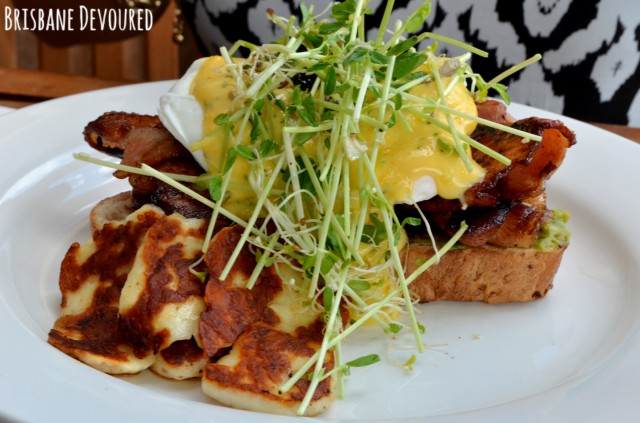
According to Greg Stolz of The Courier-Mail, a top Gold Coast cafe has pleaded guilty to putting more than 20 customers in hospital with salmonella poisoning, most after eating contaminated eggs benedict (right, exactly as shown, with a serving of sprouts).
Gold Coast Hospital had to open a special ward to cope with the mass outbreak, Southport Magistrates Court heard.
Thirty had laboratory-confirmed salmonella poisoning while another 14 also reported being ill.
Twenty-two customers were hospitalised with symptoms including nausea, stomach cramps, vomiting, fever, blood in their stools and diarrhea.
The court heard poor food handling practices, including “temperature abuse” and using a tea towel to drain moisture from eggs used to make hollandaise sauce, was to blame for the outbreak.
Grocer and Grind had been issued an official warning about poor hygiene including dirty tea towels four months before the outbreak, the court heard.
Grocer and Grind and its owner Taletha March pleaded guilty to two charges, brought by Queensland Health, of selling unsafe food.
The cafe and Ms March face maximum fines of more than $330,000.
My second daughter is getting married on Saturday, she was 10 when Walkerton happened, and we were and still are close friends with some of the families involved.
At least seven were hospitalized, and six Montana counties have been affected.
“If you had to have a foodborne outbreak, the timing couldn’t have been better,” says Jennifer Fladager, Dawson Co. Emergency Preparedness Coordinator.
Fladager had relatives who attended the celebration. She says staff members were prepared for this outbreak.
“We were aquatically trained and prepared for something like this. It’s rather ironic, we were just at a public health summer institute and we went over how to properly conduct case interviews with foodborne illness,” says Fladager.
Investigators say they have nearly completed their investigation and are working with the caterer to determine how the meal became contaminated.
Two patients have been hospitalized at Meir Medical and another patient at Schneider Hospital in Petach Tikvah, suffering from brucellosis linked to the consumption of unpasteurized camel milk produced by the dairy company “Genesis.”
Last week, two children were hospitalized for mild to moderate condition at Ichilov Hospital, following a drinking camel’s milk marketed by the company. Following the admission office ordered destroyed four tons of camel milk.
Amir Shreibman (64) and his wife, Kfar Sava have suffered in recent weeks from a high fever. “Four months ago we started to drink camel’s milk of Genesis, after we were convinced that it had medicinal properties,” he said. “They told us that many people drink this milk, and everything was fine. We did not think anything would happen to us, even if unpasteurized milk.”
Washington County health officials are investigating after cases of Shiga-toxin producing E. coli were reported after some attendants at the Washington County Fair became ill.
No sources has been identified, but public health officials said that livestock at the Washington County Fair may have been a cause, as well as food items brought to the fair from outside.
According to Washington County, anyone who attended the Washington County Fair and has had, or develops, symptoms of stomach cramps, diarrhea, vomiting or fever, should call their health care provider.
“The best way to prevent getting STEC infection is by washing hands well with soap and water,” Baumann said. “It’s very important to wash your hands after using the bathroom or changing diapers, before preparing or eating food, and after contact with animals or their environments at farms, petting zoos and fairs.”
Educational events encouraging human–animal interaction include the risk of zoonotic disease transmission. ‘It is estimated that 14% of all disease in the USA caused by Campylobacter spp., Cryptosporidium spp., Shiga toxin-producing Escherichia coli (STEC) O157, non-O157 STECs, Listeria monocytogenes, nontyphoidal Salmonella enterica and Yersinia enterocolitica were attributable to animal contact. This article reviews best practices for organizing events where human–animal interactions are encouraged, with the objective of lowering the risk of zoonotic disease transmission.

 The research has been released to coincide with the resumption this month of our campylobacter survey, part of our on-going efforts to reduce the high levels of food poisoning caused by the bug. Testing was suspended in April so we could update the way the survey was carried out to ensure results continued to be robust.