It’s all over now: Another UK E. coli O157 mystery with hundreds sick

There’s a reason the Britain’s contribution to global cuisine is mushy peas and mad cow disease.

mushy.peasI get the UK is a small island, sinking in all kinds of animal shit, but tell us what you are doing for on-farm food safety?

And don’t answer with some bogus certification scheme.

Beginning in December 2010, a subtype of E. coli O157, began sickening Brits and resulted in over 250 sick with 80 hospitalizations, four with hemolytic uremic syndrome, and one death.

Dr. Andrew Wadge, chief scientist at the Food Standards Agency was reported as saying “This outbreak is a timely reminder that it is essential to wash all fruits and vegetables, including salad, before you eat them, unless they are labeled ‘ready to eat’, to ensure that they are clean. It is also important to wash hands thoroughly as well as clean chopping boards, knives and other utensils after preparing vegetables to prevent cross contamination.”

This advice is of limited use. Maybe a 1-log reduction use.

But it blames consumers.

The outbreak was linked to the handling of raw leeks and potatoes, and a public warning was given – reportedly months after a guidance had been issued the food industry on reducing the risk of E. coli cross-contamination.

In Nov. 2015, the BBC reported the number of people infected with E. coli across England rose by more than 1,000 over the previous year.

Public Health England figures show there were 39,604 from September 2014 to September 2015, compared with 38,291 for the same period the year before.

Another mysterious affliction.

Now, once again, the PhD health types are baffled by an outbreak of E. coli O157 in the UK that has sickened at least 161.

Those same health-thingies do say the likely cause of the outbreak was imported mixed salad leaves.

The last recorded case of the bug was on July 5 and now PHE has declared the outbreak over.

People are being urged to remove any loose soil before storing vegetables and thoroughly wash all vegetables and salads that will be eaten raw unless they have been pre-prepared and are labelled ‘ready to eat’.

Because the Brits have a long history of blaming consumers for something that should be controlled on the farm.
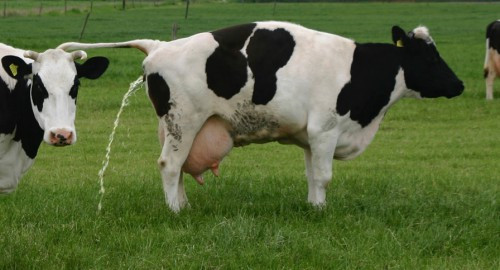

How to stop people peeing in pools? Australian finds way to keep cow pee out of waterways

I’ve left the mic on before.

Jennifer Nichols of ABC reports that Amanda Neilen discovered that if carbon was added to paddocks, it could reduce nitrogen run-off, fertilise pasture, and prevent the pollution of creeks, rivers and reefs.

cow-peeing-e1435628430577“Cow urine is a problem in waterways because it is readily available for algae,” Ms Neilen said.

“Algae gobble it up and they can form into blooms, which means we can’t swim in our waterways and also it costs more money to treat the water, so we really want to keep the food source for algae out.

“Your average cow can have up to five or six urination events a day, and each time a cow pees it can produce between half a litre to about two litres of liquid.”

Multiplied by 26.1 million cattle in Australia, it is estimated that between 65 to 312 million litres of cow urine enter our environment every day.

The PhD student at Griffith University’s Australian Rivers Institute worked with farmers, environmentalists and other scientists during the two-year research project.

“I think from when I first started and suggested this topic to my supervisor, she found it instantly novel and funny and she said, ‘Yes, you should look at what keeps cow piss out of waterways’,” Ms Neilen said.

“I collected fresh cow urine from Maleny Dairies and I was able to apply this to different treatments, and look at the different pathways that kept urine in the soil and stopped it from leaching out of the soil.

“We did find that we could add carbon to the soil, which was a pretty novel and exciting finding, because the carbon was actually like a great food source for the microbes and made them start increasing their productivity.

“They were able to hold the nitrogen in the soil, which is what we wanted.

“Adding carbon to the soil made quite a big difference. For example, grass uptake reduced nitrogen leaching by 70 per cent.”

MNA fighter’s wife Chael Sonnen’s daughter born premature, battling Listeria

I don’t care how tough you are, Listeria, with a 30 per cent kill rate, is some scary shit and not to be taken lightly.

001_Chael_Sonnen_gallery_post.0Chael Sonnen’s daughter was born 10 weeks premature last week, Sonnen informed MMA Fighting.

According to doctors, Sonnen’s wife, Brittany, contracted listeria, which caused the early birth. The illness has been passed along to their daughter, as well.

Sonnen is currently unsure how his wife contracted the disease. He has retained the law firm Flesher Schaff & Schroeder Inc. to investigate whether she consumed contaminated food, and they have already reached out to the CDC and FDA on behalf of the Sonnen family.

“She’s in a battle and we are prepared to fight,” Sonnen said.

Blauna Dian Sonnen was born Friday, Aug. 12, in Portland, Ore. The couple also has an older son, Thero.

Market food safety at retail and show me the data: Science fairs and rockmelon

I judged my first science fair this morning.

I’ve done lots of stuff with schoolkids over the years – food is a wonderful teaching tool – but this was tough.

cantaloupe.salmonellaThere were 10 of us, judging about 180 projects at one elementary school.

Being the newbie, I got the prep (kindergarten) and grade 1s (grade 2 would have been a conflict of interest).

We had score sheets that will be returned to the students, and I thought, how do I evaluate this, I don’t want to crush the investigative soul of a 6-year-old.

It’s fair game to crush the souls of PhD students and other profs through peer-review, but this felt like peer-review for little kids.

I mainly wrote encouraging things and asked questions.

The things kids think of.

We have an awards thingy later tonight, with the all-Aussie sausage sizzle (yes, I will bring my tip-sensitive digital thermometer and use it, because that is the only data that matters when involving food safety), but I wonder if they’ll serve rockmelon (cantaloupe).

Probably not.

They know who I am, and didn’t serve it at the last school function, after 97 were confirmed sick with Salmonella linked to rockmelon from Red Dirt Farms in the Northern Territories of Australia.

But, as is often, public health seems to take a back seat to biz.

Matt Brann of ABC reports that demand for rockmelons has dived following a salmonella scare earlier this month, which was linked to rockmelons from a farm in the Northern Territory.

(It’s not a scare, it’s an outbreak with lots of sick people).

Christian Bloecker is in the middle of his rockmelon harvest in the Kimberley’s Ord Irrigation Scheme, and said fruit was now being left in the paddock.

“There’s nothing as a farmer that you can really do about it, apart from getting the awareness out there that rockmelons from the Ord are beautiful, fresh and safe to eat,” he said.

Then you’re getting bad advice.

Prove everything you do to produce a safe crop. Look at models in California and Colorado.

Market your food safety at retail.

Some growers are better than others. They should be rewarded.

Soundbites are empty when people are sick.

And as I judged the students this morning, it wasn’t about soundbits and show: it was, show me the data.

NZ growers provide absolutes and soundbites in campy outbreak

Water is often a concern in fresh produce.

Irrigation water standards associated with FSMA (are the indictors correct? are there geographical differences? Is the measure protective?) are being discussed in food safety meetings all over the place.

In the absence of good science and a whole bunch of variability I figure that folks will eventually just treat water (with something) instead of trying to test their way to safety.Water_Irrigation

Wash water can be trouble too.

I guess we could all move to New Zealand where, according to Newshub, campy has been spread through a municipal water system and local growers, who may or may not have been using the water, say ‘there are no risks because of the food safety systems.’

Growers are desperate to reassure the public it’s safe to eat fruit and vegetables from Hawke’s Bay, despite the region’s contaminated water supply.

“You need to have a fruit cut open… and for contaminated water to touch the cut-open bit of fruit for there to be a problem,” says chief executive Mike Chapman (no relation -ben).
“It’s a long, long, long stretch for anything to be of concern to the public.”

However, many growers in the region are holding off on picking their crops as a precaution.

“Even if [they were], there are no risks because of the food safety systems we have,” says Mr Chapman.

There’s always a risk. Pathogens can internalize. Show me the data.

Dole and Listeria: The Shaggy Defense

Dole’s Springfield plant, source of an awful outbreak of listeriosis linked to over 30 illnesses and four deaths, had resident Listeria monocytogenes problem. With illnesses stretching back to July 2015, linked through whole genome sequencing, the pathogen was hanging out somewhere.

The Packer reports that Dole is disputing a couple of lawsuits that have been filed on behalf of victims.

A suit filed in July for the estate of Ellen DiStefano alleges Dole failed to design and implement a food safety program capable of preventing listeria contamination of its salad mixes.

Listeria was found eight times in the Springfield plant from March 2014 to December 2015, according to a Food and Drug Administration report cited in court documents. The suit, filed in U.S. District Court for the Southern District of Ohio, also claims Dole did not use newer detection technologies such as genome sequencing.

DiStefano became ill Jan. 17 and died Feb. 27. She was 79.

“The product was not defective at the time it left Dole’s custody and control,” attorney R. Leland Evans said July 15 in the court record. “Any later defect was caused by a substantial alteration and change in the condition of the product by other parties over whom Dole had no control.”

Show me the data.


Blast from the past: hep A inactivation in scallops

Raw scallops served at Genki Sushi have been fingered in a Hawaiian hep A outbreak. What if Genki had seared the scallops? According to some historic work, seared scallops aren’t probably hep A risk-reduced scallops either.

Inactivation of Hepatitis A virus in heat-treated mussels
Journal of Applied Microbiology
dec.99
L. CROCI, M. CICCOZZI, D. DE MEDICI, S. DI PASQUALE, A. FIORE, A. MELE and L. TOTI.1999.Hepatitis A is a widespread infectious disease world-wide. In Italy, shellfish consumption was shown to be a major risk factor for hepatitis A infection, especially when these products are eaten raw or slightly cooked. The aim of the present study was to evaluate Hepatitis A virus (HAV) resistance in experimentally contaminated mussels treated at different temperatures (60, 80 and 100 °C) for various times. The presence of HAV was evaluated by cell culture infection and reverse transcriptase-polymerase chain reaction confirmation. The experiments, carried out on HAV suspension and contaminated mussel homogenate both containing about 105 50% tissue culture infectious dose ml−1, showed that, under our experimental conditions, the treatments at 60 °C for 30 min, 80 °C for 10 min and an immersion at 100 °C for 1 min were not sufficient to inactivate all the viruses; it was necessary to prolong the treatment at 100 °C for 2 min to completely inactivate the virus. Thus it is advisable to eat only cooked shellfish, paying particular attention to the times and temperatures used in the cooking process, since evidence suggests that the shellfish body may protect the virus from the heat effect.

Also, here’s the health department’s entire press conference on the source of the outbreak.

Food Safety Talk 106: Mouth spit

Food Safety Talk, a bi-weekly podcast for food safety nerds, by food safety nerds. The podcast is hosted by Ben Chapman and barfblog contributor Don Schaffner, Extension Specialist in Food Science and Professor at Rutgers University. Every two weeks or so, Ben and Don get together virtually and talk for about an hour.Unknown-4

They talk about what’s on their minds or in the news regarding food safety, and popular culture. They strive to be relevant, funny and informative — sometimes they succeed. You can download the audio recordings right from the website, or subscribe using iTunes.

Episode 106 can be found here and on iTunes.

Show notes so you can follow along at home:

It was the imported scallops, served raw: 168 sick from Hep A in Hawaii

I don‘t eat raw seafood, and I don’t trust chefs on food porn programs that who think scallops are cooked by bouncing them on the floor.

raw.scallops.dillions.aug.09I do believe in vaccines, and food porn chefs should be fully vaccinated.

The Department of Health has determined that the Hepatitis A outbreak on Oahu is likely due to imported frozen scallops served raw at Genki Sushi restaurants on Oahu and Kauai.

The restaurants were closed Monday to prevent any further illness and protect the public.

Nicole Takahashi was eating at the Waikele restaurant when it happened.

“Everything was going great until we got the news that we needed to finish and could just leave without paying for the food. We just got scared,” she told KHON2. “I had to ask why. I was scared, getting nervous, and they just got a call that there were scallops, tainted scallops, so all the Genki locations were being closed down.”

There are also Genki Sushi restaurants on Maui and Hawaii Island, but health officials say they have not been linked to any hepatitis A cases.

Health officials say the scallops were imported from another country by the distributor True World Foods, and only supplied to Genki Sushi.

As of Aug. 10, the DOH reported 168 confirmed cases of hepatitis A.

Hong Kongerers urged not to consume French raw goat milk cheese contaminated with E. coli

The Centre for Food Safety (CFS) of the Food and Environmental Hygiene Department today (August 15) urged the public not to consume a batch of raw goat milk cheese imported from France as it was contaminated with Escherichia coli (E. coli). The trade should also stop using or selling the affected batch of the product.

e.coli.fromage-valencayProduct name: Valencay raw milk cheese

Product brand: Anjouin

Place of origin: France

Manufacturer: Fromagerie d’Anjouin

A spokesman for the CFS said, “The Centre received a notification from the Rapid Alert System for Food and Feed (RASFF) of the European Commission that certain batches of the above-mentioned raw goat milk cheese were found to have been contaminated with E. coli and the French manufacturer concerned has initiated a recall of the affected products.

According to the RASFF, some of the products under Lot No. V161 have been imported into Hong Kong.”