
There’s no shortage of food safety press releases, repeated and regurgitated using funky new media tools; there is a shortage of evidence-based, incisive approaches that challenge food safety norms and may eventually lead to fewer sick people.
barfblog.com is the fastest way to stay current on food safety issues. Powell, Chapman and assorted food safety friends offer evidence-based .jpg) opinions on current food safety issues. Opinions must be reliable – with references — rapid and relevant.
opinions on current food safety issues. Opinions must be reliable – with references — rapid and relevant.
Anyone can subscribe directly to barfblog.com and receive an e-mail immediately when something new is posted. Go to barfblog.com and click on the ‘subscribe’ button on the right side of the page.
Food safety infosheets are designed to influence food handler practices by utilizing four attributes culled from education, behavioral science and communication literature:
• surprising and compelling messages;
• putting actions and their consequence in context;
• generating discussion within the target audiences’ environments; and
• using verbal narrative, or storytelling, as a message delivery device.
Food safety infosheets are based on stories about outbreaks of foodborne illness. Four criteria are used to select the story: discussion of a foodborne illness outbreak; discussion of background knowledge of a pathogen (including symptoms, etiology and transmission); food handler control practices; and emerging food safety issues. Food safety infosheets also contain evidence-based prescriptive information to prevent or mitigate foodborne illness related to food handling. They are available in several languages.
The bites.ksu.edu listserv is a free web-based mailing list where information about current and emerging food safety issues is provided, gathered from journalistic and scientific sources around the world and  condensed into short items or stories that make up the daily postings. The listserv has been issued continuously since 1994 and is distributed daily via e-mail to thousands of individuals worldwide from academia, industry, government, the farm community, journalists and the public at large.
The listserv is designed to:
• convey timely and current information for direction of research, diagnostic or investigative activities;
• identify food risk trends and issues for risk management and communication activities; and
• promote awareness of public concerns in scientific and regulatory circles.
The bites listserv functions as a food safety news aggregator, summarizing available information that can be can be useful for risk managers in proactively anticipating trends and reactively address issues. The bites editor (me – dp) does not say whether a story is right or wrong or somewhere in between, but rather that a specific story is available today for public discussion.
If you only want to receive specific news, use RSS feeds.
RSS (Rich Site Summary, or Really Simple Syndication) is a format for delivering regularly changing web content. Many news-related sites, weblogs and other online publishers syndicate their content as an RSS Feed to whoever wants it.
If you only want stories about food safety policy, or norovirus, go to  bites.ksu.edu and click on that section. Then click on the RSS symbol, and add to your reader. barfblog.com is also available as a RSS feed.
Breaking food safety news items that eventually appear in bites-l or barfblog.com are often posted on Twitter (under barfblog or benjaminchapman) for faster public notification.
These are the various information products we deliver daily, in addition to research, training and outreach. Sponsorship opportunities are available for bites.ksu.edu, barfblog.com, and the bites-l listserv.
Any money is used to support the on-going expenses of the news-gathering and distribution activities, and to develop the next generation of high school, undergraduate and graduate students who will integrate science and communication skills to deliver compelling food safety messages using a variety of media. Research, training and outreach are all connected in our food safety world.
.jpg) For several years, the health department has sought to change that by posting details of restaurant inspections online. But budget cuts, combined with opposition from restaurant owners, have made that an elusive goal, said Stuart White, supervisor of community health in the environmental health division.
For several years, the health department has sought to change that by posting details of restaurant inspections online. But budget cuts, combined with opposition from restaurant owners, have made that an elusive goal, said Stuart White, supervisor of community health in the environmental health division..jpg) Posting graphical, concise food safety information sheets in the kitchens of restaurants can help reduce dangerous food safety practices and create a workplace culture that values safe food, according to a new paper co-authored by Kansas State University’s Doug Powell.
Posting graphical, concise food safety information sheets in the kitchens of restaurants can help reduce dangerous food safety practices and create a workplace culture that values safe food, according to a new paper co-authored by Kansas State University’s Doug Powell.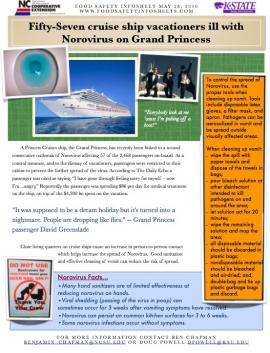 Posting graphical, concise food safety stories in the back kitchens of restaurants can help reduce dangerous food safety practices and create a workplace culture that values safe food.
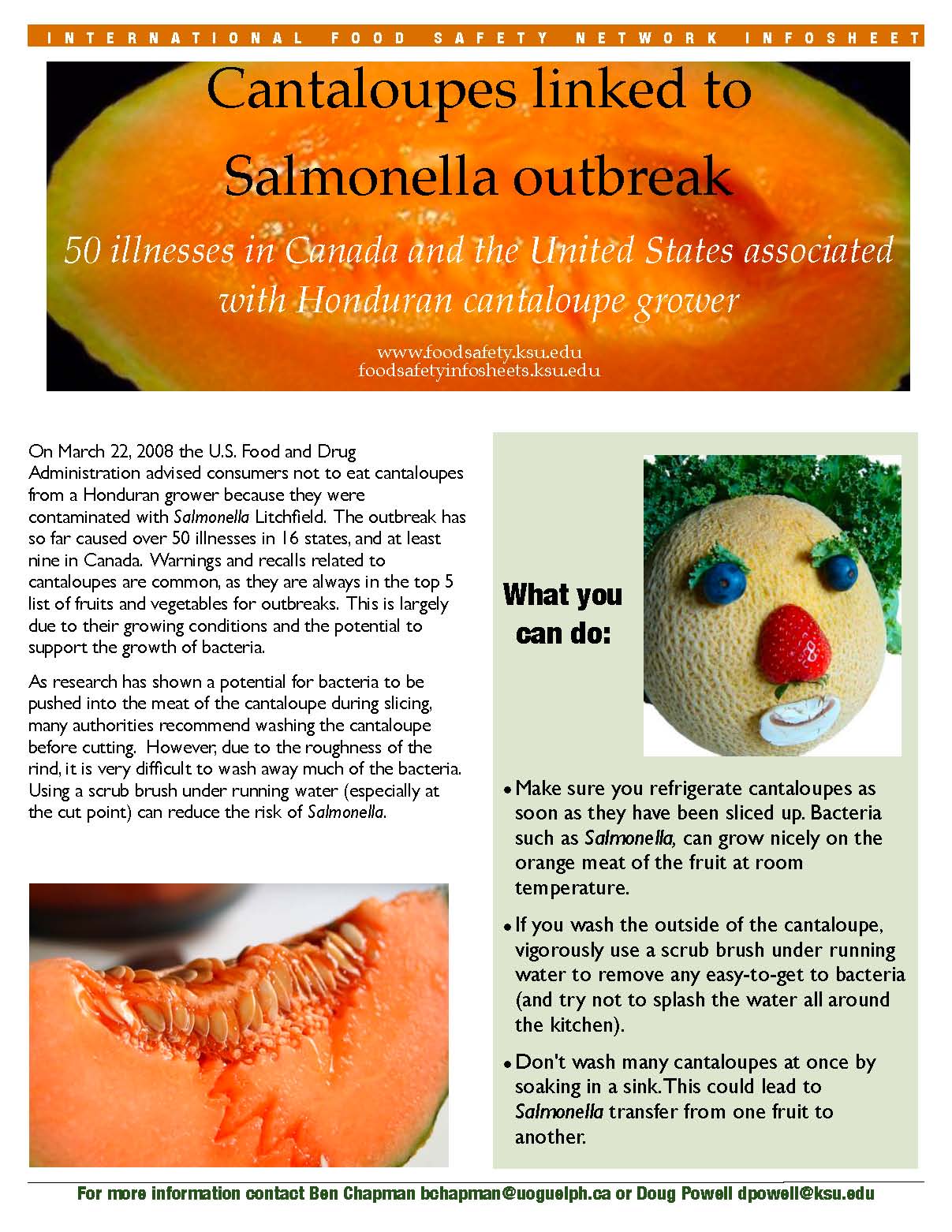 communication tool designed to appeal to food handlers and compel behavior change, were evaluated. Food safety infosheets were provided weekly to food handlers in working foodservice operations for 7 weeks. It was hypothesized that through the posting of food safety infosheets in highly visible locations, such as kitchen work areas and hand washing stations, that safe food handling behaviors of foodservice staff could be positively influenced. Using video observation, food handlers (n ~ 47) in eight foodservice operations were observed for a total of 348 h (pre- and postintervention combined). After the food safety infosheets were introduced, food handlers demonstrated a significant increase (6.7%, P , 0.05, 95% confidence interval) in mean hand washing attempts, and a significant reduction in indirect cross-contamination events (19.6%, P , 0.05, 95% confidence interval). Results of the research demonstrate that posting food safety infosheets is an effective intervention tool that positively influences the food safety behaviors of food handlers.
  “Doug, I want you to talk about food safety messages that have been proven to work, that are supported by peer-reviewed evidence and lead to demonstrated behavior change,” or something like that.
 But a bunch of e-mails doesn’t count as much in the way of evidence.
 The Charlotte Observer features Chapma
 P.J. O’Rourke
 People often ask Amy, “Why are you with Doug?”
 The listserv is designed to:
 Ben and I went along with Uncle Denton to the Canadian Horticulture Council meeting in Montreal in Feb. 2003. I had chaired a national committee on on-farm food safety program implementation – and the advice was completely ignored – Chapman and I had done years of groundwork with Denton and the Ontario Greenhouse Vegetable Growers, and we agreed to share a room at the annual meeting to cut down on expenses.
 He showed up a few hours later, seemingly intact.
 From the University of Guelph and the beginning of the On Farm Food Safety program, Doug has moved to Kansas State University where he is associate professor of food safety. He is still very much in the industry – just relocated to a different university — and still writing newsletters, hence the reputation of “the guru” of On Farm Food Safety.
 And I knew Chapman, way back when.
 Instead, getting college students to wash hands, halt disease, requires giving them proper tools and spreading the word in ways that get attention: the path to poor hand sanitation is paved with good intentions, according to researchers from Kansas State and North Carolina State Universities.
.jpg) Hand sanitation stations and informational posters were stationed at the entrance to a residence hall cafeteria, where the potential for cross-contamination was high. The researchers observed that even during a high-profile outbreak, students followed recommended hand hygiene procedures just 17 percent of the time. In a self-reported survey after the outbreak had subsided, 83 of 100 students surveyed said they always followed proper hand hygiene but estimated that less than half of their peers did the same.
Hand sanitation stations and informational posters were stationed at the entrance to a residence hall cafeteria, where the potential for cross-contamination was high. The researchers observed that even during a high-profile outbreak, students followed recommended hand hygiene procedures just 17 percent of the time. In a self-reported survey after the outbreak had subsided, 83 of 100 students surveyed said they always followed proper hand hygiene but estimated that less than half of their peers did the same..jpg) Most students surveyed perceived at least one barrier to following recommended hand hygiene procedures. More than 90 percent cited the lack of soap, paper towels or hand sanitizer. Additional perceived barriers were the notion that hand washing causes irritation and dryness, along with just being lazy and forgetful about hand washing. Fewer than 7 percent said a lack of knowledge of the recommended hand hygiene procedures was a barrier.
Most students surveyed perceived at least one barrier to following recommended hand hygiene procedures. More than 90 percent cited the lack of soap, paper towels or hand sanitizer. Additional perceived barriers were the notion that hand washing causes irritation and dryness, along with just being lazy and forgetful about hand washing. Fewer than 7 percent said a lack of knowledge of the recommended hand hygiene procedures was a barrier..jpg)