$236,000 fine for listeria-tainted chicken wraps on Australian flight

A company that provided listeria-contaminated chicken to the airline Virgin Blue, sickening 29 passengers and causing two premature births in 2009, has received the largest fine of its type in New South Wales.

Directors of GMI Food Wholesalers pleaded guilty to 26 charges relating to the production, handling and sale of unsafe food.

They were fined $236,000 plus legal costs, in the Downing Centre Local Court. Details of the case will be published on the NSW Food Authority’s website today.

Chicken livers sicken with salmonella

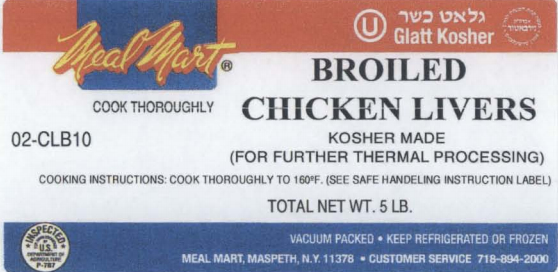
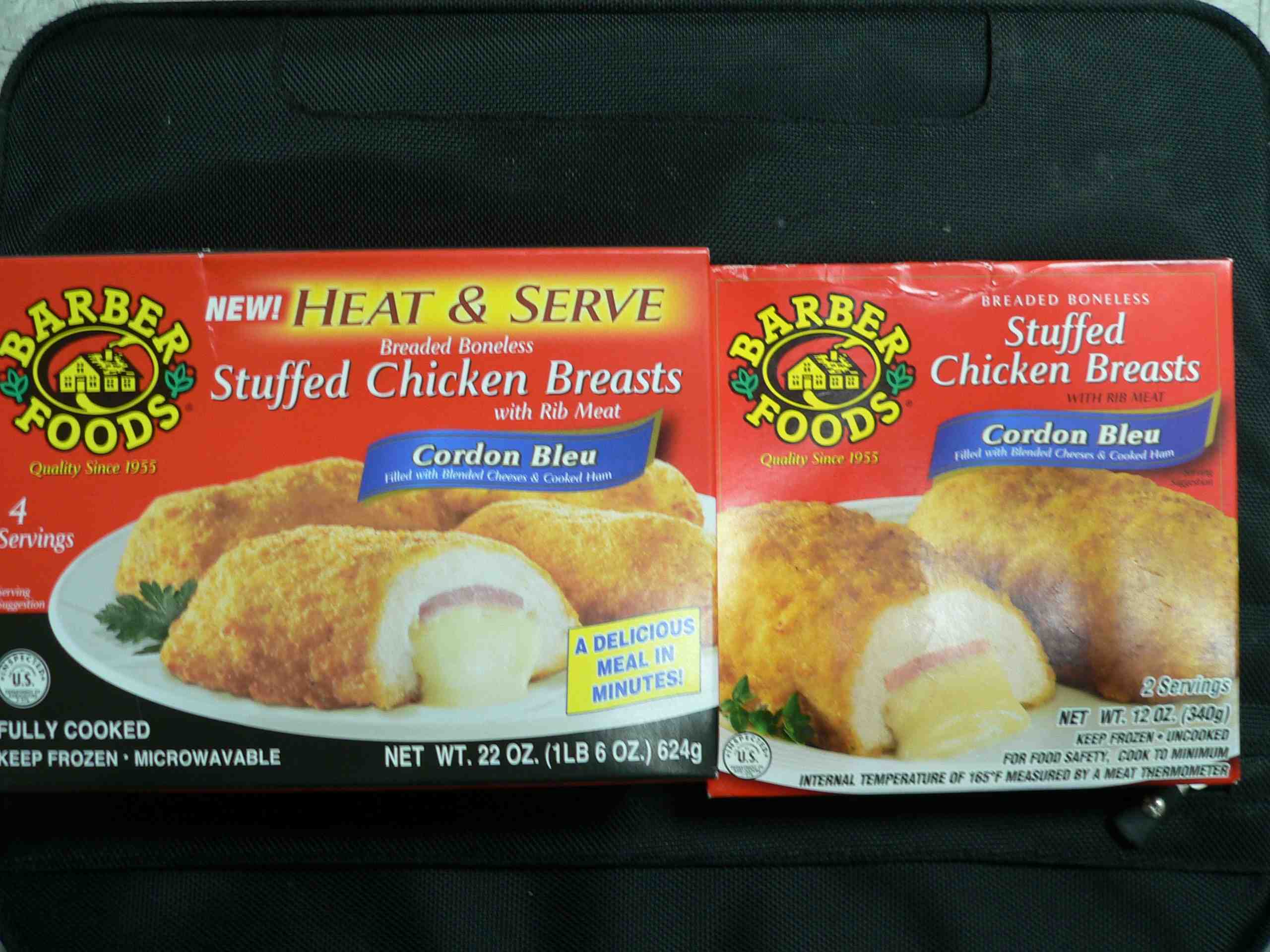
In a new twist to the on-going saga of frozen, not-ready-or-ready-to-eat chicken thingies (below, left), broiled chicken liver products that are linked to a cluster of Salmonellosis illnesses in New Jersey and New York, have been recalled.

No word on how many people are sick.

The illnesses are linked to the consumption of broiled chicken livers which appear to be ready-to-eat, but are in fact partially cooked and need to be fully cooked before consumption. See, it says so on the label (right). Illnesses are also linked to chopped liver made from this product at retail stores. The outbreak strain of Salmonella Heidelberg was isolated by the New York State Department of Agriculture and Market from samples of broiled chicken livers from the establishment, and chopped chicken livers produced at retail from these livers. These products would have been repackaged and will not bear the original packaging information.

The U.S. Department of Agriculture’s Food Safety and Inspection Service (FSIS) said Schreiber Processing Corporation, a Maspeth, N.Y. establishment, is recalling an undetermined amount of broiled chicken liver products.

The outbreak strain PFGE pattern does not match another strain of Salmonella Heidelberg associated with ground turkey recalled earlier this year. It is not known at this time if this outbreak strain has any drug resistance, but any finding of drug resistance will be made public by FSIS once it becomes available.

The products subject to recall include:
• 10 lb. boxes with two, 5 lb. bags of "Meal Mart Broiled Chicken Liver; Made for Further Thermal Processing"
• 10 lb. boxes of loose packed "Chicken Liver Broiled"

This Housewife is banned from my kitchen; washing chicken is a cross-contamination risk

I don’t watch any of the Real Housewives of Whereverland, but Amy does.

I don’t know the characters; I don’t care. But I like a good food safety yarn.

Lisa of The Real Housewives of Beverley Hills, says, “I’ve sold thousands of chicken dinners in my restaurant so I’m perfectly qualified to teach Adrienne how to cook a chicken. I mean, it’s not rocket science.”

Lisa and Adrienne wear gloves, spread bacteria everywhere, wash the bird, and then remove their gloves to stuff the birds with herbs and stuff.

Lisa is amazed that Adrienne wants to wash her chicken with soap.

I’m amazed Lisa the restaurant owner wants to wash the bird.

Most government agencies now advise against washing chickens, but decades will pass before bad culture catches up.

As a spokesthingy from the U.K. Food Standards Agency said a while ago,

”Washing raw poultry is a common kitchen mistake, and it simply isn’t necessary. … By washing your raw bird, you’re actually more likely to spread the germs around the kitchen than get rid of them.”

A (thermometer-verified) Canadian Thanksgiving in Australia

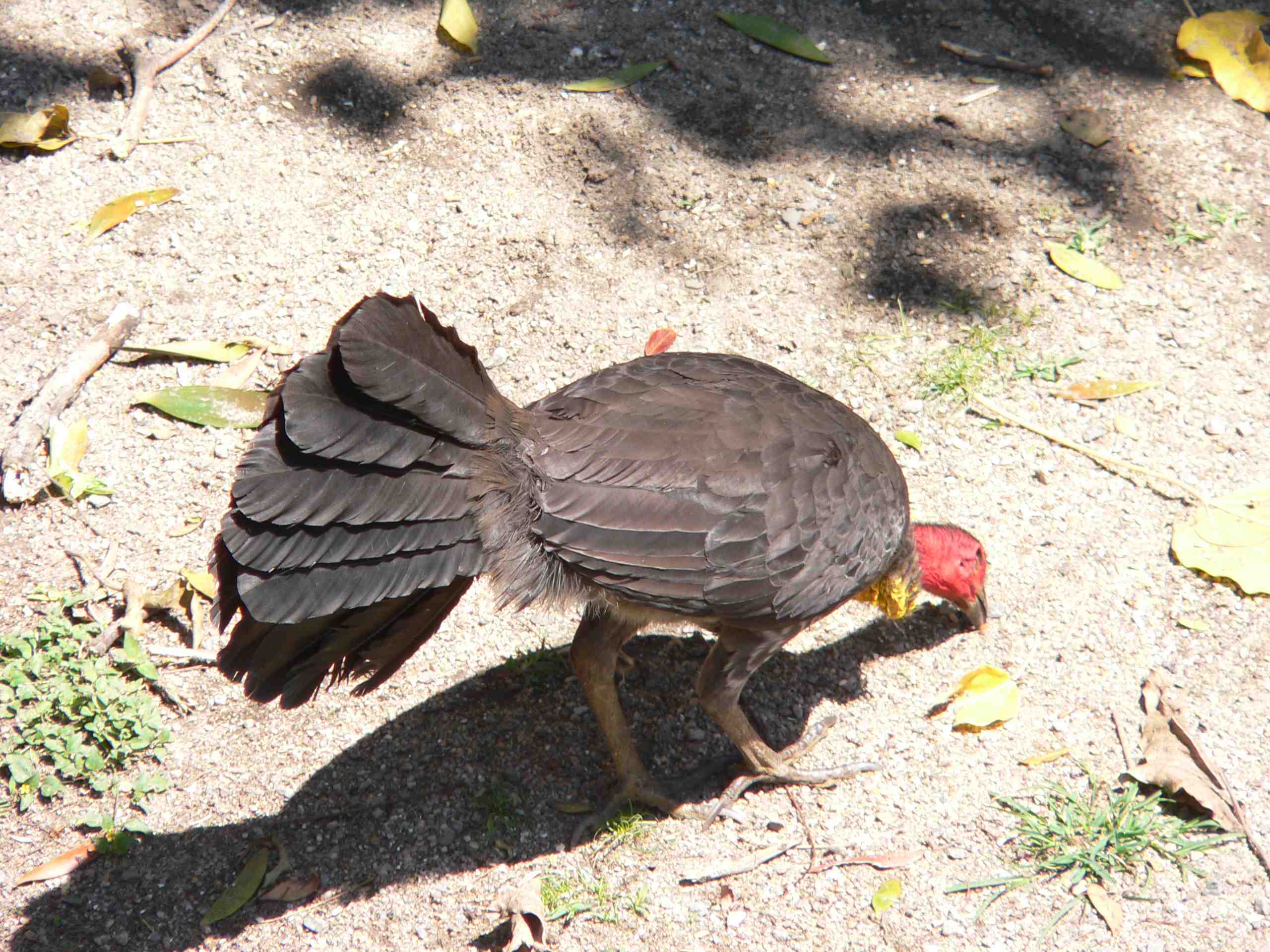
 I’ve got turkeys wandering around the yard but I can’t buy one at the grocer or butcher.

Paul the butcher in Annerley, Brisbane, Australia, took pity on me and gave me – gave me for free – a frozen turkey breast he had in his freezer.

“If it sucks, throw it out.”

I threw it out.

Paul says he does a lot of turkeys for Christmas, but Thanksgiving just isn’t an Australian thing.

And it’s sorta weird, with spring strawberries and asparagus abundant rather than the traditional North American harvest foods.

Was even weirder prepping food all morning while Amy played with Sorenne and listened to the K-State football game on Internet radio.

But, we continued our tradition and had some 15 Aussies over for a Canadian Thanksgiving feast.

And instead of North American football, there was the 2011 Rugby World Cup quarterfinals: yeah Wales (suck it Ireland); France will lose next weekend to Wales; yeah Australia (suck it South Africa), and in a few hours it should be yeah New Zealand (suck it Argentina).

Salmonella stays with chickens, from birth to kitchen

 News21 is part of a national Knight-Carnegie university reporting project that worked on a bunch of food safety stories over the summer. I spent a lot of time on the phone with these students, as did many others. One of the results was published in the Washington Post over the weekend; excerpts below.

On a late June morning, thousands of newborn chicks in a West Virginia chicken house huddled together for warmth, forming a fuzzy, moving yellow carpet.

Over the next two months, these chicks pecked at the dirt, nibbled on pellets, grew up. They were packed into crates, trucked to a slaughterhouse, cut into parts and sent to a distribution center for shipment to supermarkets and restaurants.

At every step along the way, some of those chickens were infected with salmonella, a pathogen that lives in the intestinal tracts of birds and other animals and can easily spread. Invisible, tasteless and odorless, it doesn’t make the chickens sick. But transferred to humans, it can lead to salmonellosis — an infection that causes diarrhea, fever and stomach cramps, and, in severe cases, can spread from the intestines to the bloodstream.

A look at how the nation’s food safety system operates in the case of salmonella-infected poultry shows how a combination of industry practices and gaps in government oversight results in a fractured effort that leaves the ultimate responsibility for safe food with the consumer.

Food safety experts and poultry scientists say that salmonella control must start on the farm, but federal food safety inspectors never set foot there. The Agriculture Department’s Food Safety and Inspection Service lacks the legal authority to test for salmonella on farms or to require farmers to have a food safety plan.
As a result, attempts to prevent salmonella are done voluntarily by farmers or because poultry processing companies ask them to — leading to a patchwork of efforts, some of which work better than others.

Stan Bailey, a retired USDA microbiologist, said that during his career, he noticed that some companies worked harder than others on food safety. “I think different people have different attitudes on how much they’re willing to spend,” he said.

And no matter how much salmonella USDA finds in raw meat, it cannot be kept off the market.

safefood Queensland: you’re breaking my (temperature-verified) heart

 In what appears to be an ineffectual use of twitter akin to travel and weather updates from people who occasionally say something useful, safefood Queensland (that’s in Australia) posted 10 tips for chicken preparation ending with this nosestretcher.

“And finally Tip 1: Make sure that you never serve partially cooked chicken to anyone. Chicken is cooked when the juices run clear.”

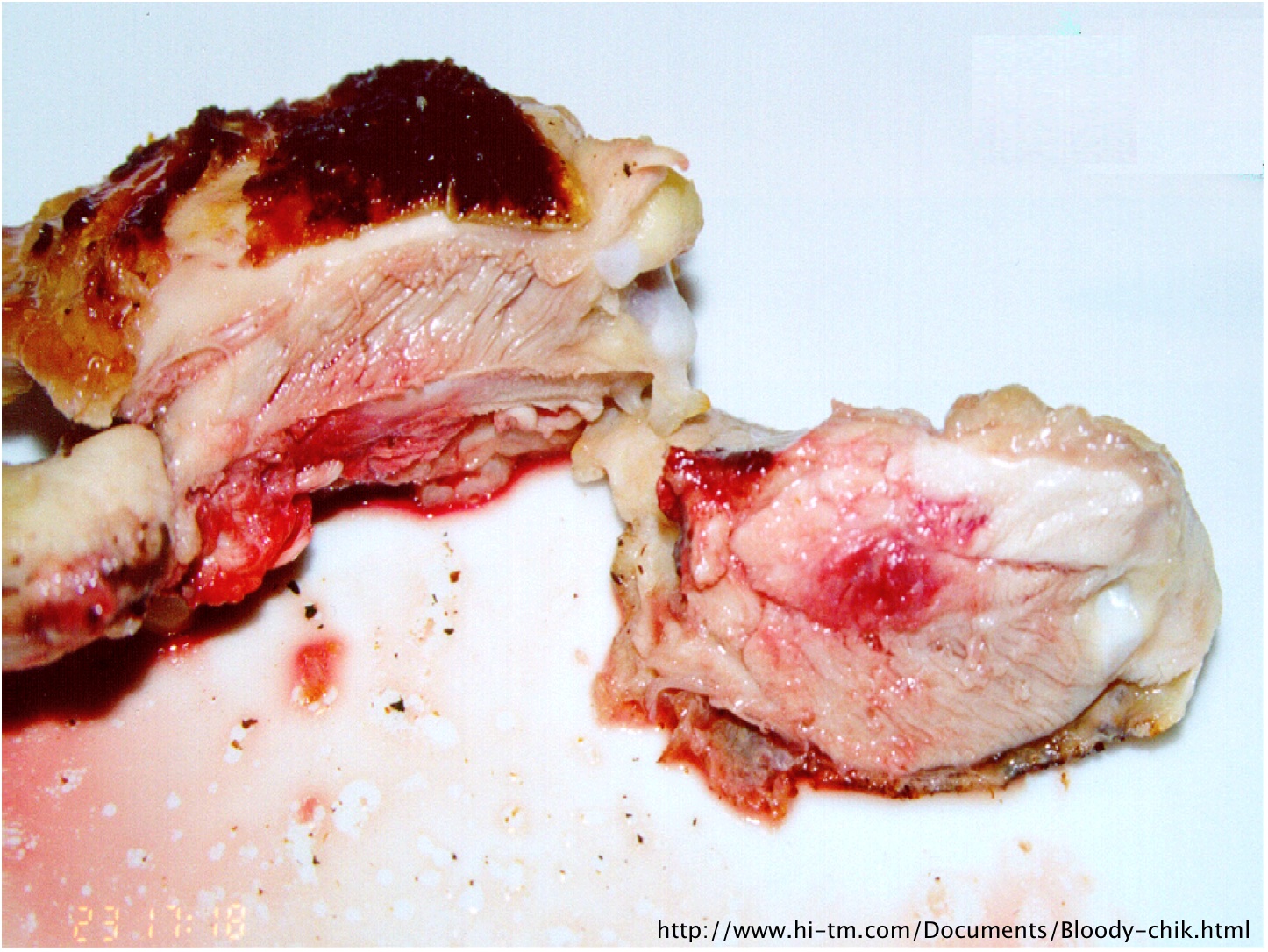
Color is a lousy indicator of safety for any meat. This has been extensively referenced, and why Canadians and Americans tell people to use a tip-sensitive digital thermometer. The chicken leg with back attached (right, thanks Pete Snyder) has been cooked to a thermometer-verified and safe 165F. There may be a yuck factor, but it’s microbiologically safe.

Stock on the counter invites microbiological trouble

I’m in Brisbane one day and I cook a whole chicken and then make stock.

It’s my go-to food.

Back in Manhattan I had a groovy measuring cup similar to the one, right, that easily separates the fat. Overnight in the refrigerator also works (I have 3 containers biding their time in the fridge).

A well-flavored – careful not to over-salt — chicken stock is a key ingredient, not just for soups and stews, but a meal of shrimp and red pepper over rotini, stir-fried veggies, even some kinds of bread.

So when Michael Ruhlman, some sort of cookbook author, said on his blog that he likes to make chicken stock and leave it out on the stovetop all week, using portions day to day to make quick soups and sauces, Harold McGee of The New York Times decided to check with a real expert: O. Peter Snyder, a food scientist and veteran educator and consultant to the food-service industry, who has at times taken issue with government guidelines he considers unnecessarily conservative.

“The process described by Mr. Ruhlman is a very high-risk procedure,” wrote Dr. Snyder. “It depends totally on reheating the stock before it is used to be sure that it doesn’t make anyone ill or possibly kill them.”

Boiling does kill any bacteria active at the time, including E. coli and salmonella. But a number of survivalist species of bacteria are able to form inactive seedlike spores. These dormant spores are commonly found in farmland soils, in dust, on animals and field-grown vegetables and grains. And the spores can survive boiling temperatures.

After a food is cooked and its temperature drops below 130 degrees, these spores germinate and begin to grow, multiply and produce toxins. One such spore-forming bacterium is Clostridium botulinum, which can grow in the oxygen-poor depths of a stockpot, and whose neurotoxin causes botulism.

Once they’ve germinated, bacteria multiply quickly in nourishing stock. They can double their numbers every 90 minutes at room temperature, every 15 minutes at body temperature. A single germinated spore can become 1,000 bacteria in a matter of hours, a billion in a few days.

As Dr. Snyder put it, “After sitting on the stove and growing bacteria for two or three days, Mr. Ruhlman’s stock almost certainly has high levels of infectious Clostridium perfringens cells, or Clostridium botulinum or Bacillus cereus cells and their toxins, or some combination thereof.”

Why has the Ruhlman family survived? Because Mr. Ruhlman boils the stock before he serves it, Dr. Snyder wrote. Any active bacteria are killed by holding the stock for a minute at 150 degrees or above, and botulism toxin is inactivated by 10 minutes at the boil.

But quickly reheating a contaminated stock just up to serving temperature won’t destroy its active bacteria and toxins, and the stock will make people sick.

In 2008, a 26-year-old Japanese mother in the Osaka region shared a meal of leftover fried rice with her two children, ages 1 and 2. She had prepared and served the rice the day before and kept it at room temperature.

All three became ill 30 minutes after eating the leftovers, and were hospitalized. Both children lost consciousness, and the youngest died seven hours after the meal. Pathologists later reported in the journal Pediatrics that the rice contained a very common spore-forming bacterium, Bacillus cereus, along with a heat-resistant toxin that the bacterium tends to make on starchy foods, and that can cause vomiting even after being heated to the boil.

Dr. Snyder agreed that official pronouncements on food safety can be inconsistent and self-defeating. “The F.D.A. Food Code is very conservatively written,” he wrote. “Four hours after it’s cooked is plenty fast enough to get food into the refrigerator.” And slow enough to relax and enjoy the meal.

I’m with Pete.

Gonzalo Erdozain: The only chicken on your table should be cooked chicken

Who lets a chicken eat scones on a dining table?

Zoonotic dumbass Tori Spelling.

On the latest episode of Watch What Happens Live, a short clip from a new show that celebrity wannabe Tori Spelling is either part of, or makes an appearance has reinforced the fact that people in general have a poor understanding of the risks involved with animals in the transmission of zoonotic diseases.
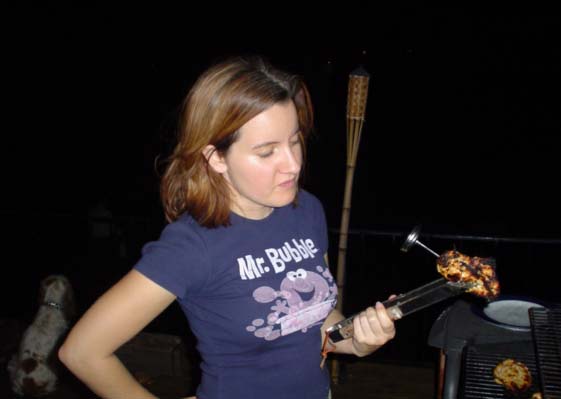
Baby chicks and chickens have been linked to many salmonellosis outbreaks throughout the world. The most recent outbreak in the U.S., still ongoing, has already sickened 39 people in 15 states. Tori, cook the chicken or get it off the table.
 

Whole Foods still sucks at food safety; so does a Toronto newspaper and Cooks Illustrated

In the latest installment of Whole Foods Market has terrible food safety advice — blaming consumers for getting sick, selling raw milk in some stores, offering up fairytales about organic and natural foods – today’s grilling tip is that “chicken that is cooked enough will feel springy when pressed. If you’re uncertain, cut into the thickest part of one piece. The meat should still be juicy, but the juices should be clear, never reddish.”

Color is a lousy indicator.

Use a tip-sensitive digital thermometer.

Toronto’s Globe and Mail has gotten into the trend of using someone with what appears to be an Australian accent to flog food but seems to skimp on the food safety.

Stephen Alexander, owner of Cumbrae Meats, says in a video  that, “cooking a burger to medium is totally fine as long as you start with good quality fresh ground meat.”

I don’t know what medium means. How is good quality defined, by bacterial counts? And where’s the thermometer, the same one Alexander uses when cooking chicken on the grill but that Whole Foods doesn’t know exists.

Cook’s Illustrated likes its burgers “juicy and rosy throughout.” 

Roast chicken for two: cooking and sex and safety

I make a decent roast chicken.

Michael Ruhlman has a recipe, roast chicken for two (when the kids are gone) that’s making the rounds on the Intertubes.

Step 1: Preheat your oven to 425?F or, if you have ventilation, 450?F, and use convection heat if it’s available.

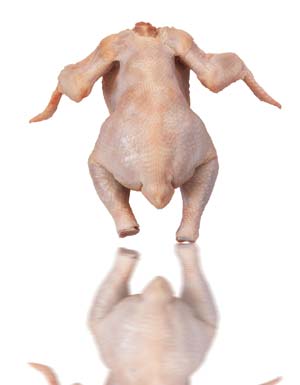
Step 2: Wash and pat dry a 3- to 4-pound chicken. Truss it if you know how, or stuff 2 lemon halves in its cavity. Season it aggressively with kosher or sea salt (it should have a nice crust of salt). Put it in a skillet and slide it into the hot oven.

Step 3: Have sex with your partner. (This can require planning, occasionally some conniving. But as cooks tend to be resourceful and seductive by nature, most find that it’s not the most difficult part of the recipe.)

Step 4: Remove the chicken from the oven after it’s cooked for 1 hour, allow it to rest for 15 minutes, and serve.

Cooking, like sex, is good for your marriage.

Once the kids are regularly gone during the day, carve out two hours (more if you can swing it) to rendezvous at home. The home itself will be strangely, wonderfully peaceful. Neither you nor your partner will be exhausted; instead, you’ll still be fairly fresh and energetic—it’s time for lunch, after all.

I prefer lime over lemon, and stuff the bird with about 30 cloves of garlic and a generous helping of rosemary. Use a meat thermometer for safety (at least 165F).

What should have been the title for this blog post?