
Raw milk cheeses are commonly consumed in France and are also a common source of foodborne outbreaks (FBOs). Both a FBO surveillance system and a laboratory-based surveillance system aim to detect Salmonella outbreaks.
 In early August 2018 5 familial FBOs due to Salmonella spp. were reported to a regional health authority. Investigation identified common exposure to a raw goats’ milk cheese, from which Salmonella spp. were also isolated, leading to an international product recall. Three weeks later, on 22 August, a national increase in Salmonella Newport ST118 was detected through laboratory surveillance. Concomitantly isolates from the earlier familial clusters were confirmed as S. Newport ST118. Interviews with a selection of the laboratory identified cases revealed exposure to the same cheese, including exposure to batches not included in the previous recall, leading to an expansion of the recall. The outbreak affected 153 cases, including 6 cases in Scotland. S. Newport was detected in the cheese and in milk of one of the producer’s goats.
The difference in the two alerts generated by this outbreak highlight the timeliness of the FBO system and the precision of the laboratory-based surveillance system. It is also a reminder of the risks associated with raw milk cheeses.
Outbreak of salmonella Newport associated with internationally distributed raw goats’ milk cheese, France, 2018, 04 May 2020
Epidemiology & Infection pp.1-23
Robinson(a1)(a2), M. Travanut (a3), L. Fabre (a4), S. Larréché (a5), L. Ramelli (a6), L. Pascal (a6), A. Guinard (a7), N. Vincent (a8), C. Calba (a8), L. Meurice (a9), MA. Le Thien (a10), E. Fourgere (a10), G. Jones (a1), N. Fournet (a1), A. Smith Palmer (a11), D. Brown (a12), S. Le Hello (a4), M. Pardos de la Gandara (a4), FX. Weill (a4) and N. Jourdan Da Silva (a


 As we all recover from the flu, our appetites are only mediocre. In the spirit of things, I cooked an Archer Farms spinach and goat cheese pizza for dinner tonight. I added olives because that’s one of the few things Sorenne currently loves. When looking at the cooking time and temp I noticed detailed directions that seem straight from this blog:
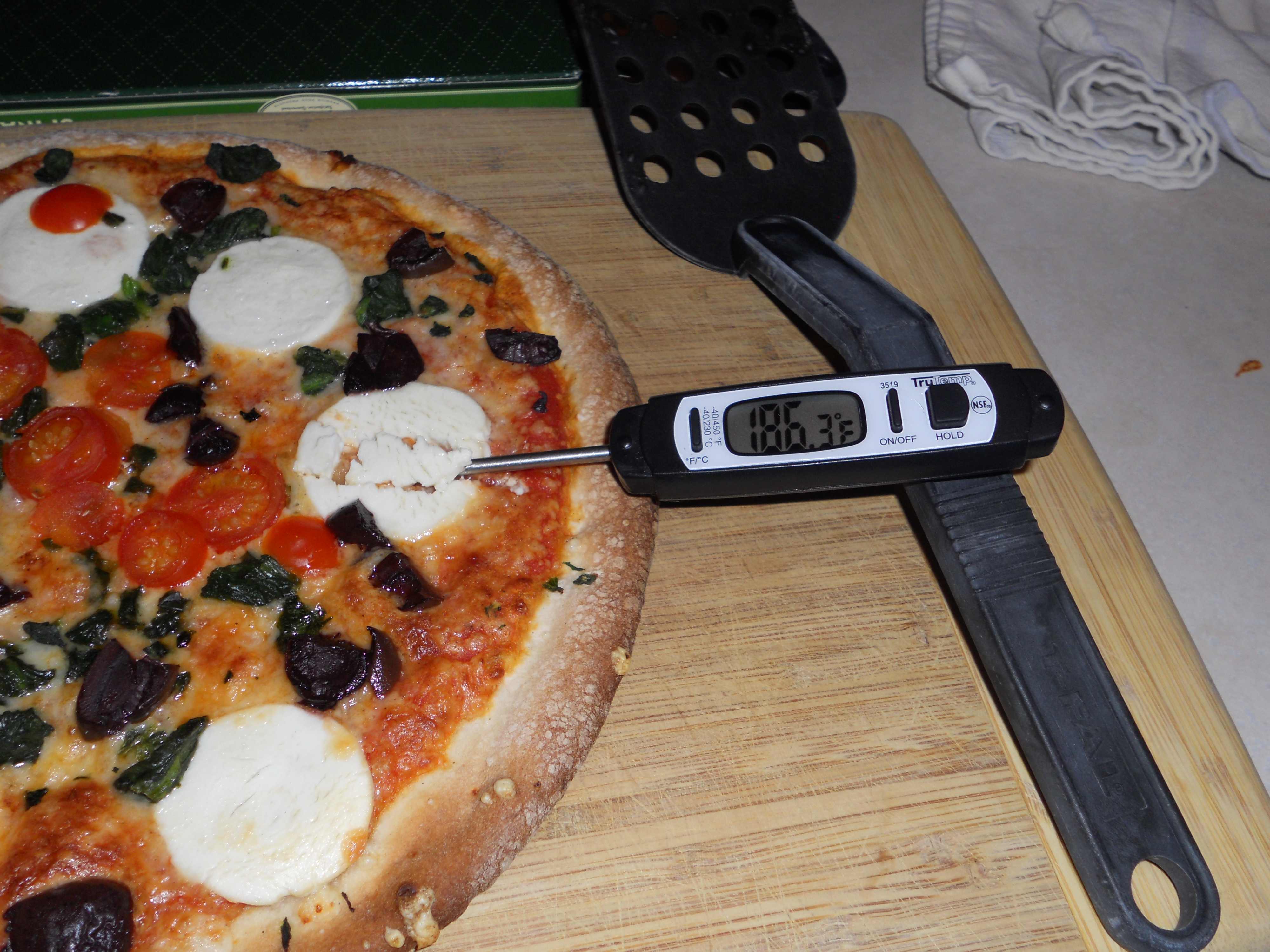 So I did (exactly as pictured). After cooking the pizza at 400F for about 18 minutes, I took it out and tried to eye the thickest part. Then I tried to put the thermometer in somewhat sideways being careful not to poke through the other side. To take the picture, I had to prop the thermometer on my spatula. The process made a big gash in my pizza toppings and the cheese stuck like glue on the thermometer, but it was easy to see the pizza was well above 165F.