Another ‘Bamaburger, no thermometers in sight

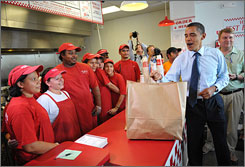
U.S. President Obama went to another burger shop in Washington for lunch today, ordering up a cheeseburger with lettuce, tomato, jalapeno peppers, and mustard – not the fancy Dijon mustard.

He also ordered a cheeseburger for Brian Williams, anchor for NBC. The network was filming a day-in-the-life program at the White House.

The media accounts and video do not indicate how the burger was ordered – I always order well-done. Hopefully someone is sticking in a tip-sensitive thermometer to ensure the burger is cooked to 160F.

The U.S. Department of Agriculture says Americans should use a thermometer. Shouldn’t that apply to the President as well (photo below from AP)
 

Memorial Day: Stick It In to verify the burger is cooked

I already caused a mini cow-poop storm when I suggested U.S. President Obama and VP Biden should be ordering their burgers based on a tip-sensitive thermometer verified 160F, and not the vague and meaningless, medium-whatever.

But food porn will always trump food safety.

So when the Obama Foodorama person wrote about turkey burgers today, there was no mention of temperature (in this case – 165F). There was 900 words of food porn – seriously, get an editor – and the cooking instructions consisted of:

“In a deep skillet, heat a small amount of neutral cooking oil on medium heat, almost to the smoking point. Put in four burger balls to cook at a time, and flatten down with a spatula. Cook for 3 minutes and flip, and cook an additional 3 minutes on the other side. In the last 30 seconds of cooking, pop Munster cheese slices on burgers, and cover pan so it melts.”

That has nothing to do with final end-point temperature, the temperature that kill the microorganisms that make people barf. Enjoy the Memorial Day holiday. And Stick It In for safety.

Obama at E. coli risk? What does a medium-well hamburger mean?

U.S. President Barack Obama and VP Joe Biden (right, photo from AP) ordered a couple of medium-well hamburgers for lunch today at Ray’s Hell Burger in Virginia, and while media and blog reports were the usual gaga over, OMG, the President ate, no one asked, what does medium-well mean? Was the President at risk of contracting foodborne illness like the other 83 million American mortals each year?

Color is a lousy indicator. And who knows what medium-well means from one mom-and-pop shop to the next. One of the blogs is already having a heated discussion about what medium-well means and not one person has mentioned temperature.

Anyone out there want to do a graduate degree? Go to 100 burger joints, order burgers, and when they ask how would you like it cooked, ask the server, what does that mean. See if anyone mentions temperature. Write up the various responses in a methodologically sound way. You may save a President.
 

Cross-contamination at checkout

Katie and I were craving hamburgers this weekend and Doug decided to indulge us. At the supermarket on Saturday he picked up some ground beef along with our normal cart full of produce and other proteins. As usual, I tried to separate the items in the cart so that the fresh produce was not touching the beef, pork, or salmon filets, even though all the meat was wrapped.

Checkout on Saturdays is always busy, and with a baby, a shopper’s plus card, a payment method, eco-friendly shopping bags, and chatter with the cashiers and baggers, there are plenty of distractions. On this particular day, the new store manager was bagging our items and complementing Doug on his culinary ability: “I can see you must be a good cook because those items require skill.” I chimed in with full-hearted agreement. Doug’s an awesome cook.

In the meantime, as the hamburger was being passed over the scale and scanner, juice poured out all over the place. I watched the cashier and was about to say something, but she pulled out a sanitary wipe and cleaned her hands. She then proceeded to pass every one of our produce items over the scale and through the hamburger juice. I felt like I should say something but wanted Doug to be the bad ass. And as I stood there stunned, not wanting the store manager to fire the woman, she completed our transaction and was on to the next person.

As soon as we exited the store, I declared we would have to wash every piece of produce in the bags. It didn’t even occur to me until later that the following person’s items were also going to pass over that potentially E.coli-laden scale. And maybe the same thing had already happened five times before we arrived. Maybe we were already at risk before our hamburger leaked all over.

It’s important to wash fresh fruits and vegetables to remove external contamination, because you never know where it’s been. Once your produce is exposed, it can contaminate other items in your bag or at home. Even if you are a careful consumer, it’s difficult to know just where that tomato has been.

(P.S. Doug cooked the burgers to a perfect 160F and they were delicious.)


90210: Pregnant and hungry for a hamburger

Last night on 90210, Adriana, the drug-addict turned mother-to-be, was out dining with her boyfriend and ordered a hamburger, medium rare.

Pregnant Adriana could learn some things from Barfblog.

Medium rare does not mean the burger is safe to eat – rather a hamburger needs to be cooked to 160F, by someone who knows how to use a meat thermometer properly, to be safe. Cooking hamburgers to 160F is the only way to kill deadly microorganisms like E. coli O157:H7. Pregnant women, with their suppressed immune systems, should be particularly careful, and avoid certain foods.
 

Hamburgers in France, steak tartare in the Netherlands linked to shiga-toxin E. coli

Epidemiological studies conducted in France show that beef burger consumption is the main risk factor of a serious disease caused by Shiga toxin-producing Escherichia coli bacteria or STEC.

A quantitative risk assessment for the consumption of beef burgers containing STEC by the Agence Francaise De Securite Sanitaire Des Aliments concluded that almost 50% of children under the age of 5 eat well-done beef burgers (as well as 29% and 24% of 5-10 year olds and 10-15 year olds respectively). The proportion of beef burgers consumed rare increases with the children’s age: 10%, 17% then 20% for each of the age groups defined (under 5, 5-10 year olds and 10-15 year olds). Regarding the effectiveness of cooking (a frozen beef burger being pan-fried and turned over once), it should be noted that cooking “rare” is associated with a percentage of STEC destruction of 0% to 87% ; “medium” 37% to 96% and “well done” 94% to 99.8%. Concerning the consumption habits that prevail in French households today, these results highlight the importance of the length of cooking on STEC destruction (currently not enough), and the hygiene of beef burger production.

A place to start might be to accurately define what rare, medium and well-done actually mean, as quantified by time and temperature

Eurosurveillance reports that the Netherlands experienced a nationwide outbreak of Shiga toxin-producing Escherichia coli (STEC) O157 with onset of symptoms from the end of December 2008 until the end of January 2009. A total of 20 laboratory-confirmed cases were linked to the outbreak strain, serotype O157: H-, stx1, stx2, eae and e-hly positive.  The investigation into the source of this outbreak is still ongoing, but evidence so far suggests that infection occurred as a result of consuming contaminated raw meat (steak tartare). 

Child stricken with HUS in France; link to frozen ground beef patties

Our French correspondent Albert forwarded a press release issued yesterday by the French Ministry of Health and Sports; Amy translated.

Following notification on February 11, 2009 to InVS (The French Institute for Public Health Surveillance) of a case of hemolytic uremic syndrome in a child who is hospitalized in the Parisian region, health authorities have begun an investigation to identify the source of contamination.

The tests done on the child indicated he or she was infected with E. coli.

Among the foods consumed was frozen ground beef patties on which tests were conducted. The results of these tests were relayed today to health authorities and demonstrated the presence of E. coli. The link between this case and the consumed food will only be confirmed after further testing which is currently in progress.

While waiting for those results, the authorities have asked the producer to proceed with a  recall of CERGEL brand frozen ground beef patties sold in boxes of 10 with a best-by date of 10/31/09.

The health authorities are asking people who have bought these patties to not eat them and to return them to where they were purchased.

The Ministry also has some general advice, which seems a bit lacking, but maybe it got lost in translation.

Generally you are reminded that:

–    Ground meat ordered at the butcher shop must be consumed that day and frozen ground meat must be used without any prior defrosting;

–    Cooking the ground beef patties through to the center prevents the consequences of E. coli contamination. The bacteria is destroyed by a temperature of 65°C (149°F). Children and pregnant women should not consume rare meat.

–    Hemolytic Uremic Syndrome (HUS) is an illness most frequently originating in food, rare in France, and potentially serious for the very young and very old. It can cause acute renal insufficiency in children under the age of 3.
 

Millionaire City boss tells staff to eat two-day-old burgers … to remind them how lucky they are to still have jobs

Local health-types are a bit miffed that UK gazillionaire Damon Buffini decided to punish the inflated egos – and bellies – of his staff by sending out for more than 100 McDonald’s burgers, waiting two days and then providing the aged burgers for a staff lunch.

Buffini apparently told the gathered staffers he was tired of their poor attitude, reminded them how lucky they had been in life, and that lunch would not be taken at any of the smart restaurants in and around Covent Garden. Instead, they were told to eat their ‘two-day-old’ burgers and reflect on how fortunate they all were to still have their jobs.

The burgers were apparently reheated.

Andrew Hamadanian, senior communication officer for the Chartered Institute of Environmental Health, said,

“Without knowing the specific details, McDonald’s and other fast food are made to be eaten straight away. We would not encourage eating food that may not have been stored properly between purchase and consumption.”
 

Casey the blogger and inappropriate instruments

I got my start on barfblog more than a year ago as a senior in Food Science at K-State when I went to a club picnic with my boyfriend and gasped at an offensive tub of tater salad.

Two days later I gasped again…  this time at an Associated Press story in which a Chinese buffet worker was spied stomping garlic with his boots behind the restaurant. Aghast, I asked,

“Could a fellow eater like myself be so distracted from the bacterial ramifications of using one’s shoes as a culinary instrument?”

Pretty soon I was a regular. Then I was graduated, married, and working with Doug full-time… and far too busy to formulate a blog (or some such nonsense).

So, today you’re privy to my second debut on barfblog.

This jaw-dropping tale is set at another get-together with my husband (same great guy, just a new title). And, interestingly, another use of inappropriate instruments. This one was a little closer to home:

As our hostess busied herself preparing desserts and planning her meal, she realized the spiral ham she purchased was too large for her Crock Pot. It would have to be cut to fit (finished product shown at left).
 

Lacking your standard bone saw, she enlisted the help of her husband… and his reciprocating saw.

She carefully washed the blade in hot, soapy water and assured her husband’s hands were clean. (He had been in the garage, after all.) Then he set to work.

She saw my eyes widen in disbelief and started to apologize, explaining she had no other choice. I quickly smiled and said,

“Oh, I understand. But don’t think for a second I won’t blog about this!”

The moral of the story is: Invest in some appropriate instruments for use with food, if you want to ensure your cooking won’t cause dinner guests to barf.

But don’t eat poop, folks. Wash your hands. And your reciprocating saw, if necessary.

 

Rob Mancini: Use a thermometer, and use it right

“A concierge is the Winnipeg equivalent of a geisha.”

I thought that line was so good on the television show, The Office, last night –when a few of the staff took a business trip to Winnipeg, Canada — that I wrote it down for future use.

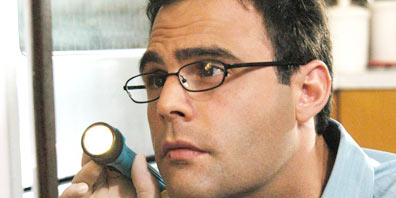
So when telegenic public health inspector Robert Mancini of Winnipeg (former co-host of the television series Kitchen Crimes, right, pretty much as shown) e-mailed me about something he saw, I had my excuse to use the Winnipeg line.

Rob writes:

“Yesterday, upon walking into a restaurant kitchen to perform a routine inspection, the chef was actually using a metal stem thermometer to determine doneness of a hamburger patty. Naturally, this excited me until I asked the chef what temperature he was aiming for. He said 130?? F. Lovely.

“Just because a chef has a thermometer and uses it once in a while doesn’t really mean anything, they need to be aware of proper cooking temperatures. The chef, assuming that I was a health inspector (I guess all my fancy gadgets gave that away) used the thermometer to impress me and perhaps gain some extra bonus points.  It almost did as I scurried over, maybe too excitedly, but sadly left disappointed. Let’s get people talking about food safety.”