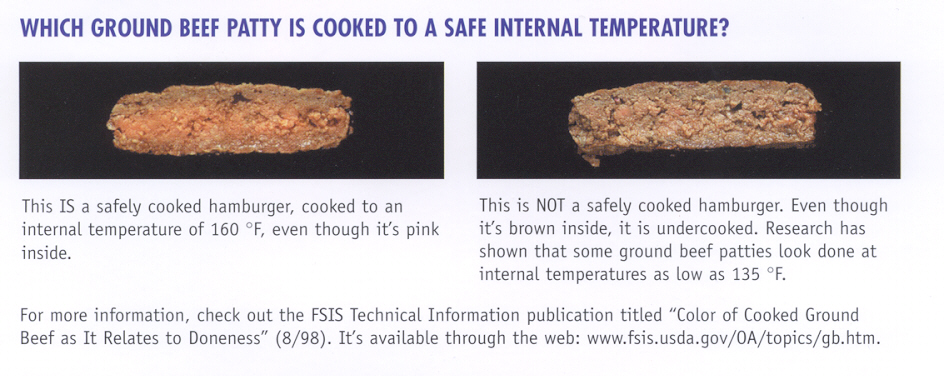
What do rare, medium and well-done mean? Especially with hamburgers?

Amy and I are at the University of Wisconsin in Madison — and I’m struck by how food safety things seem the same.

Amy got invited to speak at a French conference, and we didn’t know if we’d embark on the 10-hour drive this late in the pregnancy, but she said yes, so I tagged along.

Last time I was in Madison was 1997, when I gave a couple of talks at a BSE seminar for the Food Research Institute (FRI). A cursory look back and there were outbreaks involving petting zoos, unpastuerized apple cider, contaminated meat, and listeria. Once I get caught up on news you’ll see the outbreaks are still the same.

So we’ll keep looking for new messages and new media to reduce the number of sick people. As part of that, I had lunch with some FRI friends at The Great Dane Pub & Brewing Co.

Under the sandwiches and burgers section, the menu states,

“We cook our hamburgers and steaks to temperature. Here is a general guideline:

Rare – a cool red center
Medium Rare – a warm red center
Medium – a pink center
Medium Well – a slight hint of pink
Well Done – no pink."

Veteran barfbloggers will know that color – especially with beef – is a lousy indicator of doneness, and an even worse indicator of safety. Over half of all burgers will turn brown before they reach a safe temperature of 160F.

So I told the waitress I wanted a burger, and, when she asked me how I wanted it, I said 160F.

She looked at me.

My guests started to chime in, “You have to understand, he’s an assh…” but I cut them off.

Your menu says, cooked to temperature. That is the temperature I want it.

She started to back away slowly …

OK, well-done, but tell me what the cook says when you ask for 160.

When the waitress returned with the burger, she looked at me, like, you really are an asshole, but did tell me the cook said, if he wants it 160F, he wants it well-done. Why didn’t he just ask for that?

Because temperature is the only way to tell. Stick it in – for safety.

Restaurant sinks are not bathtubs

An Ohio man is in hot water for taking a hot bath in a Burger King bathtub. The video shows a man sitting in the sink, while other employees look on laughing. At one point the employee with the camera goes to ask the manager if she wants to come watch. The manager declines, but also fails to take any action. The video was then posted on Myspace. The fast food restaurant has fired all employees involved. They added that the sink was sanitized twice and all utensils were thrown out. Health officials are working with prosecutors to see if charges will be filed. However the health department has declined to issue any fines. If bathing in a kitchen sink isn’t worth a fine, what is?

The video contains some not safe for work language.
 

Burger King Employee Takes Bath In Sink – Watch more free videos

Want a rare burger in Dubai? Sign for it

Neil Rumbaoa, director of communications at the Shangri-La Hotel in Dubai, told The National that hamburgers served anything less than well-done come with a legal waiver.

“We just want to make sure that we serve the best quality food and the safest. And so if it’s rare, obviously there are factors that will contribute to how safe the food is.”

Levent Tekun, the director of marketing at Shangri-La Hotel in Abu Dhabi, said it is a worldwide policy for the hotel chain.

“As a company, globally, when a burger is ordered and a guest is asking for it to be medium or rare or something along those lines, our verbal phrase on that would be that the hotel prefers for the burgers to be well-done. Then it’s down to the guest to choose whether he wants it well-done or rare or whatever.”

In both Abu Dhabi and Dubai, customers who ask to take prepared food away from the hotel premises or use hotel facilities to store food from outside must sign a disclaimer. That practice is used in other hotel restaurants in the UAE, such as the Crowne Plaza Hotel.

It’s all part of the Shangri-La Hotel’s HACCP plan and has been in place for several years. But I wonder, how are rare and medium defined? Are they using meat thermometers and the right ones?

French food porn – burger chic

The New York Times reports that,

As French chefs have embraced the quintessentially American food, they have also made it their own, incorporating Gallic flourishes like cornichons, fleur de sel and fresh thyme. These attempts to translate the burger, or maybe even improve it, strongly suggest that it is here to stay.

The story has a lot of food porn about $50 burgers and nothing about food safety. Or thermometers.

Frédérick Grasser-Hermé, consulting chef at the Champs-Élysées boîte Black Calvados, said,

“A hamburger is the architecture of taste par excellence. The meat needs to be a mix of fatty and lean. Not raw, not rare. It must be medium rare. At the same time the bread needs to be smooth, tepid, toasted on the sesame side. I like to brush the soft side with butter. There needs to be a crispy chiffonade of iceberg lettuce. Everything plays a role.”

Rare, medium-rare, these terms are too subjective. Use a thermometer, and stick it in.

I try not to be a food safety jerk

After telling Misti Crane of The Columbus Dispatch that I feel naked without a thermometer – when cooking – she came back for more, and asked if I would ever take a thermometer to, say, a Fourth of July BBQ at someone else’s place.

Here’s what Doug Powell does: He whips out the thermometer he’s recently taken to carrying with him.

You might wonder how the food-safety expert finesses such a potentially awkward social situation.

"I go into it very academic, professor-ish like," he said.

"I try not to be a jerk."

… But nobody will eat a burger off his grill that hasn’t been stabbed in the side with a tip-sensitive digital thermometer and is cooked to a minimum of 160 degrees.

I’ve taken thermometers while tailgating at Kansas State football games, I’ve stuck them in potpies, and I’ve converted at least one French professor into using a thermometer. I know it’s awkward to ask questions, or listen politely while someone gases on about how safe their food is cause it comes from some dude with a RR address, but really, I try not to be a jerk.

Below are two videos, one tailgating, and one on how to cook hamburgers.

Now, can someone explain the American fascination with fireworks and the desire for students – especially males – to  ignite the noisemakers every night, beginning July 1. What are they compensating for?

I feel naked without my thermometer — when cooking

Me and Misti Crane, of The Columbus Dispatch, had a chat about all things food safety yesterday, as 18 people in Ohio and another 20 in Michigan have been stricken with the same strain of E. coli O157:H7, linked to hamburger from Nebraska Beef.

As Bill Marler pointed out last night, Nebraska Beef tried to downplay the seriousness of its recall of over 265 tons of ground beef and components when it said in a press release,

"The Company has processed over 10 billion pounds of product without a confirmed customer illness."

Not sure what confirmed means, but …

What I tried to explain with Misti was that it’s not nearly enough to expect people to just handle things safety because food safety is so simple; that pathogen loads – the sheer numbers of dangerous microorganisms on product like hamburger – need to be reduced from farm-to-fork.

If you’ve ever tried making hamburgers from scratch, you’ll know why.

The opportunities for cross-contamination — a few of those E. coli O157:H7 moving from hamburger to hands or counters or utensils, and then somewhere else –are just overwhelming.

And if the burger does make it to the grill, it has to be cooked. As I said,

"I feel naked without a thermometer," and that brown meat is not necessarily cooked meat. "Color is just a terrible indicator. Over half of hamburger will turn brown before it’s actually done.”

That’s why a risk reduction approach, beginning on the farm and right through to the fork, is essential. Especially with E. coli O157:H7.

Color is crap — no matter what the French government says

A FSnet reader sent along a Feb. 2007 inter-ministerial memo for food service professionals from France’s General Director of Health, Didier Houssin and the General Director of Food, Jean Marc Bournigal.

Amy translated parts of the document, which stated,

“I would especially like to point out the simple method of control described in the memo that consists of visually verifying that the meat is no longer pink in the center to assure that the temperature range is respected.”

Amy’s best translation of another part of the document is:

Cooking the ground beef patties through to the center eliminates the E. coli O157:H7 bacteria. This method of cooking can be considered as a kill-step according to the French Agency for Food Safety (AFSSA). This corresponds to an internal temperature of 65 C. While elaborating control procedures for the cooking temperature of ground beef patties, a simple method for assuring that the temperature range is sufficiently respected is to visually verify that the meat is no longer pink in the center. This can provide a sure and practical control procedure for personnel preparing the meals in institutions that do not have means to continually measure the internal temperature of finished products.

It is important to make the food service staff aware of these measures that allow the prevention of the risks of E. coli O157:H7. These measures are not incompatible with the good quality of the dishes served.

If eating habits cause certain French consumers to prefer ground beef patties that are pink in the center, recent organoleptic studies seem to indicate that the taste for rare meat develops with age and that young children appreciate well-done meat. The same has been found by a recent ad hoc study recently directed by a committee from the AFSSA.

Color is a lousy indicator of doneness in all kinds of meat, especially hamburger. The references are all here, along with a video.

Stick it in. Use a digital, tip-sensitive thermometer.

Hamburger Habits: Is Medium Safe?

I’m a reformed medium-rare hamburger eater. Before I met Doug, I always wanted my hamburgers pink in the middle and frankly had no clue that this was a potentially risky habit. Now that I’ve learned hamburger needs to be cooked to 160 F to be safe, however, I rarely eat hamburger unless Doug cooks it at home. That’s the only way I can assure that the cook is using a meat thermometer and knows how to properly do so.

Tonight, though, I’m in Buffalo, NY and I had dinner with two British friends in a rowdy Irish pub. While I intended to order salad, the pickings were few on the menu and I settled on a cheeseburger with fries. The waitress asked me, “How do you want that cooked.” Somewhat startled and without my food safety arsenal beside me, I said, “Medium.” I hate well-done hamburger because of the texture, but I wanted my burger safe. How could I tell her that?

My burger came and was very medium rare looking … very pink in the middle and done on the outside. I ate it. The whole thing. And it tasted good. And now I’m thinking about my foolish behavior and wondering if I’ll get e. coli. I know that color is a lousy indicator and I know it’s not likely I’ll get sick. But without the thermometer, how can you be sure?

Staph suspected in illnesses among Claudia Sanders patrons

State health officials said that a staph bacteria may have sickened more than 137 people who ate an Easter buffet at Claudia Sanders Dinner House in Shelbyville.

Preliminary results from the Kentucky State Lab suggested that staphylococcus aureus might be the culprit in the food poisoning, although it’s not definitive since it was found in some stool samples and not others.

The restaurant served 3,100 people on
 aster Sunday. Ham is the chief suspect in the case, although officials are also exploring other possible contaminated food.

Claudia Sanders and her husband, Col. Harland Sanders, moved into a large white house on four acres on U.S. 60 in Shelbyville in 1959. They initially used the house as the headquarters for Kentucky Fried Chicken, but later put up a building next door for that purpose.

When the fast-food franchise was sold in the 1960s, the couple turned the building next to their home into a restaurant. Now owned by a former employee, the restaurant serves country-style food, including fried chicken.

Hamburgers contaminated by E. coli O157:H7 in France

A FSnet reader provided a link to the French Ministere de l’Agriculture and we’re going to start trying to translate the significant microbial warnings and outbreaks.

Amy, the French professor partner took a crack at this one:

"On March 25, 2008 the press conference held by DGS, DGAL, InVS and AFSSA made precisions on the available information on the contamination of hamburger by the bacteria E. coli O157:H7 on which the shelf life has expired.

This outbreak was revealed by analyses that were undertaken at the producer’s initiative, conforming to communal and national hygiene rules.

It remained to be clarified the levels of contamination of these products because the first analyses were conducted without a microbial count. The official count analyses performed on the same hamburgers confirmed an important contamination on two samples and a weaker one on two others.

Since beginning informing consumers on March 21, 2008, there have been no human cases confirmed tied to this outbreak. In specific, no hemolytic uremic syndrome cases have been found.

Recommendations for consumers:
You are reminded that if you bought or are storing in your freezer the lots of hamburgers in question (fresh ground steak or ground meat, 5-15% fat, Monoprix or Carrefour brands, expiration date March 17 or 18, 2008, sanitary check number FR 50.147.02), you are formally recommended to not consume them and to bring them back to the store where you bought them.

In case digestive problems arise within a maximum of 10 days after consumption of the hamburgers from the incriminated lots, you are recommended to consult your physician and indicate your consumption to him."

And in what I’ve learned to love about the French, the press release says,

If you have not consumed any of the hamburgers from the incriminated lots or if you have no symptoms, it is useless to worry or to consult anyone.

The release also says to cook hamburger to the center. Whatever that means. What is French for piping hot?

Generally, it is advisable to remember that cooking the hamburgers through to the center prevents the consequences of such an outbreak, as the bacteria are destroyed by a temperature of 65°C.

Here’s our advice.