
How to properly cook hamburgers

The best way to make a hamburger is debatable. In my opinion adding Swiss cheese, pickles, onions, and mustard to a burger nearly perfects it. The one other ingredient? Temperature.
Cooking burgers to 160°F is the only sure way to tell that it is fully cooked. Cooking hamburgers to 160°F kills unwanted microorganisms such as E. coli O157:H7, a deadly ingredient. The U.S. Center for Disease Control and Prevention estimates 61 deaths a year from E. coli, and thousands more ill. Ground beef was recalled 19 different times in 2007 for E. coli contamination.
E. coli O157:H7 loves hiding in the intestines of animals, such as cows. During slaughter, if workers do not follow safe practices it can get onto the cuts of meat. Steaks can be cooked to varying degrees of doneness because any potential for microorganisms exists only on the surface. However, with ground beef the muscle is mixed up and the organisms are spread throughout the meat.
When cooking, don’t rely on the burger’s appearance to tell if it is done. Many people think a burger that is no longer pink is a done burger. This is not the case as pointed out in many studies (here, here, and here). Sometimes burgers look done well before they hit 160°F.
To measure the temperature of a burger, go out and buy a tip sensitive digital thermometer. Remove the burger from the grill or stove and insert the thermometer into the side of the meat all the way to the center. Wait until the thermometer reads 160°F before serving. Add the toppings of your choice, and enjoy!

Podcast 1
Podcast 2


References
Hunt, M.C., O. Sørheim, E. Slinde. Color and Heat Denaturation of Myoglobin Forms in Ground Beef. Journal of Food Science Volume 64 Issue 5 Page 847-851, September 1999.
http://www.blackwell-synergy.com/doi/abs/10.1111/j.1365-2621.1999.tb15925.x?prevSearch=authorsfield%3A%28M.C.+Hunt%29

Ryan, Suzanne M., Mark Seyfert, Melvin C. Hunt, Richard A. Mancini. Influence of Cooking Rate, Endpoint Temperature, Post-cook Hold Time, and Myoglobin Redox State on Internal Color Development of Cooked Ground Beef Patties. Journal of Food Science. Volume 71 Issue 3 Page C216-C221, April 2006
http://www.blackwell-synergy.com/doi/abs/10.1111/j.1365-2621.2006.tb15620.x?prevSearch=authorsfield%3A%28M.C.+Hunt%29

Seyfert, M., R.A. Mancini, M.C. Hunt. Internal Premature Browning in Cooked Ground Beef Patties from High-Oxygen Modified-Atmosphere Packaging. Journal of Food Science. Volume 69 Issue 9 Page C721-C725, December 2004
http://www.blackwell-synergy.com/doi/abs/10.1111/j.1365-2621.2004.tb09923.x?prevSearch=authorsfield%3A%28M.C.+Hunt%29

Man alleges he found condom in burger

The Rutland Herald is reporting that Van Miguel Hartless of Fair Haven, Vermont, said he was three bites into his Southwestern Whopper sandwich when he knew something was wrong.

"It had a sour taste and I felt something rubbery. I immediately spit it out and ran to the bathroom to vomit."

Hartless, 24, contends that what he bit into in his Burger King sandwich last summer was a condom — unwrapped and possibly used.

The incident last summer led him first to complain and then to file a lawsuit in Rutland Superior Court.

Hartless said his first inclination was to complain to the restaurant’s manager, who he said laughed off the incident.

"That’s the part that upsets me the most, is that he laughed about it."

About a week after he bought the hamburger, he said he received a letter of apology from Burger King he said was vague and ended with the optimistic phrase "Hope you come back and have a more pleasurable experience."

Science fair: Using photos to check when a burger is done

In a more systematic approach to a visually-safe burger, three teenagers in Pennsylvania have taken an Annie Leibowitz-like approach to fast food cooking by comparing safe temperatures and photographs.  The Philadelphia Inquirer reports that:

Above a stove, the girls mounted a camera that took a picture every 30 seconds. They measured how much each burger shrank during cooking, and recorded the size when it reached the proper temperature. Aided by computer software designed to measure geometric shapes, they calculated the percentage of shrinkage for various brands of frozen patties. And then they tested the finding by injecting raw burgers with E. coli.

The principal investigator, Naomi Collipp, suggested that "It pretty much worked every time."

Interesting idea, but seems like it’s drastically more complicated than having thermometers everywhere. I do like the thinking-outside-of-the-box nature of the project though — thermometers might not get used in every kitchen and maybe a grill-mounted camera snapping pictures burgers leads to safer food. Would be interesting to see how fat content impacts their findings.

Polite people eat raw hamburgers?

Daryll E. Ray, who has a lot of titles at the University of Tennessee, writes in an op-ed promoting irradiation that,
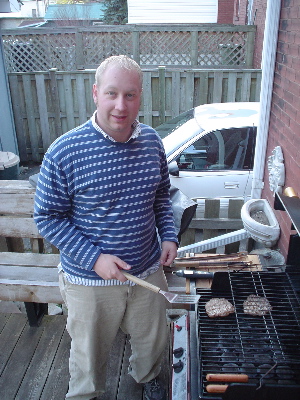
"The most immediate thing a consumer can do is to make sure that all of the hamburger that they serve is cooked to a minimum of 160 degrees F and that they observe sanitary precautions in the handling of meat and meat products.

"On a recent trip, one of us ordered a hamburger at a major restaurant chain-the cooking instructions was “medium.” When the hamburger arrived at the table it was not just pink inside, it was raw. Being polite, we went ahead and ate the burger."

Like so many food safety gurus, Ray is preaching one thing and doing another. And like a lot of public policy types, he talks a good game but doesn’t really say anything. And certainly doesn’t do anything.

Fifteen years after Jack-in-the-Box, it’s time to stop being polite. Only if consumers demand safe food will the corporations — or mom-and-pop burger shops — actually pay attention and deliver. Ask hard questions. Demand safe food. And help create a culture that values safe food.

Here are some examples:

During the halfway point of a food safety golf tournament in Baltimore in 2005, a burley, 50-ish goateed he-man requested his hamburger be cooked, "Bloody … with cheese."
His sidekick piped up, "Me too."
I asked the kid flipping burgers if he had a meat thermometer.
He replied, snickering, "Yeah, this is a pretty high-tech operation."
The young woman taking orders glanced about, and then confided that she didn’t think there was a meat thermometer anywhere in the kitchen; this, at a fancy golf course catering to weddings and other swanky functions along with grunts on the golf course.
We ordered the burgers well-done.

Two iFSN researchers went to a local restaurant and ordered a hamburger. When asked how we would like them done, Doug asked, "What temperature is well-done?"
The server replied, "All our burgers are well-done unless the customer specifies."
The burger came out dripping blood, and still cold. So even though color is a lousy indicator of doneness, the burger was returned. And a lesson was given on doneness of burgers.

A graduate student and I were recently in Seattle, home of the infamous 1993 Jack-in-the-Box outbreak of E. coli O157:H7 that sickened some 600 and killed four, and put microbial food safety firmly in the minds of American media, lawyers and even the President.
After arriving at the hotel in Seattle and wandering around a bit, we ended up back at this rather posh hotel. Upon ordering burgers, we were asked how we would like them, "Rare, medium, well-done?" We looked at each other, and I asked if they ever used a meat thermometer. The waiter looked befuddled.
We both ordered well-done.

Salt makes policeman vomit

McDonald’s staffer Kendra Bull was charged with a reckless conduct, a misdemeanor, for her role in food preparation after dousing police officer Wendell Adams burger with salt,

The burger made Adams so ill after a couple of bites that he vomited.

Officer George Louth, spokesman for the department said investigators don’t know if Bull was targeting the officer with the Big N’Tasty blue-light special, only that she admitted putting the salt on the burger, but that the cash register, er, registered a discounted meal.

"In the middle of the night the only people they discount for are their employees or a member of the Police Department," Louth said.

Just cook the burgers and no one will get sick …

Andrew Wadge is the chief scientist for the U.K. Food Standards Agency; Andy has a blog.
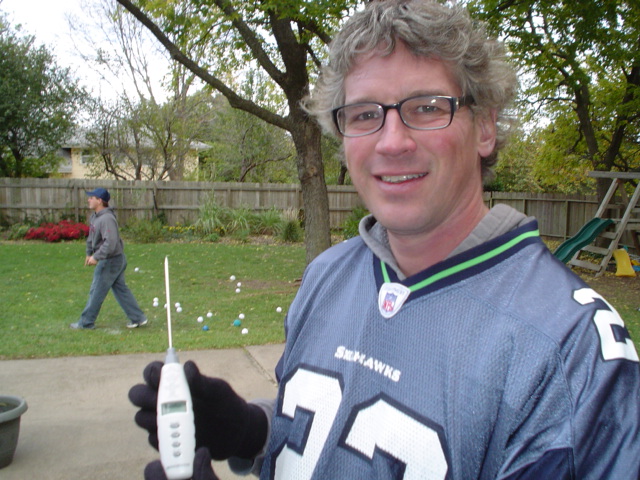
On Aug. 2, 2007, a Judith Hilton posted on Andy’s blog that,

"UK Government advice about cooking burgers is more stringent than in the US and we were asked to consider whether our advice was still appropriate, bearing in mind claims the cooking times and temperatures recommended in the UK may lead to overcooking and deterioration in the quality of some products.

"Mindful of this, but also of the fact that undercooked burgers can harbour harmful food bugs such as E. coli O157, which can cause food poisoning and kidney failure, and that the advice had not been expertly reviewed since 1998, we asked the ACMSF to review what we were saying, which is that burgers should be cooked to 70°C for 2 minutes or equivalent. In other words, until burgers are piping hot throughout, there are no pink bits and the juices run clear."

On Aug. 2, 2007, I posted a comment, asking,

Why is the U.K. advice considered more stringent that the U.S.? Especially when the U.K. makes no mention of using meat thermometers and instead relies on the tremendously misleading, cook until the juices run clear?

On Aug. 7, 2007, Ms. Hilton responded that,

"The stringency relates to the time-temperature combinations whereby US guidance allows combinations that will provide a lower log reduction that 70 degrees for two minutes.
The reason we don’t mention temperature probes during cooking is that they’re not commonly used in the home over here. … Sorry you don’t find the reference to juices running clear helpful. It’s there as an additional safety check, alongside cooker manufacturer’ instructions. These instructions are designed to achieve a minimum temperature of 70 degrees C for two minutes or equivalent."

Without getting into the inadequacies on cooking instructions (and we don’t just blather about it, we’re doing research on it, rightt now — dp)  I responded,

"Thanks for your comments. But they seem incomplete, especially when you are claiming that U.K. standards are more stringent than U.S. (and I’m Canadian so find the jingoism peculiar).

"The U.S. Department of Agriculture seems to have covered much of the basics in this oldie but goodie release. And while use of thermometers may be low in the U.K. and elsewhere, isn’t it the responsibility of government agencies to produce evidence-based material, and even promote best practices? Like using meat thermometers? It’s a research challenge we will be undertaking."