
I’m a fan of the creative approach to using falcons to control wild pests on farms; with the caveat of balancing tradeoffs.
Back when I was doing on farm food safety stuff in greenhouses in Ontario (that’s in Canada) I had many farmers tell me that cats controlled the mice. They often asked what what’s worse – cat poop and feline tracking pathogens on their feet, or rodents everywhere. I never really had a good answer (and suggested traps for the the rodents). Today I saw an article form New Food Economy on using falcons as pest control on ranches and farms, with the click-worthy headline of ‘Could falcons prevent the next salmonella outbreak?’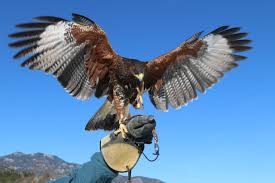
Not if it’s linked to chicken eggs.
Maybe there’s some merit to the controlling-the-wild-with-the-trained approach, but in the absence of falcon diapers (as Don Schaffner suggested on Twitter) what’s the risk benefit tradeoff related to adding falcon poop into the mix. Maybe vaccination is the key (but I don’t know).
Wildlife biologist Paula Rivadeneira knows feces can be funny. Informally known as Paula the Poop Doctor (@PaulaThePoopDr on Twitter), she’s no stranger to the poop-based pun. Her SCATT lab—that’s Super Cool Agricultural Testing and Teaching lab to you—is a mobile research center inside a bus-sized RV, one she uses in Arizona’s crop fields to makes scat (animal droppings) scat (go away). But she also knows when poop stops being funny: if it gets into the food supply.
Which is where Rivadeneira comes in. As a specialist for the University of Arizona’s cooperative extension, it’s her job to find new ways to keep crop fields safely poop-free. Recently, she’s been at the forefront of a surprising new food safety initiative, one that—somewhat counterintuitively—entails bringing more birds onto agricultural lands. Rather than barricade, poison, or blast interlopers away, she’s helping farmers police their fields with the aid of an unusual ally: trained falcons.


 adicionales donde dichas pestes pueden esconderse y proliferar.
 meat to give to her dog. She then noticed the cockroach.
.jpg) Arthur Allen, a Washington writer and the author of "Ripe: The Search for the Perfect Tomato" (March 2010, Counterpoint), writes that whatever our politics, we increasingly eat from a communal kitchen.
Arthur Allen, a Washington writer and the author of "Ripe: The Search for the Perfect Tomato" (March 2010, Counterpoint), writes that whatever our politics, we increasingly eat from a communal kitchen. .jpg) Based on its evolutionary tree, scientists think that O157:H7 probably has existed for hundreds or even thousands of years. But it hadn’t been noticed in our food supply until 1982, when a small-town doctor in Oregon reported to the CDC that he’d seen a group of patients with bloody diarrhea. Another group got sick with the same symptoms in Michigan a little later. All had eaten hamburgers at McDonald’s, said Michael Doyle, director of the Food Safety Center at the University of Georgia (left, exactly as shown).
Based on its evolutionary tree, scientists think that O157:H7 probably has existed for hundreds or even thousands of years. But it hadn’t been noticed in our food supply until 1982, when a small-town doctor in Oregon reported to the CDC that he’d seen a group of patients with bloody diarrhea. Another group got sick with the same symptoms in Michigan a little later. All had eaten hamburgers at McDonald’s, said Michael Doyle, director of the Food Safety Center at the University of Georgia (left, exactly as shown)..jpeg)
 The surprised diners were refunded and the company apologized in a statement for any distress caused by the fallen mice.