An Oregon City man who told a government hotline last summer his mother had been harmed by bottled water has pleaded guilty to making a false report of consumer product tampering, a federal crime that carries a potential five-year prison term.
He may have been stoned.
The Oregonian reports Curtis A. Purdy, 34 (right, exactly as shown), acknowledged in court papers that he lied last summer to the U.S. Food and Drug Administration’s Consumer Complaint Line about how his mother came to be injured after drinking a bottle of Crystal Geyser water.
Purdy reported to the FDA hotline on Sept. 1 that the water, purchased from an Albertson’s grocery, had caused burns to his mom’s mouth, throat and stomach and that she had vomited and suffered diarrhea, according to a criminal complaint affidavit.
He later told investigators that he had put in the bottle some rubbing alcohol, which he kept around to clean his marijuana pipes. His memory of the incident was hazy, according to the complaint, because he was undergoing opiate withdrawal.
Sorenne’s school is doing the hatching-chicks-thing in anticipation of Easter (which is a surprisingly big deal in Australia) and I’ve been doing my best Dougie-Downer about handwashing, Salmonella, pestilence and death.
In the northern Hemisphere, this is apparently the start of the petting farm season (didn’t have that one penciled in), so the UK Health Protection Agency is reminding people, especially those with responsibility for young children, to enjoy their farm visits safely by ensuring good hand hygiene after touching farm animals or their surroundings.
Outbreaks of gastrointestinal illness associated with contact with farm animals peak in the spring and summer as this coincides with schools holidays when visits to petting farms tend to be more popular, although outbreaks can occur at other times.
The route of transmission in these illnesses, which include the infections E. coli O157 and Cryptosporidium, is direct contact with animals in petting and feeding areas as well as contact with the droppings of animals on contaminated surfaces around farms.
Dr Bob Adak, head of the gastrointestinal diseases department at the HPA, said, “… hand gels or wipes have their uses in areas that are generally clean, such as offices or hospitals, but they are not effective in completely removing from soiled hands bugs such as E. coli or Cryptosporidium that are commonly found in animal droppings and on contaminated surfaces around farms. This is why washing the hands thoroughly with soap and water is so important – it is the only way to effectively remove the bacteria and reduce the risk of becoming unwell.”
Figures from the HPA’s national surveillance system show that there were 61 outbreaks of gastrointestinal illness associated with farms visits between 1992 and 2011. Twenty two of these outbreaks (36 per cent) occurred in the last three years (2009-11).
Around half were caused by E. coli O157 and around half were caused by Cryptosporidium. A handful were caused by Salmonella. Overall 1,238 people were affected in these outbreaks – 1,003 people with Cryptosporidium and 235 with E. coli O157.
The latest entry to our food-related 911 Hall of Shame is Donna Marie Nichols of Rockwood, Tennessee (right, exactly as shown) who called 911 twice to complain about a substandard fast food hamburger.
In one call, obtained by the website The Smoking Gun, Ms Nichols, 50, tells the 911 dispatcher that the burger is "no good" and "nasty."
When deputies arrived at her home, she said that she had called the restaurant before she called 911 and the manager had offered her a refund for her food, according to WCRB.
She was arrested on abuse of 911 charges and booked into the Roane County Jail. She was released Monday night.
Previously, customers have been popped for calling 911 to register dismay about Burger King lemonade, McDonald’s McNuggets, and pizza.
Selfridges, the British concern that makes raw milk available from public vending machines, has decided to stop that, after the Food Standards Agency launched an investigation into whether the practice is legal.
The London Standard reports that shops in England and Wales are not allowed to stock raw milk due to the threat of salmonella, E. coli and campylobacter — but since December, Selfridges has got around the ban by allowing Longleys Farm in Hailsham, East Sussex, to sell the product from dispensers in its food hall.
Selfridges said customers should have the choice, but it would honor any “newly clarified rules.”
Chinese officials say they have arrested more than 100 people suspected of making "gutter oil," illegal cooking oil made from waste and sold to restaurants.
In a food safety crackdown, 13 underground workshops were shut down and more than 3,584 tons of "gutter oil" were seized, the official Xinhua news agency reported.
"Gutter oil" is made by taking used up cooking oil, often left over from restaurants, along with spent animal fat, and reprocessing it into edible oil to be sold to restaurants.
Investigators found suspects used not only waste fat and oil, but also fat from rotten meat and slaughterhouse waste.
Bell have been forced to recategorise the performance on Wednesday 4 April as a preview performance for family and friends after cast members Dan Spielman (Macbeth), Ivan Donato (Macduff) and Robert Jago (Malcolm) as well as Assistant Director John Kachoyan all contracted severe food poisoning. Two of the group had to be admitted to hospital as a result of their illness, with the other two members bed-ridden for several days.
Other opening night guests will be contacted and moved to another performance next week, with the season set to commence as planned on Thursday 5 April.
The downgrading of the show’s Opening Night follows the cancellation of the first three previews of the production, that had been scheduled for Friday 30 March, Saturday 31 March and Sunday 1 April.
Bell Shakespeare General Manager, Christopher Tooher said in a statement that “the condition of the four affected Company members is being constantly monitored. All are now showing significant signs of improvement and we aim to go ahead with a preview tomorrow night, with a second preview now scheduled for Wednesday 4 April.
"We are currently working with the NSW Food Authority regarding the source of the food poisoning."
Today I spent a couple of hours with some new family and consumer science extension agents talking about the history of food safety, how risk is calculated and how messages should be based on data – not conjecture. We talked about why the FDA model food code provides guidance on a specific water temperature for handwashing (100F/38C). It’s mainly because folks might be more likely to wash hands when water is warm (except no one can point to that in the literature), that fat is more soluble and soap lathers better. But some research has shown that temperature isn’t a factor in pathogen removal at all (which is the desired outcome of the action).
One of the agents asked me how something like that gets into and stays in a regulatory document and I responded by saying "It probably seemed like a good idea to someone, and it stuck."
I feel the same way about the discussion about the safety of reusable bags.
The Academy of Nutrition and Dietetics has put out a press release saying that reusable bags need to be washed regularly by users as pathogens grow well and cross-contamination is likely.
From the release:
Reusable grocery totes are a popular, eco-friendly choice to transport groceries, but only 15 percent of Americans regularly wash their bags, creating a breeding zone for harmful bacteria, according to a survey by the Home Food Safety program, a collaboration between the Academy of Nutrition and Dietetics (formerly the American Dietetic Association) and ConAgra Foods.
“Cross-contamination occurs when juices from raw meats or germs from unclean objects come in contact with cooked or ready-to-eat foods like breads or produce,” says registered dietitian and Academy spokesperson Ruth Frechman. “Unwashed grocery bags are lingering with bacteria which can easily contaminate your foods.”
Sort of.
Williams and colleagues (2011) have published the only peer-reviewed study on the microbial safety of reusable bags and tested growth of Salmonella in 2 batches. They spiked the bags with 10^6 cfu and let them sit in the trunk of a car for 2 hours. One of the batches, where the temperature reached 47C/117F, showed a one-log increase in the Salmonella. The other batch, where the temperature reached 53C/124F, there was a one-log reduction. That data doesn’t show just a breeding zone – it shows they can be a killing zone too (and I’m not sure how realistic a 10^6 contamination really is).
The part of the press releases that is the least rooted in science is that pathogen-containing bags "easily contaminate your foods." The same Williams study showed generic E. coli is floating around in bags, recoverable in 12 % (n=58) of those tested but can it be (or is it likely) to be transferred to any ready-to-eat foods, or somehow to food contact surfaces in the home?
Just because the bacteria might be there, doesn’t mean it can contaminate a ready-to-eat food. No one has presented data to support that. Maybe the Academy of Nutrition and Dietetics – if so, they should share it.
In a cross-contamination event there is a dilution effect when it comes to transfer. 1000 cfus of Campylobacter on the outside of the package of raw chicken might become 100 cfus when transferred to the bag, and then only 10 cfus when transferred to ready-to-eat apples.
Washing bags frequently (as the Academy of Nutrition and Dietetics suggests) is probably a good idea (like washing hands in warm water) and probably won’t increase risk, but I wonder how much it decreases the probability of cross-contamination when compared to doing nothing.
The British Columbia Centre for Disease Control (BCCDC, that’s in Canada) is warning the public not to consume Tomme d’Or cheese manufactured by Moonstruck Organic Cheese located on Saltspring Island. Other types of cheeses produced by Moonstruck Organic Cheese are not affected by this advisory.
This health alert is the result of a routine sampling program by the BCCDC and further investigation by the manufacturer which revealed that samples of the finished products contained Listeria monocytogenes. Affected products include all lot numbers of Tomme d’Or cheese. In order to ensure the health and safety of consumers, a photo of the product is provided below so the public can easily identify the product. The manufacturer is fully cooperating and assisting with the investigation.
This product was sold at various retailers throughout British Columbia, and anyone who may have purchased this recalled cheese should not consume it, and discard or return it to their place of purchase. The BCCDC is concerned that this cheese product may still be in the homes of consumers as these cheeses can be stored and consumed well beyond the product’s best before date. Listeria, if present, will grow to high numbers even if the cheese has been stored in the refrigerator. Food contaminated with Listeria monocytogenes may not look or smell spoiled.
Currently there are no illnesses linked to this product.
The Australian Food Network reports a notable rise in the number of cases of Cryptosporidium in the Northern Territory has prompted the state government to urge Territorians to practice good hygiene and food safety practices.
According to the Northern Territory Government, 114 cases have been reported so far this year.
Director of the Centre for Disease Control, Dr Vicki Krause, said this is more than twice the number of expected gastroenteritis cases this year caused by the Cryptosporidium parasite.
Dr Krause said, “The current hot and humid weather is providing the perfect conditions for the bug to thrive and we are expecting to see more cases.
“It’s important that infected people don’t prepare or handle food or drinks that will be consumed by others,” she said.
In the 2001 film K-Pax, the would-be alien played by Kevin Spacey comments to psychiatrist Dr. Mark Powell (no relation) played by Jeff Bridges, the bestest greatest actor in the world, “Your produce alone has been worth the trip.”
(For a while I thought maybe I had some mysterious role in the film or book’s creation, being a Dr. Powell, and the tragic set-up for the plot occurring in Guelph, Texas, but then Amy reminded me that not every movie is about me, or us).
The Packer reports that a recent Big Apple conference was told to go to where the food bloggers, recipe writers, cookbook authors and cooking school teachers are and wow them with a product and message. It turns into fodder for blogging, tweeting, experimenting and developing.
Conference organizers incorporated New York’s publishing offerings into the program by scheduling media tours, one to the test kitchens of Meredith Corp., which publishes Better Homes and Gardens, Family Circle, Ladies Home Journal and Every Day With Rachael Ray magazines. With the magazine food editors present for the tour, Rodger Helwig, marketing specialist with California Vegetable Specialties, Rio Vista, Calif., found the opportunity to inform them of endive, getting agreement from each editor to receive a box to experiment with — something he was unable to accomplish by phone, he said.
The Australian limes are outstanding this time of year, and I incorporate them into every meal. Still waiting in Brisbane.

 mother came to be injured after drinking a bottle of Crystal Geyser water.
.jpg) although outbreaks can occur at other times.
although outbreaks can occur at other times. the manager had offered her a refund for her food, according to WCRB.
 by allowing Longleys Farm in Hailsham, East Sussex, to sell the product from dispensers in its food hall.
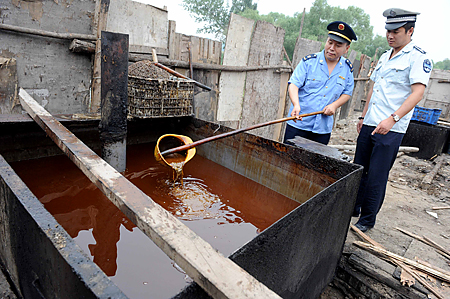 "Gutter oil" is made by taking used up cooking oil, often left over from restaurants, along with spent animal fat, and reprocessing it into edible oil to be sold to restaurants.
 the group had to be admitted to hospital as a result of their illness, with the other two members bed-ridden for several days.
.jpg)
 Affected products include all lot numbers of Tomme d’Or cheese. In order to ensure the health and safety of consumers, a photo of the product is provided below so the public can easily identify the product. The manufacturer is fully cooperating and assisting with the investigation.
 Currently there are no illnesses linked to this product.
 Director of the Centre for Disease Control, Dr Vicki Krause, said this is more than twice the number of expected gastroenteritis cases this year caused by the Cryptosporidium parasite.
 movie is about me, or us).