Needle or blade tenderized steak continues to raise safety concerns

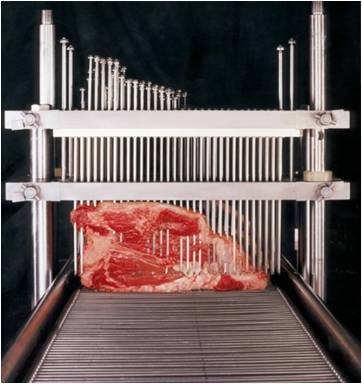
It’s an important day for food safety types because new research shows E. coli O157:H7 can enter beef cuts like steak during mechanical or blade or needle tenderization, as it’s called.

The idea is that small needles are inserted into steak to inject tenderizers. All hamburger should be cooked to a thermometer-verified 160F because it’s all ground up – the outside, which can be laden with poop, is on the inside. With steaks and roasts, the thought has been that searing on the outside will take care of any poop bugs like E. coli and the inside is clean. But what if needles pushed the E. coli on the outside of the steak to the inside?

Previous work has shown similar results, and the new research in the Journal of Food Safety confirms that E. coli O157:H7 can enter the interior of beef cuts like steaks during the tenderization process. The new work does not assess whether cooking on a grill can kill off the internalized bacteria but does refocus attention on a lingering food safety issue, almost one year after an E. coli O157:H7 outbreak in needle tenderized beef sickened at least 21 people in 16 states.

Luchansky et al. wrote in the July 2009 JFP that based on inoculation studies, cooking on a commercial gas grill is effective at eliminating relatively low levels of the pathogen that may be distributed throughout a blade-tenderized steak.

Quantitative analysis of vertical translocation and lateral cross-contamination of Escherichia coli O157:H7 during mechanical tenderization of beef
30.nov.10
Journal of Food Safety
Lihan Huang, Shiowshuh Sheen
http://onlinelibrary.wiley.com/doi/10.1111/j.1745-4565.2010.00273.x/abstract
ABSTRACT
Quantitative vertical translocation and lateral cross-contamination of Escherichia coli O157:H7 during mechanical tenderization of beef meat were investigated using a restaurant-style meat tenderizer, which was first used to tenderize a surface-inoculated sample, and then an additional four uninoculated samples. It was observed that the vertically translocated bacteria (in log10 cfu/g) was directly proportional to the logarithm of the tenderization depth, with an average translocation coefficient of 3.14 ± 0.66 log10 cfu/g per log10 mm of depth. For lateral cross-contamination, the bacterial counts recovered from the top layers of the first four pieces of meat decreased by approximately 0.5 log10 cfu/g after each tenderization. There was no decrease in the bacterial counts recovered from the top layers after the 4th tenderization. More tenderization studies were needed to quantitatively analyze the trend of lateral cross-contamination. However, it is evident that both vertical translocation and lateral cross-contamination can occur during mechanical tenderization of meat.
PRACTICAL APPLICATIONS
Foodborne illnesses caused by consumption of undercooked non-intact beef meats contaminated with Escherichia coli O157:H7 are an emerging public food safety concern as evidenced by a major outbreak recently. This study investigated both vertical translocation and lateral cross-contamination of E. coli O157:H7 during mechanical tenderization of beef. The results from this work can aid quantitative assessment of risks caused by non-intact beef meats.

Crypto crime probe in Sweden

Police said today a criminal investigation is under way in Sweden to determine how an intestinal parasite ended up in the town of Ostersund’s municipal water supply, sickening more than 2,000 residents.

Environmental prosecutor Christer B. Jarlas said release of the parasite cryptosporidium may have been the result of criminal negligence, the Swedish news agency TT reported Tuesday.

He said he has reason to believe that the contamination was due to carelessness by one or several individuals who didn’t have control of their operations.

Sweden’s National Center for Infectious Disease Control told TT the 50,000 residents of Ostersund will have to boil their water for several weeks.
 

Scores on Doors was a better name: UK launches National Food Hygiene Rating Scheme

The U.K. Food Standards Agency (FSA) is today launching a national food hygiene rating scheme that will help consumers choose where to eat out or shop for food by providing information about the hygiene standards in restaurants, pubs, cafes, takeaways, hotels, supermarkets, and other places.

You can search for food businesses and their hygiene ratings at food.gov.uk/ratings.

As more local authorities roll out the scheme over the coming months, more ratings will be published online.

The bright green and black food hygiene stickers showing a rating from zero to five will soon be a feature of shopping centres and high streets, as the FSA, in partnership with local authorities, rolls out its Food Hygiene Rating Scheme (FHRS) across England, Wales and Northern Ireland. The aim is to reduce the one million cases of food poisoning suffered by people each year (I prefer the one in Welsh, upper right).

At the top of the scale is ‘5’ – this means the hygiene standards are very good. At the bottom of the scale is ‘0’ – this means urgent improvement is required. A different scheme, with similar aims, is being rolled out by local authorities in Scotland.
Questions remain for the U.K. system: why numbers; is the scoring system based on actual food safety hazards; what research guided FSA in these decisions; will it ever be published? And the color. What’s with the puke green?

What happens in Vegas (restaurants) is now available on-line

What’s one of the most requested types of public record maintained in Las Vegas? Food establishment inspections.

Today, the Southern Nevada Health District announced it was posting inspection reports on its website, giving people a look at how their favorite eateries have been graded and which received the most demerits from inspectors.

Violations are listed on the site, such as inadequate plumbing or poor pest control.

FOX 5 News reports a quick search showed that more than 10,900 of the 11,245 establishments listed have been given an “A” following their last inspection.

The list includes bars and restaurants, as well as grocery stores and retailers.

The launch of this new feature allows the public to view health inspections for all permitted food establishments in Clark County and is available at www.SNHD.info.

Information provided on the site includes inspection reports for all food establishments with active health district permits and archived reports as far back as 2005.

These records provide a snapshot of the day and time of the inspection and new reports are posted within five business days of when they are completed. Food establishments are inspected annually or more often if it is deemed necessary. Risk factors that have the potential to contribute to foodborne illness are more heavily weighted in the inspection demerit process than items related to design, maintenance or general sanitation.

Inspection findings can result in an “A” grade, a downgrade to a “B” or “C” status, or for an extremely excessive number of violations or an uncontrolled imminent health hazard, a facility closure.
 

Cryptosporidium outbreak sickens thousands in Sweden

UPI reports that cryptosporidium in the water supply has sickened more than 2,000 people in the city of Ostersund, in northern Sweden.

The source of the contamination is unknown.

It is feared 3,000 to 9,000 people may be infected.
A warning to boil tap water was issued Friday and renewed Monday.

Several members of Sweden’s biathlon team, training in Ostersund for an international competition in the city, have come down with symptoms.
 

Mason’s mum: change the law

When a coroner ruled last week a lack of food hygiene standards at a Welsh butchery was the cause of 5-year-old Mason Jones’ death but there was insufficient evidence to prove “a serious and obvious risk of death,” Sharon Mills was stunned.

Mason’s mum told Abby Alford of Wales online,

“To me this is a travesty of justice.”

Ms Mills, 36, from Deri, near Bargoed, said she and partner Nathan Jones, Mason’s father, are considering calling for a change in the law which meant Bridgend butcher William Tudor – the man responsible for the 2005 outbreak during which more than 150 people were infected with potentially deadly E. coli O157 – escaped a manslaughter charge.

Last week’s verdict followed a decision by the Crown Prosecution Service in 2007 not to pursue a manslaughter case because there was not a realistic prospect of conviction.

“Last Thursday after the inquest I woke up and I felt like I had lost Mason all over again. It’s been us versus the system and it’s a hard system to beat.”

Ms Mills said despite the support of some officials, she believes the pace of change in improving food safety systems has been painfully slow following the 24 recommendations for improvement put forward by expert Professor Hugh Pennington after the public inquiry.
 

Claire and Vikki vomit during Amazing Race food challenge

Amy likes the television show, The Amazing Race.

I don’t, and play on my computer while sitting with her after Sorenne has gone to bed.

I did look up this evening as a couple of contestants yakked while consuming vast amounts of Honk Kong food in an attempt to identify one of the five plastic food replicas on the buffet tray. Nice sound effects.

Our marriage is solid.

Real-time turkey – forget that, stock is on the stove, hockey in Wichita

By Saturday morning after the Thursday Thanksgiving feast, the turkey frame and whatever else had been reduced to turkey-flavored stock. I left the stock in the fridge for the fat to separate, and Amy, Sorenne and I went to Wichita, Kansas for an adventure weekend – a hockey game.

From what I can figure, there’s the National Hockey League (NHL, the pros), the American Hockey League (AHL, farm teams to the NHL), and then feeder semi-pro leagues like the Central Hockey League, where the Wichita Thunder ply their trade. 18 of the 22-member roster hails from Canada.

The game was reasonably entertaining, although the intensity level varied dramatically.

Aspects of a hockey game in Wichita:

• in honor of the birthday of late, great guitarist Jimi Hendrix, the Star Spangled Banner was performed Hendrix-style by a local dude;

• the brand-new In Trust arena in downtown Wichita was an outstanding venue, with sparkling restrooms and excellent handwashing facilities;
• there is a dance squad associated with the team called the Lampton Lightening, sponsored by Lampton Welding, and they performed after the second period (left);

• even though it is Manvember – the month of November is supposed to represent manliness at its peak, so no shaving – there were more bad moustaches on the players than the cast of a 1970s porn movie; and,

• not a single fight. I was expecting Slap Shot style goon hockey. It wasn’t bad. Wichita beat first-place Colorado 5-3.

Tonight, it’s turkey stock stew.

How not to handle foodborne illness: ‘put an adult diaper and get back to work’

Food service employees working while sick is a recurring theme in restaurant-related outbreaks.

Add this scenario:

An outbreak of diarrhea has decimated the staff of a Tex-Mex restaurant and Godfrey the manager, is on the phone imploring a staff member to come in anyway, even if that means wearing an adult diaper.

“Astronauts wear them. Do you think you’re better than an astronaut?”

The scene is from an upcoming Canadian movie called Servitude, and like the best comedy, has an element of truth.

Godrey is being played by Kids in the Hall/News Radio alumnus, Dave Foley. He’s one of the French fur trappers in the bit below.

Dominos fined $120K over cockroaches, bad hygiene in Sydney

ABC News reports a Dominos pizza shop in Sydney’s west has been described as having committed one of the worst breaches of food safety and hygiene in the Australian state of New South Wales.

The store in Quakers Hill has been fined almost $120,000 after investigations by the state’s Food Authority, following reports from customers who suffered food poisoning.

Primary Industries Minister Steve Whan says conditions inside the store were appalling, stating,

"They had evidence of significant infestation of cockroaches and also very poor hygiene of cleanliness habits. I’m told by our experts at the Food Authority that they’re a prime candidate for spreading foodborne illnesses and that’s why they’ve been given such a big fine. There are always people who don’t do the right thing unfortunately and we need to make sure that we can protect people from foodborne illnesses. Things like food poisoning are not insignificant. There are people every year who die of food poisoning and food-related diseases."