
Don Sapatkin of the Philadelphia Inquirer has been writing for at least a year about deficiencies in the antiquated Philly system and that even with improvements in inspections, most food establishments don’t publicize even their most positive inspection reports, and no government in the  Philadelphia region requires that they be tacked up for easy viewing like a menu.
Last week, Sapatkin turned his investigative focus to Philadelphia’s hospital kitchens, and found they were far more likely than food establishments as a whole to be out of compliance with food-safety regulations, averaging six violations apiece in their most recent quarterly inspections by the city health department.
The Hospital of the University of Pennsylvania, routinely named among the nation’s best medical centers, was cited 14 times. The largely organic kitchen at Cancer Treatment Centers of America’s Eastern Regional Medical Center in the Northeast had eight violations.
 And in New Jersey, Virtua Memorial Hospital in Mount Holly was rated "conditional satisfactory" after inspections in November and last month found several violations.
"Many live German cockroaches observed on or at base of wall in dish-washing room, dead roaches observed under shelving in paper storage, next to ice machine, and behind refrigerator in vegetable prep area," a Burlington County health department inspector wrote June 28.
All three hospitals said the violations had been quickly corrected.
Food generally isn’t considered when patients choose a hospital. Yet a review of inspection reports from around the region found scores of violations, as well as wide variations in what was cited from county to county. Some evidence suggests that the scrutiny is more rigorous in the city.
Inspections are a far-from-perfect measure of risk: Inspectors found nothing amiss before or after an outbreak sickened 54 people and killed three patients at a Louisiana state hospital in May. And experts say most hospital kitchens go overboard with food safety, cooking so thoroughly to kill microbes that flavors may be lost.
Sheri Morris, food program manager at the Pennsylvania Department of Agriculture, which regulates restaurants and stores but not hospitals, said,
 "Anybody who has a compromised immune system is going to be more susceptible to food-borne illness. And hospitals are full of people with compromised immune systems.”
Since inspections are a snapshot of a constantly changing kitchen, they have limited ability to predict either safety or danger. "Just because you went in there and the place had no violations doesn’t mean that 15 minutes later the place didn’t go to pot," said Dennis J. Bauer, food-safety coordinator for the Bucks County Health Department.

 boroughs.
 "If you don’t have hand towels in your restroom that’s points off. We don’t like it but we’ve learned to live with it."
 According to a national survey conducted for NPR by Thomson Reuters and released today, 61 per cent are concerned about contamination of the food supply. Most of them — 51 per cent — worry most about meat.

 The company announced a recall
 Acting on a tip from a "confidential informant", a pat-down search on Plank after he arrived at Los Angeles international airport last November on a United Airlines flight originating in Sydney found two money belts strapped to his chest containing two geckos, two monitor lizards and 11 skinks worth more than $US8500 ($A9400).
 Press Association reports
 sure this does not happen again."
 characterizations. These changes were often the result of efforts to revive interest in a show whose audience had begun to decline, usually through the employment of different actors, writers or producers.
 We’ve done this before, but now there are a couple of public health students interested in doing some formal work to decrease the risk of dangerous bugs passing from animals to humans, or humans to animals, so we introduced them to the petting zoo/fair concept, and the hygiene measures available.
 In 1999, 159 people, mainly children, were sickened with E. coli O157:H7 traced to goat and sheep at the 1999 Western Fair in London, Ontario
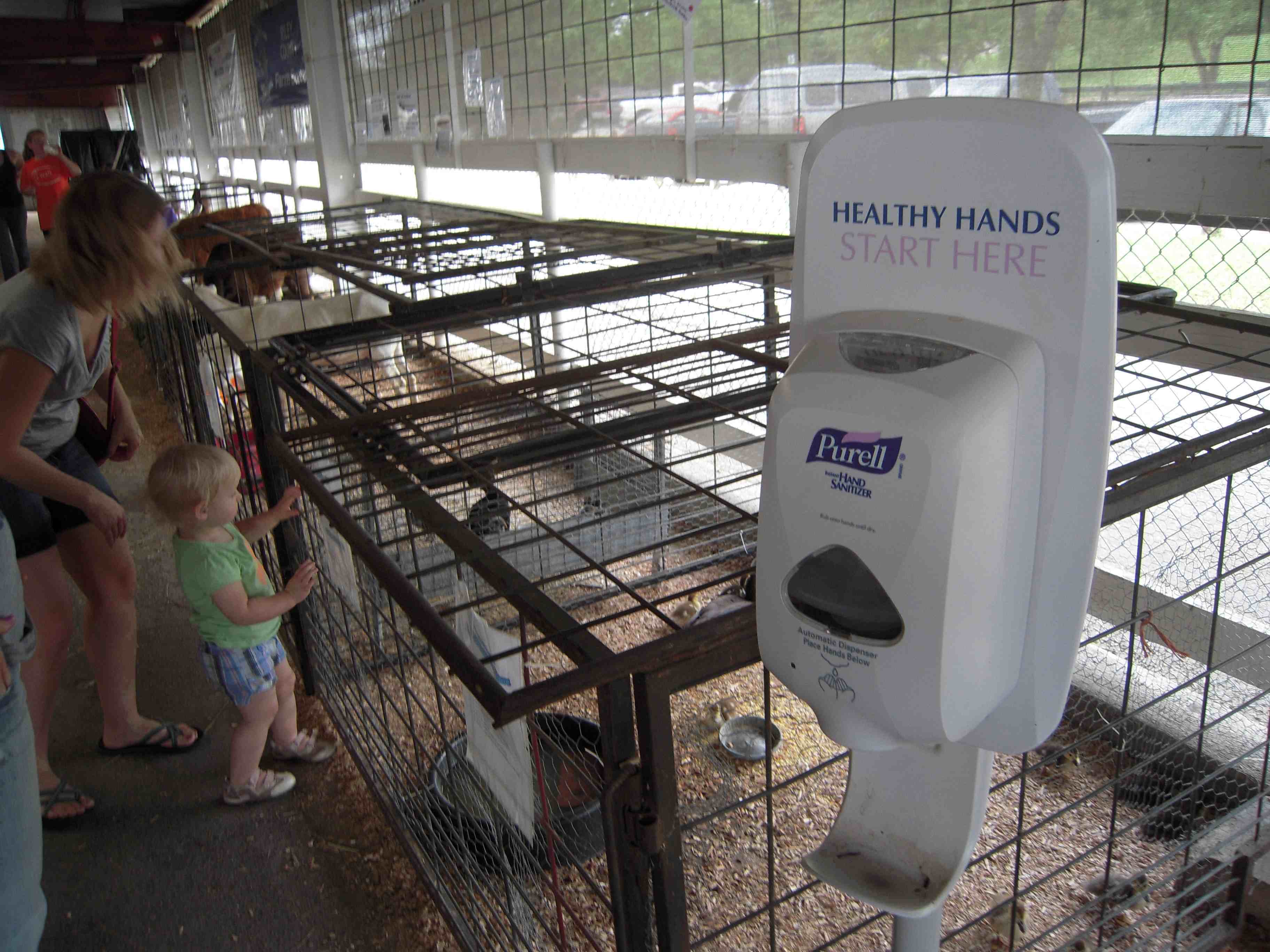 So, how best to motivate fair managers to provide petting zoos that are microbiologically safe? Should the urban public be allowed to interact with livestock at all? Should petting zoos be inspected, as restaurants are, and the results displayed? We’ll be looking, and hoping that Bubba improves. Bubba has his own Facebook page at
 So it seems reasonable to have some minimal training for those who prepare food for public consumption.
 Mr al Reyaysa’s comments came after the release of a wide-ranging annual report, which detailed the agency’s programmes, draft laws, financial status and the total number of inspections and food establishment closures last year.
 AOL decided to track a single airline meal,
 5:30 a.m. Chef Danielle Nahal and her team of eight to 12 cooks and food handlers, arrive at Gate Gourmet to begin the day’s preparations. The kitchen will be making lots of meals today for flights to London, Asia, Amsterdam and Paris, so the prep work covers 250-300 servings of each entrée. Though the kitchen is very large, it is also very busy and crowded. Nearly 300 people work on a shift, and the kitchen runs 24 hours a day, seven days a week.
 aircraft. The meals fit into a refrigerated compartment. It will take the driver about 30 minutes to get to the aircraft, then another 45 minutes to an hour to load the meals onto the plane.