Best Breakfast in Kansas

I’m a sucker for Sunday brunch, especially if a good Bloody Mary is involved. On more than one occasion we’ve thought of trying The Chef café in downtown Manhattan (Kansas). But each time we see the line stretching out the door and down the block, we decide to take our small child somewhere without a wait. Today “Downtown Manhattan, Inc.” shared on Facebook that The Chef was rated the best breakfast in Kansas by the Food Network. The story says The Chef makes its own chorizo for their frittatas, which appear to be amply cooked, but chorizo should be handled with care to avoid food safety risks (see http://chowhound.chow.com/topics/454431 for a lively discussion). While I’d vote for Doug’s cooking as the best breakfast in Kansas, the next time Sorenne wakes up at 5 a.m. on a Sunday, we just might be first in line.

UN Food and Ag Organization endorses One Health

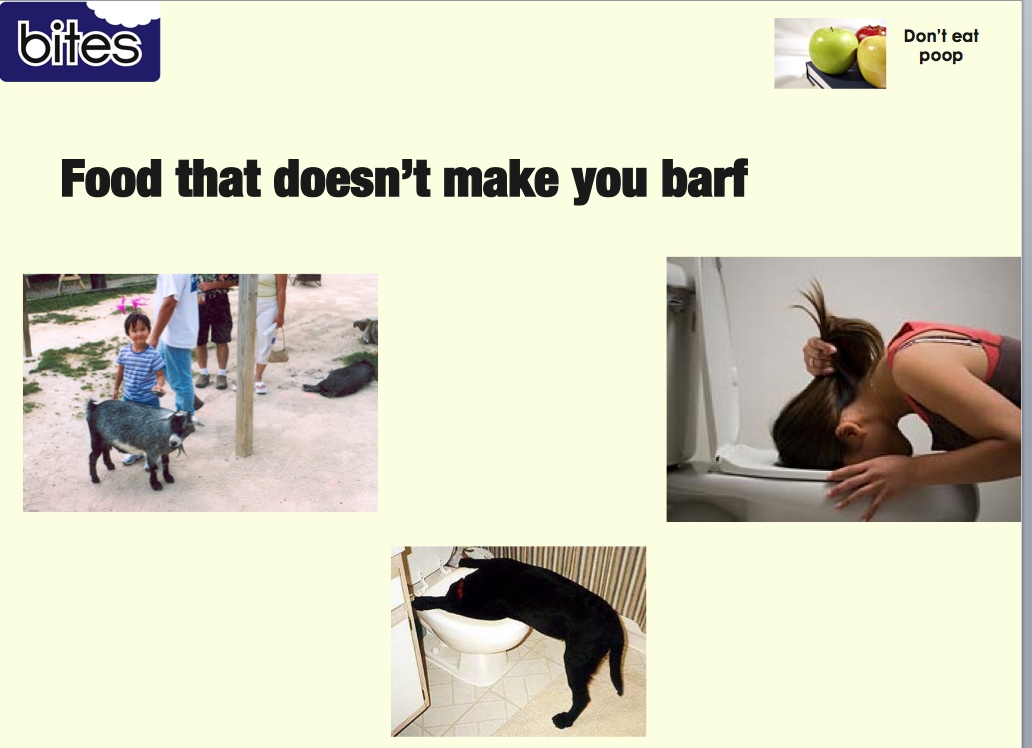
Safe food is food that doesn’t make people barf. Or animals.

That’s the essence of One Heath. Things that make people and animals sick.

The American Medical Association and the American Veterinary Medical Association have approved resolutions supporting ‘One Medicine’ or ‘One Health’ that bridge the two professions. Rudolf Virchow, the Father of Modern Pathology, and Sir William Osler, the Father of Modern Medicine, were outspoken advocates of the concept, which was re-articulated in the 1984 edition of Calvin Schwabe’s Veterinary Medicine and Human Health.

Today, the Food and Agriculture Organization of the United Nations said governments could save billions of dollars by stepping up the prevention and control of high impact animal diseases, some of which pose a direct threat to human health.

?Many other animal diseases have a negative impact on people’s livelihoods. Pandemic influenza viruses H5N1 and H1N1, foot-and-mouth disease, Rift Valley fever, and rabies are among the more recent disease outbreaks.

Land use, ecological dynamics including climate change, and expanding trade and trade routes are all posing new challenges to animal disease prevention and control, the UN agency warned.

These emerging threats are also related to increased urbanization and strongly growing urban demand for meat, milk and eggs. A rapid increase and intensification in poultry, production in East Asia translated into a five-fold increase in duck meat output between 1985 and 2000. In 2008, over 21 billion animals were produced for food globally, a figure expected to rise by fifty percent by 2020.

FAO, in partnership with the World Organisation for Animal Health and the World Health Organization has adopted a One Health strategy to more effectively detect and combat these new pathogens.

Drawing on the agency’s experience in past animal health emergencies, the One Health initiative aims to make a key contribution to the global response to disease outbreaks, implementation of effective prevention and containment strategies and management of risks of disease emergence, including improving knowledge of disease-emergence drivers in livestock production and in associated ecosystems.

Special attention of the programme is given to risk communication at all levels of action.

Don’t crap where you eat

Sometimes, for mental floss, I check out the blog, It Was Over When: Tales of Romantic Dead Ends. Today’s post came from Michelle.

I prepared a nice meal for my husband. He was hungry but also had to poop. So, he took his plate into the bathroom and ate it while he was pooping. To this day I cannot eat ham.

— Michelle

Aftermath: Divorce.
 

Nosestretcher alert: Organic Trade Association tells FDA organics a national model for food safety

Thanks to Tom Karst of The Packer for taking the time to read submissions to the U.S. Food and Drug Administration as the agency contemplates preventative controls for fresh produce.

Christine Bushway, Executive Director of the Organic Trade Association (OTA) says “organic agriculture is the most highly regulated system of agricultural production in the U.S., and the USDA-accredited verification system, especially its recordkeeping and inspection requirements, should be recognized and considered by FDA when drafting rules requiring similar features.”

Lots of record-keeping does not mean lots of food safety.

Bushway also says, “the organic system offers an integrated process approach to preventive food safety practices that could stand as a national model for both farming and manufacturing operations. The organic process already contains many steps that contribute to food safety processes and it can be easily integrated into a more elaborate food safety system – especially in processing.”

That’s true, and we said as much back in 2004 (see below). But why is it up to everyone else; why don’t organic processes expand so they can be considered a more rigorous or even certifiable food safety program?

The potential for microbial contamination along the food production chain exists for both conventional and organic food products. Water quality, soil amendments such as composted manure and general sanitation need to be monitored and verified in any food production system. Organic certification is not a food safety certification.

Microbial food safety considerations for organic produce production: an analysis of Canadian Organic Production Standards compared with U.S. FDA guidelines for microbial food safety,” by K.A. Blaine and D.A. Powell. Food Protection Trends 24, no. 4 (2004): pp. 246-252.

Increased attention has been focused on fresh fruits and vegetables, especially raw or minimally processed, as a significant source of foodborne illness. Outbreaks have been linked to both conventionally and organically grown produce. This paper outlines the risks associated with fresh produce, common pathways of contamination, and current trends in organic agriculture. The primary objective was to determine whether the Canadian General Standards Board (CGSB) organic standard is consistent with the production of microbiologically safe produce and to examine the potential for the CGSB organic standard to include considerations for microbial food safety. This objective was achieved by examining information gaps between the US Food and Drug Administration on-farm food safety guidelines and the organic standard developed by the CGSB. This examination showed a significant degree of commonality and, in some cases, it was demonstrated that microbial food safety standards are achieved indirectly under organic production. The main difference between the U.S. guidelines and the CGSB standard is the focus on the process rather than the safety of the final product,and the lack of discussion of microbial considerations in the CGSB standard. Specific omissions include worker hygiene and recommendations for safe use of processing and irrigation water. The production of safe food is the responsibility of everyone in the farm-to-fork chain. With established relationships between growers and regulatory infrastructure, the CGSB organic standard would be an ideal vehicle for providing organic growers with information and guidelines on identifying and controlling microbial hazards on their produce.
 

Government’s still not that into you; target food safety efforts using pocketbook power

There’s a wonderful moment of clarity in the 2004 biopic, Bobby Jones: Stroke of Genius, depicting the famed golfer’s first trip to the British Open at St. Andrews in 1921, where he withdrew in frustration. His caddy, Angus, says,

“Do you know the definition of insanity Bobby? It’s when you do the same thing over and over and expect a different result.”

Bobby Jones was trying to hit a ball out of a sand trap; lots of well-meaning people are trying to improve food safety in the U.S. by focusing on the federal government, but the ball keeps rolling back into that pot-bunker.

Latest to the plate is Eric Schlosser, the author of Fast Food Nation, who wrote in the New York Times Sunday,

“if the Senate fails to pass the food safety legislation now awaiting a vote, tens of thousands of American children will become needlessly and sometimes fatally ill.”

Whether the Senate acts or not will have little effect on kids barfing from dangerous food.

Schlosser roles out the standard fairtytales about Upton Sinclair and the role his book, The Jungle, had on inspiring The Pure Food and Drug Act of 1906, but food safety was improving in previous decades, driven largely by the same two factors driving global food safety improvements today – technology and trade.

Something the Chinese are now discovering.

Most food purchases are based on faith. That’s why an extensive series of rules, regulations and punishments emerged beginning in 12th century Mediterranean areas, long before Upton Sinclair came along. But who knows if the rules actually make a difference.

Big or small, local or global there are microbiological basics with any kind of food production system that require attention and diligence.

Yet there are so many examples of food safety failures despite government oversight – peanut paste, pot pies and 2005’s E. coli outbreak in Wales – Angus may ask, what?

I generally ignore food safety chatter from Washington. If a proposal does emerge, such as the creation of a single food inspection agency or the passage of this Senate bill, I ask, Will it actually make food safer? Will fewer people get sick?

The American-Statesman in Texas reported this morning that with the government and regulators making little food safety progress, individuals and businesses are taking on the responsibility themselves.

Whole Foods spokeswoman Kate Lowery said,

"We see the law as a minimum requirement, and we are always proactive and look at areas to raise the bar. Our approach is more of a preventative one, and we work with our suppliers and at the store level to ensure we meet and exceed what is required to stay ahead."

And Whole Foods has crappy food safety.

I admire people who can tell compelling stories. I also admire the food safety types throughout the world who work diligently to deliver food that won’t make people barf.

Government has something to do with it. However the best producers, processors, retailers and restaurants will go above and beyond government standards – and brag about it. The best provide public access to food safety test results, provide warnings to populations at risk, insist on mandatory training for anyone who touches food, and market food safety at retail, to create a food safety culture all the way back to the farm.

The best organizations will use their own people to demand ingredients from the best suppliers; use a mixture of encouragement and enforcement to foster a food safety culture; and use technology to be transparent — whether it’s live webcams in the facility or real-time test results on the website — to help restore the shattered trust with the buying public.

And the best won’t sit around lamenting the failures of government: they’ll just do it.

Bobby Jones adjusted his game to the Old Course, fell in love, and designed the Master’s in Augusta Georgia as a tribute to St. Andrews. Those lobbying government about food safety rules may also want to adjust their game: governments don’t make safe food – people do.

 

Trendy trailers in trendy Austin face food safety changes

Trendy trailers and mobile food vendors are now facing tougher regulations in Austin, Texas.

KVUE News reports that late Thursday afternoon, Health and Human Services subcommittee members approved new regulations to regulate an industry that has doubled in popularity during the past four years.

Council member Laura Morrison, who serves on the Health and Human Services subcommittee, was quoted as saying,

“The bottom line is if you have people serving food on a shift for eight hours a day, it’s important to make sure there are accommodations for them to have safe hygiene and wash their hands. Public health is what we are all about when we look at this. We want to make sure there is enough controls in place to make sure we aren’t subjecting the public to foodborne issues.”

Some mobile food vendors choose to rent commercial kitchen space to prepare food. Under the new regulations, the formal agreements must be certified by a notary to ensure food safety.

The City of Austin is forecasting more than 1,600 mobile food vendors in 2011.

Stadium food safety practices not always a home run

When I turned 16 years old my dad and I (below, exactly as shown) took a trip around the somewhat North Eastern U.S. and caught a bunch of baseball games at MLB parks. In the summer, baseball dominated the TV in our house (my dad was a Yankees fan, and in a true reflection of rebellion, I grew up a Mets fan) so this was the trip of a lifetime for both of us.

This was back before the tubes of the Interwebs were in everyone’s homes (we did have a 1200 baud modem on a 486) so getting tickets was tricky. We picked up a Street & Smith’s baseball preview magazine (complete with schedules and box office contact information) in March and over the Easter weekend planned out the route. We called to order tickets and waited a few weeks.
 
Setting out on an early July morning, we drove down the 401 (that’s a highway in Ontario) towards our first stop in Montreal listening to mix tapes I had made (my dad was particularly harsh on my Pearl Jam selections). The trip was a true father/son bonding experience and is definitely one of the fondest memories of my childhood.  In 9 days we hit games in 7 stadiums (Montreal, Philly, Pittsburgh, Cleveland, Cincy, Detroit and Toronto) without much of a hitch (no rainouts, car troubles or bad seats). I even caught a ball in Cincy, which is still around and Jack has now discovered. 
 
In each of the stadiums my dad and I ate a standard hot dog (to compare and rate) as well as a sample of the local food specialty (poutine in Montreal, cheesesteaks in Philly, etc.). I wasn’t the healthiest eating teenager.
 
Like it was for my dad and I, food is a big part of the stadium experience for many. In a perfect intersection between two of my passions, ESPN’s Outside The Lines magazine show focused half an episode on food safety at the 107 major sports stadiums in Canada and the U.S., telling a not-so-flattering story.
 
ESPN’s "Outside the Lines" reviewed health department inspection reports for food and beverage outlets at all 107 North American arenas and stadiums that were home to Major League Baseball, National Football League, National Hockey League and National Basketball Association teams in 2009. At 30 of the venues (28 percent), more than half of the concession stands or restaurants had been cited for at least one "critical" or "major" health violation. Such violations pose a risk for foodborne illnesses that can make someone sick, or, in extreme cases, become fatal.
 
Bob Buchanan, food safety guru, was cited as saying:
 
"That number [the 30 venues with a majority of food establishments having critical violations], based on comparisons of the data I’ve been able to find on restaurants in general, is substantially higher than I would have expected. Certainly, if you have a high rate of facilities within a stadium coming up with critical deficiencies, that to me strikes of systemic errors in either management of the stadium or in the infrastructure of the stadium, and both of them need to be corrected."
 
Bang on Bob; practices are related to the culture within the organization from the manager’s attitude all the way to the front-line staff.
 
Steven Weiss, of Aramark, one of the stadium food providers focused on in the story was quoted as saying,"The most important thing for people to know is that food safety is our top priority. There’s nothing more important." That’s a great start, but unless everyone in the organization knows and values food safety in the same way food safety slips down the priority list, and as Bob said, bad practices can become systemic. And investigative reporters will find the multiple and repeated transgressions.
 
Our food safety infosheet evaluation study also made the companion piece on the website, supporting something an ex-frontline food handler Nicholas Casorio said,  "There’s so much volume going through at one time that it’s hard to do the necessary things to keep everything clean. Sometimes you sacrifice the cleanliness for expediting the service."
 

Last fall I took my dad to a Carolina Hurricanes game and we debated getting a bbq sandwich after the first period but the price tag was a bit steep ($7). My dad asked me "So, how do you think they are doing, food safety-wise".

I told him that it’s tough to say, anytime you eat you put trust in a food handler somewhere and hopefully they know somthing about risks and risk reduction. After the game I dug up some inspection reports. I couldn’t find the Carolina BBQ stand in question but was able to browse through 20 or so other RBC Center sites from the past couple of years. Temperature abuse, especially hot-holding seemed to be a common violation.

The bbq looked and smelled good, and judging by the lineups, was moved out of the pans to patrons’ sandwiches pretty fast. But who knows at what temperature, and how long it was held before we came by. I hope that someone did.


Gratuitous food porn shot of the day grilled brie on a cedar plank with raspberries, almonds, thyme and stuff

When I was in Australia a couple of years ago with Amy, I got a bottle of Lindeman’s red wine and it had this spice pack and recipe attached to the bottle. I rediscovered the stowaways yesterday, so after successfully preparing baguettes again with Sorenne this morning, we went for this food porn dinner:

A wheel of brie, sitting on a cedar plank, with some of the Lindeman spice on it, and then topped with a mixture of raspberries, thyme, red wine, almonds (I also added pine nuts) and more of the spice. Grill for 18 minutes.

The BBQ ran out of gas after three minutes.

So into the oven at 350 F for 12 minutes, served on baguette slices and fresh veggies to preserve our arteries.

It was yummy, but reminded me of fondue.
 

UK consumers still washing whole chicken –they shouldn’t, cross-contamination risk

An estimated three quarters of consumers who buy whole chickens wash them, potentially spreading bacteria on to work surfaces for up to a 3ft radius, research by Which? has revealed.

The Telegraph reports the most recent figures from the Food Standards Agency (FSA) suggest that 65% of raw shop-bought chicken is contaminated with campylobacter.

And while most government agencies now advise against washing chickens, cookbooks and Internet recipes are full of it (bad advice and poop).

An FSA spokeswoman said,

”Washing raw poultry is a common kitchen mistake, and it simply isn’t necessary. … By washing your raw bird, you’re actually more likely to spread the germs around the kitchen than get rid of them.”

Here’s another common kitchen mistake, courtesy of the FSA: piping hot is not a food safety indicator and color is a lousy indicator. Use a tip-sensitive digital thermometer.
 

Listeria recalls

Last night the Associated Press reported three separate recalls due to Listeria contamination.

Distribution of these products ranges from the West Coast to the Midwest to the East Coast, so make sure to check your “Raquel’s” food items, Specialty Farms, LLC sprouts salad, and Pasco Processing, LLC peppers.

More information regarding the recalled products:

“Quong Hop & Co. of South San Francisco, California is voluntarily recalling all "Raquel’s" hummus, salads, wraps, sandwiches, and other food items, because they have the potential to be contaminated with Listeria monocytogenes”

 “Specialty-Farms, LLC is recalling its Specialty Farms brand of Organic Alfalfa Sprouts Blend and its Organic Sprout Salad. The voluntary recall of the four-ounce containers with sell-by dates of 7/26/2010 is because they may have the potential to be contaminated with Listeria Monocytogenes.”

“Pasco Processing, LLC, of Pasco Wash., is recalling 2087 cases of 20 lb. bulk packaged Corn and Poblano peppers, because of the potential to be contaminated with Listeria monocytogenes.”

No illnesses have been reported, yet.