Skimmed oil, anyone?

A friend of mine works for a company in charge of collecting waste oil from restaurants to later turn it into fuel. They also pick up road kill from I-70. It’s a dirty job, but I’m glad somebody is doing it.

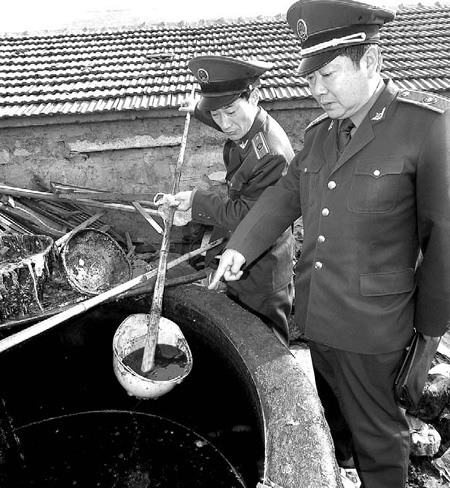
The Chinese have taken recycling to a whole new level. The waste oil is “skimmed from kitchen waste” and resold in the black market. The yuck factor is enough reason in itself to blog about, but the practice is also a dangerous one:

“Reused cooking oil would likely contain acrylamide, a chemical that forms naturally when starchy foods are baked or fried. Studies have shown the chemical, which also has industrial uses, causes cancer in lab animals and nerve damage to workers who are exposed to high levels.”

Chinese officials say they are stepping up their efforts to combat this and other food safety issues.
 

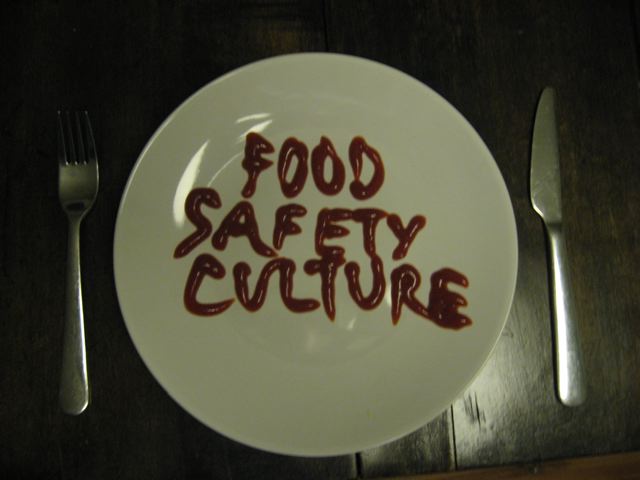
Can organizational culture sabotage food safety change?

Terri Waller, a Master of Public Administration student at Troy University and a certified food safety manager and instructor, writes in this guest blog that,

My grandfather, James Davis, always addressed an issue immediately. All bad habits in our house were addressed and put to rest. Food safety managers should do the same — immediately correcting a bad habit will have a positive affect on establishments, scores, and the community in which they serve.

Being a food safety professional, I see almost daily, educated food service managers fail to implement proper food safety concepts. This failure is associated with the culture of the establishment. If the culture of an establishment has always been to perform a task incorrectly or not at all, it is embedded into the DNA of that organization.

Food safety professionals must get in the habit of protecting the community from foodborne illness. I agree with Edgar Schein, social psychologist, that managers must embed correct shared values and assumptions in the organization’s culture and reinforce them in new and current members if they are to create and sustain strong cultures in their organizations (Tompkins, 2005, pg. 366).

“Organizations are not simple systems like machines or adaptive organisms; they are human systems manifesting complex patterns of cultural activity (Tompkins, 2005, pg. 361).”

Organizations are seen as extended families or clans held together by shared values and beliefs. These values and beliefs are established over time as organizations struggle with the usual problems of internal integration and external adaptation. Sometimes they are introduced into the culture by organizational founders or dynamic leaders. At other times they enter the culture unconsciously as members learn how to cope successfully with problems. Over time, these values and beliefs become embodied in myths and rituals that allow the shared culture to be internalized and transmitted from one generation to the next. Once these values and beliefs are firmly established in the dominant culture, they guide the daily decisions of organizational members and provide the glue that holds the organization together. (Tompkins, 2005, pg. 361)

“The strength of a culture is best defined in terms of the homogeneity and stability of group membership and the length and intensity of shared experience (Tompkins, 2005, pg. 365).”

As a manager if you see something wrong correct it. Correcting bad habits notifies present employees of what was wrong and how it should be made right. This way everyone moves forward on the right foot. When things are implemented right in an organization it is easy for new members to come on board knowing what to do and the right way to do it.

Resource:
Tompkins, J. (2005). Organization Theory and Public Management. Boston, MA,
Wadsworth.
 

UK E. coli rate ‘disgusting’

Karen Morrisroe almost died from E. coli O157 last year.

She says U.K. E. coli rates are "disgusting."

The 33-year-old from Wrexham, contracted the bug in July 2009, 10 weeks after giving birth, and spent five weeks on "death’s door" in a coma, after an outbreak was linked to a chip shop in Llay, which was still under investigation.
 

What engineers can teach food safety types, learn from failure

After bombing out as a genetics grad student and dabbling in journalism, I re-entered academia teaching risk analysis to engineering students at the University of Waterloo (that’s in Canada, down the road from Guelph). I taught a course called Science, Technology and Values to about 100 engineering undergrads twice a year.

I loved it.

We got to examine in real-time the assessment, management and communication failures of the 1994 Intel chip melt-down, which is now being repeated with the Apple iPhone. Engineers are big on failure analysis and figuring out ways to prevent future accidents.

The causes are usually cultural rather than technological failures.

As William J. Broad writes in the New York Times this morning, disasters teach more than successes.

While that idea may sound paradoxical, it is widely accepted among engineers.

They say grim lessons arise because the reasons for triumph in matters of technology are often arbitrary and invisible, whereas the cause of a particular failure can frequently be uncovered, documented and reworked to make improvements.

Disaster, in short, can become a spur to innovation.

Henry Petroski, a historian of engineering at Duke University and author of “Success Through Failure,” a 2006 book, said,

“It’s a great source of knowledge — and humbling, too — sometimes that’s necessary. Nobody wants failures. But you also don’t want to let a good crisis go to waste.”

What’s baffled me is that the food industry seems immune to such lessons. Or it takes forever. It took 29 outbreaks involving leafy greens before the California industry had a tipping point and decided to get serious about food safety? The same mistakes are repeated over and over and over and it’s boring (and really dangerous).

Canadian greats, The Tragically Hip, who are not engineers, just dudes from Kingston (that’s in Ontario) summed it up in their 1994 song, Titanic Terrarium:

An accident’s sometimes the only way
To worm our way back to bad decisions


Blame the consumer, Hong Kong style

Public reminded to prevent E. coli O157:H7 infection.

That was the headline on a press release from Hong Kong’s Centre for Health Protection today.

Consumers are important. So is everyone else in the farm-to-fork food safety system. But CHP chooses to focus on people as the critical control point:

CHP today (July 20) reminded people to observe good personal, food and environmental hygiene to prevent intestinal infection caused by E. coli O157:H7 bacteria.

The appeal followed the confirmation by laboratory test of a local case involving a 13-month-old girl living in Yuen Long. This is the fourth case of E. coli O157:H7 infection reported to the CHP this year.

A CHP spokesman said,

"People are advised to cook meat thoroughly. The core temperature of food should reach 75 degrees Celsius (that’s 167 F, guess they like hockey pucks for burgers) for at least two to three minutes, until the cooked meat is brown throughout and the juices run clear.”

Color is a lousy indicator. Use a tip-sensitive digital thermometer and stick it in. And next time, remind everyone else of their responsibility to reduce the loads of dangerous pathogens entering any kitchen rather than placing all the blame on consumers. There’s lots of blame to go around.
 

Man detained at Mexican airport found with 18 baby monkeys taped to body

Customs officials (left, not exactly as shown) at Mexico City’s airport detained a Peruvian man (right, not exactly as shown) carrying 18 baby monkeys, including two which had died, hidden under his clothes, federal police said.

"The Titi monkeys were found hidden in a band tied around the man’s body," a statement said.

The Sydney Morning Herald reports the discovery was made when the 38-year-old man appeared edgy during random checks on passengers off a flight from Lima, Peru, it said.

Titi monkeys — found in Central and South America — are protected under the Convention on International Trade in Endangered Species of Wild Fauna and Flora (CITES).

Lack of food safety costly for diners, eateries; Alabama training center tries to fix errors

Here’s a common scene from many of the mom and pop restaurants I’ve visited: a towel used to sop up juice from raw hamburger meat also is used to wipe down counters.

Phyllis Fenn, a standardization officer with the Alabama Department of Public Health’s bureau of environmental services, has seen the same thing – too often.

The Montgomery Advertiser reports today the Food Safety Training Center on Atlanta Highway is an attempt both to help restaurant owners avoid bad inspections and to protect their customers’ health.

When Alabama adopted the 2005 Food Code, one provision was that at least one person in restaurants where raw foods are handled, including fast-food eateries and sushi bars, would become food safety certified. When the state adopted the code, it opted to go with a lead-in time — Jan. 1 of this year.

The classes can help restaurants improve their health department inspection scores, which is exactly what they are designed to do, Fenn said.

She said the certification class helps restaurants reduce food-related illnesses as well as teaching them about the proper temperatures to cook and hold food (the temperature of food that sits out at a buffet) and proper hygiene.
 

Cedar brand Tahini may contain salmonella

Whenever I hear ‘Tahini’ I somehow superimpose in my brain the last line from the 1978 seminal hit from the B-52s, Rock Lobster,

"There goes a dog-fish
chased by a cat-fish
in flew a sea robin
watch out for that piranha
there goes a narwhal
here comes a bikini whale!”

Bikini whales may or may not carry salmonella, but Tahini keeps appearing with salmonella, probably from the sesame seeds.

The Canadian Food Inspection Agency (CFIA) and Produits Phoenicia Inc. are warning the public not to consume the Cedar brand Tahini described below because the product may be contaminated with Salmonella.

The affected product, Cedar brand Tahini is sold in 450 mL jars, bearing UPC 0 62356 50178 5. There is no lot code on the packages.

This product has been distributed nationally.

There have been no reported illnesses associated with the consumption of this product.
 

UK Food Standards Agency survives; new focus should help get the science right; piping hot is not a standard

‘You won’t have Nixon to kick around any more.’

That’s what eventual U.S. President Richard Nixon said to the press after losing the election for Governor of California in 1962 (he became President in 1968).

“I leave you gentleman now and you will write it. You will interpret it. That’s your right. But as I leave you I want you to know — just think how much you’re going to be missing. You won’t have Nixon to kick around any more, because, gentlemen, this is my last press conference and it will be one in which I have welcomed the opportunity to test wits with you.”

And just like Nixon, the U.K. Food Standards Agency has come back from the political backwaters with, what the government calls, “a renewed focus on food safety.”

The Government recognizes the important role of the Food Standards Agency in England, which will continue to be responsible for food safety. The Food Standards Agency will remain a non-ministerial department reporting to Parliament through Health ministers.

In England, nutrition policy will become a responsibility of the Secretary of State for Health. Food labelling and food composition policy, where not related to food safety, will become a responsibility of the Secretary of State for Environment, Food and Rural Affairs.

This is tremendous news for food safety types as it was clear the Agency was being distracted by trying to be everything to everybody. Issues surrounding salt, fat, genetic engineering, labeling and others are largely lifestyle choices – they are not food safety issues, the things that make people barf.

Although the U.K. Department of Health needs new communications types when they begin a press release with,

“Public confidence in food safety issues will be protected, as the Government confirmed its intention to retain the Food Standards Agency (FSA) with a renewed focus on food safety.”

Public confidence is earned, not protected by a bureaucratic shuffling of the chairs.

Now that FSA is clearly focused on food safety, can they get rid of their nonsensical cooking temperature advice – piping hot – and focus on some evidence that will lead to fewer people barfing.

Otherwise, like Nixon, you’ll be back, only to get kicked around.

Avoiding ‘C’ food in New York City

According to the New York Post, some of the city’s best-known eateries are lucky the Health Department is starting to hand out letter grades next week — instead of last month — because thousands would have ended up with a bottom-rung "C" plastered in their front windows.

Officials estimate that about 6,000 of the city’s 24,000 eateries had enough violation points in June to have earned the lowest mark on a three-letter rating scale devised by the city.

The "C" restaurants would have ranged from the Lion, a sizzling new spot in Greenwich Village, to the venerable Gallagher’s steakhouse in Midtown, to the century-old Katz’s deli emporium on the Lower East Side.

Even Radio City Music Hall’s snack bar made the "C" list.

The Health Department plans to award "A" grades to restaurants that accumulate no more than 13 violation points; "B" to those with 14 to 27 points; and "C" for 28 or more points.

Restaurant owners and managers contacted by The Post who would have faced a "C" last month were surprisingly supportive of the grading system.

"It’s for the sake of public health — I’m perfectly OK with that," said Jake Dell, son of the owner of Katz’s deli, which accumulated 47 points on its record for such infractions as evidence of roaches and mice, as well as bad plumbing.

Like every restaurateur contacted, he said the conditions cited by inspectors have since been corrected. A reinspection July 6 brought Katz’s score down to 23 — in the "B" range.