New IFT report reviews the role of food science and technology in providing, uh, food

The world’s food system provides food for nearly seven billion people each day. But according to a new report from the Institute of Food Technologists (IFT), more advances are critical for an adequate food supply, which must nearly double during the next several decades, for the future world population.

The first-of-its-kind scientific review, to be published in the September 2010 issue of the peer-reviewed journal Comprehensive Reviews in Food Science and Food Safety, takes a historical look at the food system, the many challenges ahead, and the crucial role of food science and technology in meeting the needs of the growing population.

The report summarizes the historical developments of agriculture and food technology, details various food manufacturing methods, and explains why food is processed. The report also describes and stresses why further advancements in food science and technology are needed — to more equitably meet growing world population food needs with enhanced food security in developing countries and solutions to complex diet-and-health challenges in industrialized countries.
Impact of Modern Food Manufacturing Methods

John Floros, PhD, of the Pennsylvania State University Department of Food Science said,

"Thanks to food science and technology and modern food manufacturing methods, nutritional deficiencies and inconsistent food availability can be addressed, harvests can be protected, and various commodities can be transformed into new products having specific nutrients for better health and wellness. However, this success has distanced consumers from the agricultural origins of today’s food products and understanding of why processing is important. As a result, there are concerns and misconceptions regarding food safety, and the food system’s effect on health and the environment.”

Uh-oh. That sounds condescending.
 

Horse tranquillizer ketamine found in aloe vera drink

Hanging out with veterinarians and vet students over the past 30 years, I’ve heard enough stories about the horse tranquillizer, ketamine, and human recreational use.

Not the best thing to get addicted too, as far as addictions go, but is apparently popular at raves.

Two women in Leicester, U.K. required hospital treatment after drinking an aloe vera-based health drink that was apparently spiked with ketamine.

Forensic tests are still being conducted and the final analysis will not be known for some time.

Leicestershire Health Protection Agency said there was only one outlet in Leicester which had bottles of the product and that stock had been seized.

Health Protection Agency spokesman Philip Monk said,

"We have bottles with that label [Gayatri] on which we know contain ketamine and the police will be working out how the ketamine got into them and indeed whether they came from the manufacturer – they may be completely fake products."
 

Cargill launches beef line with leakproof packaging

Consumers ain’t no dummies.

Cargill asked consumers what they wanted in beef packaging and they said stuff that doesn’t leak.

David Bisek, associate brand manager for Cargill said in a statement.

“Shoppers have spoken and Cargill has listened. They told us their No. 1 frustration with current fresh beef packaging is the fact that it leaked. These leaks plague consumers throughout the shopping process: they leave a mess in grocery carts, they stain car upholstery and they necessitate refrigerator clean-up during storage.”

And the cross-contamination potential is enormous.

So Cargill introduced a new Grantwood Meats line where beef is vacuum-sealed into a leakproof package with a peel-to-open tab. It is freezer-ready and has a 30-day shelf life from the packing date.

Meatingplace says the Grantwood Meats line includes muscle cuts and roasts.
 

Salmonella sickens 26 on boat docked in Cleveland

GoErie.com reports that salmonella has been confirmed as the cause of the gastrointestinal illness that sickened 26 of 42 crew members of the U.S. Flagship Niagara while in Cleveland (right, not exactly as shown).

Most of the crew members are feeling well enough for a Great Lakes tour to Duluth, Minn.; Green Bay, Wis.; and Chicago, said Bill Sutton, executive director of the Flagship Niagara League, the ship’s fundraising arm.

The fawning media coverage of organic food

In the early part of the 2000s, media outlets seemed to be co-opted by the fantastical claims of the organic food sector. Organic was portrayed as safer, healthier and better for the environment.

There wasn’t a lot of data.

There was a lot of food porn.

I had a student review and code 618 newspaper stories – it seems so quaint now, there were newspapers back then — reporting on or referencing organic food and organic agriculture from five North American media outlets from 1999-2004.

The paper was published in the British Food Journal yesterday.

Stacey found that of the 618 stories, 41.1 per cent were coded as being neutral, 36.9 per cent positive, 15.5 per cent mixed and 6.1 per cent negative.

From the discussion:

“It was determined that organic agriculture was often portrayed in the media as an alternative to allegedly unsafe and environmentally damaging modern agriculture practices — organic was defined by what it isn’t, rather than what it is. The National Post, for instance, published an article in 2002 about a report by Environmental Defence Canada, which had interpreted food safety data from the Canadian Food Inspection Agency and found that many products such as maple syrup and eggs did not meet safety standards. The article stated that, “to avoid health problems, Mary McGrath, the group’s director of research, suggested consumers consider purchasing organic or ecologically grown produce” (Sokoloff, 2002). Such unsubstantiated comments have become endemic in media coverage of all things organic.

“The stories examined in this analysis frequently suggested organic production was void of many of the challenges faced by large-scale, modern agriculture, including pesticide residue, mad cow disease and genetic engineering.

Of the themes health, safety and environment, food safety was the least important in the discussion of organic agriculture in the media. … The finding that 50 per cent of food safety-themed statements in news articles were positive with respect to organic agriculture, while 81 per cent of health-themed statements and 90 per cent of environment-themed statements were positive towards organic food, indicates an uncritical press. USDA has repeatedly stated that the organic standard is a verification of production methods and not a food safety claim: ‘National standards for organic food will be released soon, and they will make clear that such products aren’t safer or more nutritious than conventional products, Agriculture Secretary Dan Glickman says’ (Brasher, 2000).”

The abstract is below.

Coverage of organic agriculture in North American newspapers: Media: linking food safety, the environment, human health and organic agriculture19.jul.10British Food Journal, Vol. 112 Iss: 7, pp.710 – 722
Stacey Cahill, Katija Morley, Douglas A. Powell
http://www.emeraldinsight.com/journals.htm?articleid=1871116&show=abstract
Abstract
Purpose – The project explored the ways in which the topics of organic food and agriculture are discussed in representative North American media outlets in reference to food safety, environmental concerns, and human health.
Design/methodology/approach – Articles from five newspapers were collected and coded using the content analysis technique and analyzed for topic, tone, and theme.
Findings – For a six-year time period, 618 articles on organic food and organic agriculture are analyzed and the prominent topics are found to be genetic engineering, pesticides, and organic farming. Articles with a neutral tone with respect to organic agriculture and food accounted for 41.4 percent of the articles, while positively toned articles garnered 36.9 percent. The themes human health, food safety, and environmental concerns were discussed with positive reference to organic food and agriculture in 81, 50, and 90 percent, respectively, of comments pulled from the articles.
Practical implications – Analysis of these articles over time, between media outlets and by topic allows for understanding of media reporting on the subject and provides insight into the way the public is influenced by news coverage of organic food and agriculture.
Originality/value – Research that analyzes media coverage for how it portrays the topic of organic food and organic agriculture with respect to health, food safety, and environmental concern, and concludes that articles about organic production in the selected time period are seldom negative.

Hamburgers: fresh is not the same as safe

‘Our restaurant’s burgers are safe to eat undercooked: The meat is fresh and ground in-house.’

This is wrong, dangerous, and nothing more than food porn, the wishful thinking that bacteria will avoid certain products if prepared with enough manual labor and love.

Bacteria don’t care about love.

Shamona Harnett of the Winnipeg Free Press reported the all-too-common chat with her server as she tried to order a burger – she went with well-done. And she urged cooks to use a food thermometer to ensure the burger has reached 160 F, which is also an effective way to ensure the cook doesn’t overcook the burger. Thermometers make people better cooks.

Harnett then goes on to say that “experts say consumers should wash lettuce — even if it’s labelled pre-washed.”

No they don’t. An expert panel concluded,

"Leafy green salad in sealed bags labeled ‘washed’ or ‘ready-to-eat’ that are produced in a facility inspected by a regulatory authority and operated under cGMPs, does not need additional washing at the time of use unless specifically directed on the label. The panel also advised that additional washing of ready-to-eat green salads is not likely to enhance safety. The risk of cross contamination from food handlers and food contact surfaces used during washing may outweigh any safety benefit that further washing may confer."

Food safety is not simple.
 

Don’t cook when you’re crook

Does the headline mean, if you’re a convict, don’t cook? Lots of convicts cook. So I checked the dictionary where I found an Australian/New Zealand definition for crook: a situation that is bad, unpleasant, or unsatisfactory, or (of a person or a part of the body) unwell or injured : a crook knee.

It means if you’re sick, don’t work.

With the chill of winter well and truly upon us, the risk of viral gastro contamination heats up, (New South Wales, that’s in Australia, includes Sydney, and it’s what they would call winter right now) Primary Industries Minister Steve Whan warned today as he urged chefs and cooks to take care in the kitchen during the peak viral gastro season.

"This warning applies particularly to those food industry professionals who come into contact with the preparation and service of food for hundreds, if not thousands of people," Minister Whan said.

"If you’re crook don’t cook is a good basic rule to apply in the workplace."

"Under the Food Standards Code it is illegal for food handlers to handle food when they have gastric illness. It is also illegal for food businesses to knowingly have staff working if they have gastric illness.

"The NSW Food Authority is aware of cases where staff have been asked to work when they were sick, or have not told their supervisor they were sick, putting many people at risk.”
 

Can you tell me how to sneeze on Sesame Street?

Michéle Samarya-Timm, a registered environmental health specialist with the Somerset County Department of Health in New Jersey (represent) writes:

The recent New Zealand study that most people are not properly containing their coughs and sneezes comes as no surprise, as I still see air sneezes wherever I go.

Look around. Children have been taught – and are following — proper respiratory etiquette by covering their coughs and sneezes. It’s the adults we need to reach for disease prevention behavioral change. As we talk about doing the “Dracula sneeze” maybe its time to reach adults by tapping into our inner children and bring those of my generation back to what we learned when our role models had googley eyes, and skin of orange, purple or blue felt.

Close your eyes, and hum Sunny Day- Sweepin’ the clouds away…

And there we are with Count von Count – who should be the poster child for the “Dracula Sneeze.” Early on (circa 1971) we see him counting flowers – because flowers make one sneeze. Then we can count the sneezes (Ah-ha-ha-ha!). Unfortunately, Count doesn’t use his hands. Or his cape. Or anything to catch his sneezes. But he could be useful counting 20 seconds of handwashing… (20 *Wonderful* seconds!) http://www.youtube.com/watch?v=kQC82okzTXI

And sneezes can be contagious. Especially in groups. The Sneeze Song illustrated that – with cows, chickens and swine. Not a good prospect to think that the shopping mall, the train station or the barnyard could have a plethora of airborne diseases from indiscriminate sneezing. With an end message of “cover your coughs and sneezes” this clip could be a generation-catching public service announcement. http://www.youtube.com/watch?v=CgD27p9uJ0k

At least Ernie and Bert recognize sneezing etiquette. Ernie has been known to offer his handkerchief to Bert. It’s what friends do. (That, and put their noses back on.) And remember, Ernie knows about personal cleanliness. After all, when we first met him in 1969 Ernie was scrubbing to get clean. http://www.youtube.com/watch?v=R6rWY-aGVe0 Ernie’s penchant for cleanliness brought us some great handwashing songs. Forget the ABC’s …singing “everybody wash” encourages all around you to join in with good, clean and considerate handwashing fun.
Still not convinced that the Children’s Television Workshop has the makings to remind us old timers to cough and sneeze into the crook of our arms? Enlist Kermit the Frog – who really (really!) loves his elbows:

I love my elbows!
They really top my list
I love my elbows,
Even more than my wrists

We teach people to sing when handwashing…maybe we’d make some progress if we ask them to hum like Kermit while sneezing?

And if you don’t know what a sneeze is, just ask Guy Smiley and the panel on What’s My Part? The nose knows (but still could use a partnering elbow.) http://www.youtube.com/watch?v=0XfFJVkcNdg

Obviously, I’m a child of the Sesame Street generation. The Muppets taught us lifetime lessons – sharing, counting (in Spanish, too!), the people in our neighborhood, how to handle a Grouch, and that sometimes things are not like the others.

Maybe we should consider using bits from our youth – like the Sesame Street format and characters — to bring healthy messages to an older audience.

Rebranding some scenes from our youth can use our nostalgia to encourage a grown-up culture of cough-etiquette antics. I love my elbows. Everybody wash. And if you sneeze incorrectly, you don’t get your nose back.

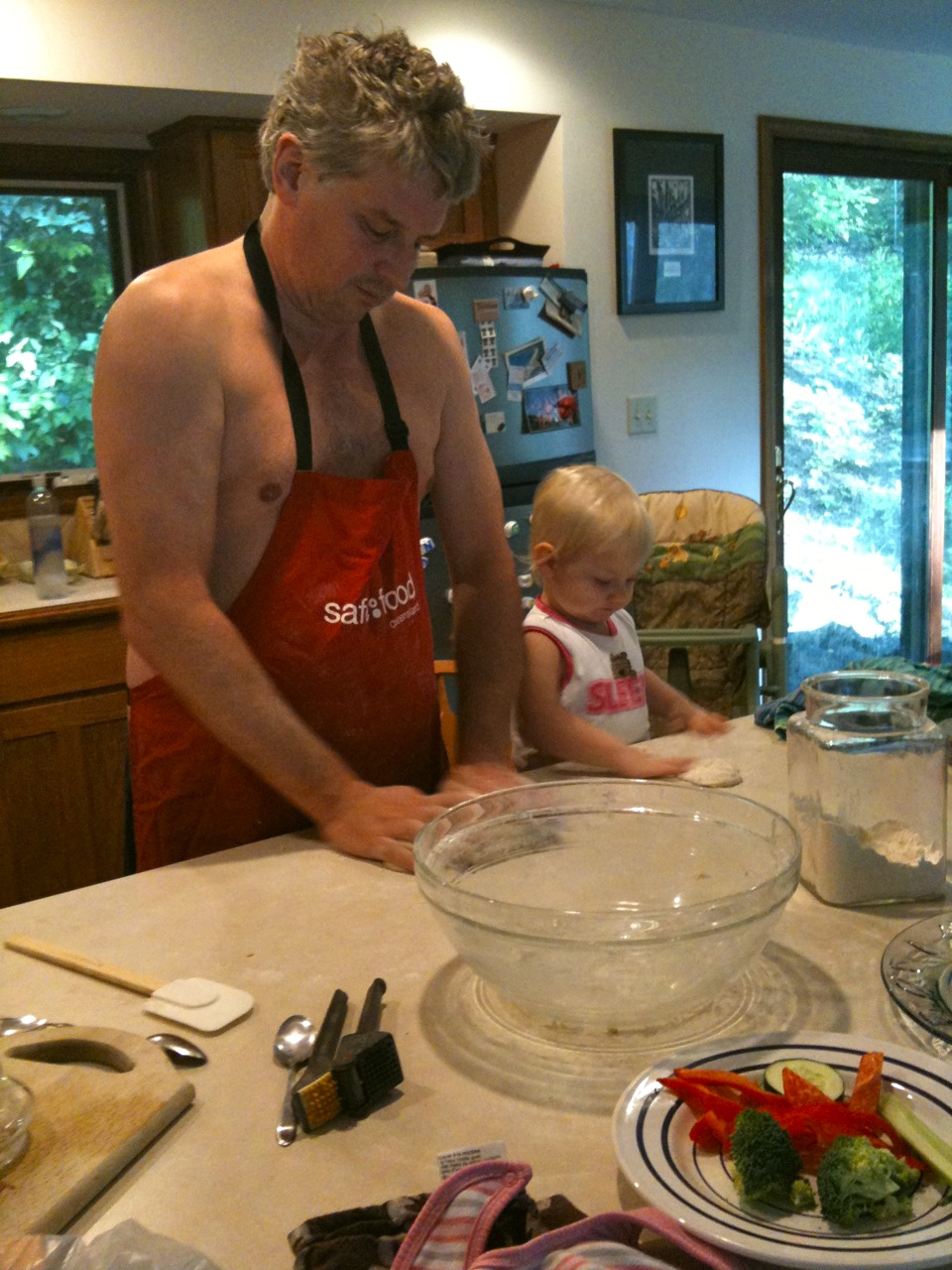
Gratuitous food porn shot of the day – Sunday morning bread making

Wearing my trusty safe food Queensland apron – and nothing else because it’s too hot – Sorenne and I had a go at bread making.

This was the first time Sorenne helped because she needed to be steady enough on the chair while kneading the dough. I use a mixture of 50 per cent stone-ground whole wheat flour and 50 per cent unbleached white, sometimes with a little rye flour, salt, honey, yeast, garlic and fresh rosemary from the herb garden. This will get formed into two or three baguettes, or maybe rolls, or maybe a loaf.

Hundreds of Texas food makers unlicensed, avoided inspections

Hundreds of businesses across Texas have been manufacturing and selling food without a state license and, in some cases, have escaped health inspections intended to ensure the safety of those products.

The Dallas Morning News reports this morning the businesses were flushed out in a statewide crackdown on unlicensed food manufacturers, begun last year by the Texas Department of State Health Services.

Carrie Williams, a spokeswoman for the health department, said,

"Many of the companies we have discovered are small operations that were simply unaware they needed a state license. For the most part, they have been more than willing to get into compliance with us. … Some of them did have safety issues. Most were corrected on the spot or we’re working with them to get them into compliance."

The state has identified 355 companies that appear to be producing and selling a wide variety of eatable products – from barbecue sauce in Fort Worth to pepper jelly in Dallas to ice cream in Houston – all without obtaining a manufacturing license from the state.

The state went searching for unlicensed food manufacturers in the embarrassing aftermath of last year’s discovery of an unlicensed peanut-processing plant in West Texas.

The Plainview plant, owned by a subsidiary of Peanut Corporation of America, had operated for four years without any state-required safety inspections.

None of these new cases investigated so far rise to the level of the peanut plant, which closed in February 2009 after salmonella was detected in the plant. A subsequent state inspection found rodent parts and feathers in a crawl space above the peanut production line.