Most food purchases are based on faith. That’s why an extensive series of rules, regulations and punishments emerged beginning in 12th century Mediterranean areas.
.jpg) Faith-based food safety systems are prevalent from the farmer’s market to the supermarket, especially in the produce section. And almost anything can, and is, claimed on food labels – except microbial food safety.
Faith-based food safety systems are prevalent from the farmer’s market to the supermarket, especially in the produce section. And almost anything can, and is, claimed on food labels – except microbial food safety.
The U.S. Food and Drug Administration has announced they are going to examine the growing number of nutrition claims found on the front of food packages after complaints the labels promote health fairytales.
In the U.K., the Royal Society for the Prevention of Cruelty to Animals has encouraged diners to boycott restaurants that cannot answer questions about the origin of their food.
British chefs Raymond Blanc, Peter Gordon, Martin Lam, Paul Merrett and Antony Worrall-Thompson issued a joint statement saying:
“The British public need to stop being so reticent in restaurants and start asking where their food comes from. It’s your right to know the origin of the food you are served and what types of farms are being used – and the mark of a good restaurant is one that is proud to tell you.”
In response to this news Freedom Food has launched a new long-term campaign called ‘Simply Ask’ which aims to get people asking about food provenance when eating out. This is in a bid to encourage restaurants, pubs and cafes to start sourcing products from higher welfare farms such as Freedom Food, free-range or organic.
Americans are questioning nutrition claims, Brits are questioning allegedly animal-friendly sources of food, maybe there’s room to ask for microbiologically safe food – the stuff that sickens up to 30 per cent of all people everywhere every year (so says the World health Organization).
Lots of companies and retailers are taking baby steps in the direction of empowering consumers to hold producers accountable, but lots aren’t.
.jpg) Maple Leaf Foods, whose listeria-laden cold-cuts killed 22 Canadians last year, is continuing on its bad Journey to Food Safety Leadership by announcing today that, “Industry and government come together to make food safer for Canadians.”
Maple Leaf Foods, whose listeria-laden cold-cuts killed 22 Canadians last year, is continuing on its bad Journey to Food Safety Leadership by announcing today that, “Industry and government come together to make food safer for Canadians.”
Invoking the two groups shoppers distrust the most – industry and government – and proclaiming they are working together to better things may not be the best communication strategy to build trust and confidence.
Dr. Randall Huffman, Chief Food Safety Officer for Maple Leaf Foods, stated,
"The Canadian food industry is united that food safety not be used as a competitive advantage. Every member at every step in the production process is a steward of food safety. This spirit of cooperation heralds a new beginning for our industry, and together we will make Canada the gold standard for food safety. This symposium is the first in a series to ensure we share experiences and knowledge, and gain insights into emerging risks, technology advances and cutting edge science that can deliver safer food for Canadians."
That’s nice. Computer companies share technology all the time but that doesn’t stop them from marketing their individual technological advantages.
Stop pandering. Companies that are serious about food safety will go beyond the trust-me approach of faith-based food safety systems and provide public access to food safety test results, provide warnings to populations at risk, and market food safety at retail, to enhance the food safety culture back at the producer or processor level, and to build consumer confidence. May even make money.
.jpeg)

 Halloween in New Zealand doesn’t appear to be as hyped-up as North America. I’ve yet to see any houses decorated in Wellington, and the usual surplus of costumes and candy in grocery and department stores is nearly non-existent here. That won’t stop me however; I’ve already begun gathering the fixin’s for my costume.
 Finally getting around to watching last week’s Curb Your Enthusiasm before delving into this week’s, and once again,
 Should have taken the picture last night with seafood surprise (in Manhattan Kansas?) and grandma here, but tonight will have to do:
(1).jpg) Which was exactly one of our thoughts when we began experimenting with food safety stickers about five years ago.
Which was exactly one of our thoughts when we began experimenting with food safety stickers about five years ago.(1).jpg)
 Mark Barry, funding development worker at the farm in St Ann’s, said,
 .jpg) The research found a dramatic improvement in ethical behavior with just a few spritzes of citrus-scented Windex
The research found a dramatic improvement in ethical behavior with just a few spritzes of citrus-scented Windex The first experiment evaluated fairness. As a test of whether clean scents would enhance reciprocity, participants played a classic "trust game." Subjects received $12 of real money (allegedly sent by an anonymous partner in another room). They had to decide how much of it to either keep or return to their partners who had trusted them to divide it fairly. Subjects in clean-scented rooms were less likely to exploit the trust of their partners, returning a significantly higher share of the money.
.jpg)
 Ben, Dani and I walked it one night after too much fine wine with some Australian colleagues. I’ve jogged across it many times. And walked, like in this pic from 2004 (right).
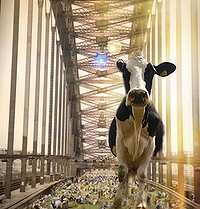 Evergreen Turf is the company responsible for trucking in the turf to cover the bridge roadway and its chief executive, Dean Holden, said it would take about eight semi-trailers to transport it and three hours to lay it.
 What better occasion to try out alleged
  And I didn’t take pictures of Thursday’s dinner, but Top Chef on Wed. night also struggled with lamb, and none of the hot-shot chefs could agree on how to define medium-rare lamb.
  The lamb shoulder roast we had last night was cooked to 140F.