UK E. coli fish bar scored zero for hygiene

The BBC reports that Llay Fish Bar in Wrexham, suspected as the source of an E. coli O157 outbreak that has left a new mother on life-support and a 3-year-old with renal failure, received zero out of five in a 2008 hygiene inspection.

The Llay Fish Bar has been closed by local council — but only since the severe illnesses emerged.


Stickers source watermelons to California farm

The San Francisco Chronicle reports that at a farm in Manteca, in San Joaquin County, workers smack labels onto watermelons freshly cut from the vine, each sticker bearing a unique string of letters and numbers that identifies where they were harvested.

Ryan Van Groningen of Van Groningen & Sons Farms, which sells watermelons under the Yosemite Fresh brand, said,

"With food safety as big as it is, we can give each watermelon its own code so a consumer can check on the Internet to see where it is grown.”

This new code, called the HarvestMark, is being developed by the Redwood City startup YottaMark Inc. at a time when Congress is considering food-safety legislation that could make some type of tracking system mandatory.

In advance of any legal mandate, a few growers have started putting HarvestMark codes on products like plastic-packaged grapes and strawberries, as well as watermelons.

The idea is to enable a consumer to type the 16-digit tracking code into a locator field at HarvestMark.com to learn where the product was grown. Depending on the grower’s records and what the farm chooses to reveal, the system could detail the date and part of the field where the product originated.

Great idea.

A decade ago, I advised the Ontario Greenhouse Vegetable Growers – whose cluster tomatoes still dominate supermarket shelves in Florida in the middle of summer – to do something similar, to market their food safety efforts directly to the concerned consumer.

For other produce producers, forget government babysitters and the non-niceties of offending other growers … growers who maybe aren’t so good at food safety.

Go further. Put a url on the sticker so concerned shoppers can check out a web site with video, not just about where a commodity was grown, but about food safety standards, and real-time test results for water quality and product sampling.

And then market it.
 

Stickers for takeaway food a hit in Dubai

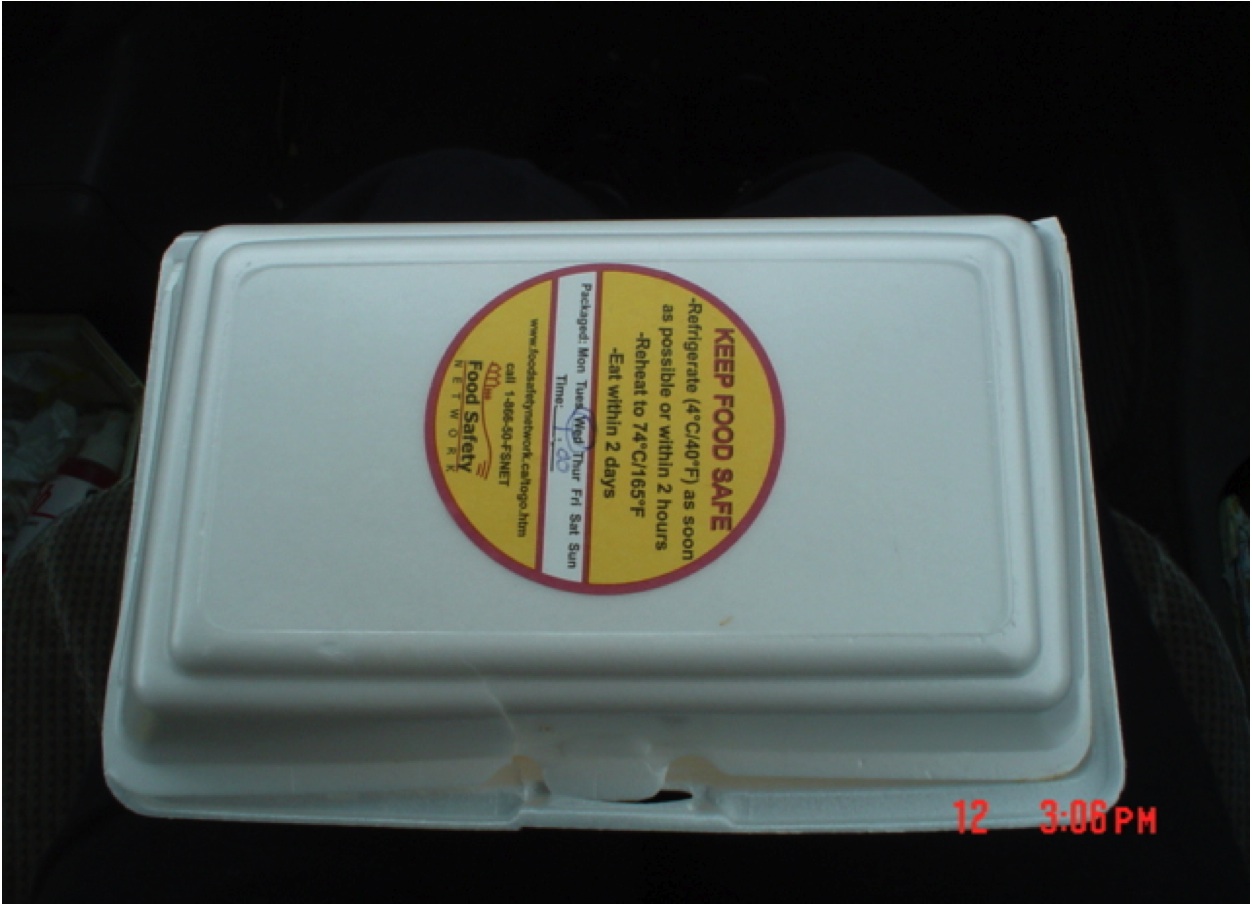
Food such as takeout or takeaway, that is initially prepared in a restaurant but is consumed in an individual’s home, may be a venue to target with safe-food handling messages. Earlier this decade, both Chicago-based Francesca Restaurants and Boston-based Buca Di Beppo Restaurants reported anecdotal success placing food safety labels on containers of takeout food.

In 2004, my group undertook research to:

• examine restaurant managements’ experience of using a safe food-handling label on takeout food;
• explore managements’ food safety concerns;
• determine the value of consumer safe-food handling labels to managers;
• establish perceived label effectiveness; and,
• identify challenges with implementation.

For our study, we defined take-out as food procured from a casual dining restaurant (i.e. sit-down restaurant) but eaten elsewhere, including food ordered as take-out and leftover food packaged to be taken home. The label we developed is right (above) and left (note, the phone line and web site don’t work anymore).

The research paper describing that work has been accepted by a peer-reviewed scientific journal and will be published in the near future.

However, the public health types in Dubai discovered over the weekend the same thing we found: most consumers and restaurateurs like the idea.

Our bites.ksu.edu Dubai correspondent contacted Ben and me about stickers on takeaway, and we sent along what we had developed. Today, the Khaleej Times reports,

The Dubai Municipality is planning to encourage all restaurants in the emirate to issue advisories to consumers on safe handling of takeaway food.

The decision follows a similar initiative by a popular south Indian restaurant group that attaches red stickers to its takeaway bags at its two outlets in Dubai. A municipality official applauded the group’s move and said the civic body intended to support such initiatives by other restaurants as well.

Director of Food Control Department, Khalid Mohammed Sherif, told the Khaleej Times,

“We are encouraging more and more food outlets to put such messages along with takeaway food to ensure that the customer handles the food properly. We will be providing all of them with modified instructions for customers to handle food taken away.”

He said the modified versions of the advisories will include the temperature at which food items have to be stored and the duration within which they have to be consumed, depending on the types of ingredients.

Below is a draft of the information intended for consumers.

Woman on life-support, 3-year-old suffering renal failure after E. coli O157 outbreak in Wales

Two people are being treated in hospital after a suspected E coli O157 outbreak in north Wales.

One woman is on a life-support machine, according to her family. Health officials say a total of four people have been taken ill.

The Llay Fish Bar in Llay, Wrexham has been closed.

The BBC has named one of the patients as Karen Morrisroe-Clutton, who has an 11-week-old baby being cared for by its grandparents. Her husband, Paul, is at her bedside at Wrexham Maelor hospital.

Rose Morrisroe, her mother, told the BBC her daughter had bought a veggie burger at the premises being investigated. She had been in intensive care since last week and was being kept in a medically induced coma. She was on a dialysis machine and had shown slight improvement.

A three-year-old girl is also being treated for renal failure in Alder Hey hospital in Liverpool.
 

Blowing (food) chunks on vacation

Amy, Sorenne and I are hanging out in Venice, Florida, and I do most of the cooking. Lots of fresh fruits and veggies from the neighborly Publix supermarket, and I even bought a digital, tip-sensitive meat thermometer from Target because I just feel naked cooking without one.

Others aren’t so fortunate, I guess.

A group called HolidayTravelWatch, somewhere in the European Union, has just published its top-20 appalling holiday complaints and problems. Included in this year’s list:

1. Family holiday to Egypt where a child was struck down by severe food poisoning, hospitalization and subsequent scalding in the hotel restaurant.

2. Family holiday to Turkey found that most of their group were ill, they were diagnosed as suffering with Salmonella and Cryptosporidium.

12. One family reported that they had returned from Turkey and their daughter had been diagnosed with Salmonella – they report that many people were ill at the hotel.

15. Holidaymakers to one hotel in Egypt reported sewage smells on the complex, gardens irrigated by stagnant water, food lukewarm, drinks served through a hatch and not via sealed bottles – they suffered severe gastric illness which still continues.

17. One family to Egypt suffered with food undercooked, poor chef hygiene practices (one chef was seen to handle bloody meat then touch other food), flies on the food in the pool bar, sewage smells in bathroom, cracks on the balcony and they are suspected as suffering with Cryptosporidium.

20, One couple’s trip to Egypt was marred by building work, diarrhoea on the public toilet walls, diarrhoea in the restaurant. They both suffered severe illness and weight loss – they are still ill.

Sydney KFC sued for $10 million after 7-year-old develops Salmonella and brain damage in 2005

Monika Samaan was seven years old when she collapsed and was rushed to hospital with salmonella poisoning after eating a Twister from the Villawood KFC outlet in Sydney’s south west in October 2005.

She has acquired spastic quadriplegia and a profound intellectual disability.

Today, Monika arrived at the New South Wales Supreme Court in a wheelchair (right) as her just over $10 million lawsuit against KFC got underway.

The family’s lawyer, Anthony Bartley SC, told the court in his opening address that Monika had been an extremely bright and active young girl before her illness.

Bartley said there was little doubt Monika’s illness was caused by salmonella on the chicken she ate, adding, "You will hear unsettling and disturbing practices in the kitchen, including the kitchen KFC operated at its Villawood store.”

To keep up with orders and deliver them with speed to customers, KFC’s "young, enthusiastic" staff would frequently help each other out. But by manning different work stations, the staff could easily have transferred bacteria from raw chicken to the cooked product, he added.

Michael Pollan — You’re no Julia Child

This will be brief because I have to cook dinner (another week in Venice, Florida, and supper will be permanently moved to 3:30 pm).

With the upcoming release of Julia and Julie, food pornographers everywhere are reminiscing about their love of Julia Child, widely credited with bringing French cooking to mainstream America.

Michael Pollan takes 8,272 words in tomorrow’s N.Y. Times magazine to say The Food Network appeals to eaters not cooks, that people wouldn’t be so fat if they had to make food with basic ingredients at home, and he’s nostalgic for his mother’s cooking.

Salon magazine has already driven a few trucks through the rather gaping holes in Pollan’s arguments and cherry-picked supporting evidence. About word 745, I recognized Pollan’s hypocrisy and wondered why I was reading this trash when I could be cooking?

And Dan Ackroyd at least deserves a cameo in the new movie for best Julia Child impersonation (although John Candy’s Julia on Second City TV, duking it out with Mr. Rogers in a boxing match during a satirical Battle of the PBS stars is a close second).
 

Want to avoid foodborne illness? Get hypnotized

The buzz created around microbial food safety leads to multiple hucksters trying to get in on the action. While we’ve covered new (and not really effective) ideas like home Salmonella testing kits, produce and consumer produce washes, this one is unique: Prevent Foodborne Infection With Seattle Hypnosis.

From the blog:

You can prevent foodborne infections with self-hypnosis that is is taught at the Seattle hypnosis offices of Roger Moore’s Counseling & Hypnotherapy LLC. Learn how to hypnotize yourself and change your eating habits…


Most cases of gastroenteritis caused by a common bacteria occur because people consume or prepare meat from infected chickens or cattle….

With self-hypnosis you really can end your desires for fats like beef and chicken and no longer expose yourself to the risks of the foodborne infection.

The Seattle-base hypnotists miss the mark (but full marks for trying) — avoiding meat is not the answer. Fresh fruits and vegetables are a significant, if not the most significant, source of foodborne illness today in North America. The very characteristic that affords dietary benefit — fresh — also creates microbiological risk: Because they are not cooked, anything that comes into contact with fresh fruits and vegetables is a possible source of contamination.

Is the water used for irrigation or rinsing clean or is it loaded with pathogens? Do the workers who collect the produce follow strict hygienic practices such as thorough handwashing? Are the vehicles used to transport fresh produce also used to transport live animals that could be sources of microbial contamination?

Herbivores, omnivores, carnivores and locavores are all at risk for foodborne illness.

Dubai restaurant requires signed disclaimer with purchase

What a cop-out.

After the tragic death of Nathan, 5, and his sister, Chelsea, 7, in connection with home-delivered Chinese food in June, the importance of food safety should have come into sharp focus for restaurateurs in Dubai.

On the off-chance that restaurant owners didn’t catch the news, the Dubai Municipality stepped up restaurant inspections and conducted a food safety awareness campaign under the banner "Food Safety is our Priority."

Establishments like Kempinski Hotel in Mall of the Emirates were given the opportunity to demonstrate to customers that food safety was indeed a priority.

Instead, as Gulf News reports,

“Hotel Kempinski in Mall of the Emirates is getting its customers to sign a disclaimer note stating that its restaurants would not be responsible for the quality of food once it is taken out of their premises.”

The disclaimer reads,

"Please note that the Kempinski Hotel Mall of the Emirates takes no responsibility whatsoever for any food or beverage bought from the hotel or any outlets of the hotel for personal consumption.

"This is due to the fact that the Kempinski Hotel Mall of the Emirates has no more control or any way of ascertaining the safety and hygienic condition of this food and beverage once outside the premises. Please sign the waiver below to indicate your acceptance of the terms stipulated.

"Otherwise the hotel is unable to permit any food or beverage to be purchased."

The establishment’s haughty and self-serving culture is absolutely disgusting and leaves me with very little faith in the safety of its food.

Another outlet, Calicut Paragon in Karama, invested their resources in stickers for take-out bags that advise consumers to eat their food within two hours of purchase—a step that suggests a shared responsibility for the safety of food and that I find a little more palatable. 

I agree with this guy:

"I think it is completely unethical to make customers sign disclaimers like that. It is good to safeguard the business, but not at the cost of displeasing customers," said Ronald D’Souza, operations manager at Sofra Worldwide – a firm that owns restaurant chains like Gelato, NaanPlus and Uno Chicago Grill.

"From your side, you have to ensure that quality and hygiene standards are maintained at the highest levels. But as we are in the business of food, there is an element of risk that you must take," D’Souza said.

Kempinski Hotel should step up to the plate and recognize that selling microbiologically safe food is a good way to protect your business, and showing a commitment to food safety is a good way to promote it.
 

Food safety Bill passes House – will it mean fewer sick people?

While the websphere, blogsphere and twittersphere were ejaculating electrons about the potential passage of new food safety legislation by the U.S. House– it passed — I was hanging out with some food safety dudes at Publix supermarkets HQ in Lakeland, Florida.

And I saw far more in Lakeland that would impact daily food safety than anything the politicians, bureaucrats, hangers-on and chatting classes could ever come up with.

When it comes to the safety of the food supply, I generally ignore the chatter from Washington, as well as the wasted Internet commentaries and conspiracy theories. If a proposal does emerge, such as the creation of a single food inspection agency, or the bill that passed the House today – and just the House — I ask, Will it actually make food safer? Will fewer people get sick?

As the General Accounting Office pointed out in a report a year ago,

“The burden for food safety in most of the selected countries lies primarily with food producers, rather than with inspectors, although inspectors play an active role in overseeing compliance. This principle applies to both domestic and imported products.”

Publix, with over 1,000 supermarkets, its own processing plants, and thousands of food products moving through its shelves, can’t afford the luxury of chatter.

After my visit, I went to the local Publix in St. Pete Beach to check out what the food safety type said – sure, the boss knows food safety, but do the front-line staff?

I ordered some shaved smoked turkey breast from the deli, and the sealable bag the meat was delivered in contained the following:

“Publix Deli
The Publix Deli is committed to the highest quality fresh cold cuts & cheeses
Therefore we recommend all cold cuts are best if used within three days of purchase
And all cheese items are best if used within four days of purchase”

(The picture isn’t very good. Note to Publix: The label warning about shelf-life is a great idea, but can’t read it if the price sticker gets slapped over some of the text.)

This is the first time I’ve seen a retailer provide information to consumers on the accurate shelf-life of sliced deli meats. It didn’t require Congressional hearings; it didn’t require some hopelessly-flawed consumer education campaign; it required a food safety type to say, this is important, let’s do it.

I also went looking for some bread for turkey sandwiches tomorrow as we move down to Sarasota, and then Venice Beach. I asked an employee in the bakery for some whole wheat rolls, and she pointed out what was available, said packages of six were pre-packaged, but she could get me whatever number I wanted. I asked for four. There was no bin for me to stick my who-knows-where-they-have-been hands in to and retrieve a few rolls. The bins were turned so that only staff had access. The employee said it had been that way since she started three years ago, and that “there’s just too much stuff going around” to let consumers stick their hands into bun bins (most commonly found item in communal bun bins? False fingernails).

It’s nice that food safety is once again a Presidential priority and that politicians are trying to set a tone. But chatting doesn’t mean fewer sick people – actions do.