Is Salmonella-laced peanut stuff making dogs barf?

When the U.S. Food and Drug Administration warned on Saturday that Americans should "postpone" eating cookies, crackers, candy and ice cream that contain peanut butter or peanut paste, they didn’t mention anything about America’s pets.

They should have.

Yesterday, PetSmart Inc, the largest U.S. pet-products and services retailer, recalled seven of its Grreat Choice Dog Biscuit products as a precaution against possible salmonella contamination because the peanut paste was produced by the Peanut Corp of America (PCA).

I told Georgia’s Gainesville Times this morning that the latest outbreak shows that food companies need to look closer at the operations of their suppliers.

"It’s where you get your food from. Whether you get it from around the corner or around the globe, you’ve got to know your suppliers. And it seems they supplied to a lot."

As of Jan. 20, 2009, 485 people were sick with Salmonella Typhimurium in 43 states.
 

67 sick from raw milk cheese in Kansas

For all the fawning media coverage and energy expended, I figured there would be millions of Americans drinking raw milk.

A story in the Dayton Daily News pegs the number at 500,000.

That’s nothing when it comes to food dollars. And there are reasons why the numbers are so low. As the U.S. Centers for Disease Control reported in its Morbidity and Mortality Weekly Report today,

“On October 26, 2007, a family health clinic nurse informed the Kansas Department of Health and Environment (KDHE) that Campylobacter jejuni had been isolated from two ill persons from different families who were members of a closed community in a rural Kansas county. By October 29, 17 additional members of the community had reported gastrointestinal illness and visited the clinic within a week. All 19 persons reported consuming fresh cheese on October 20 that was made the same day at a community fair from unpasteurized milk obtained from a local dairy.

"This report summarizes the findings of an investigation by KDHE and the local health department to determine the source and extent of the outbreak. Eating fresh cheese at the fair was the only exposure associated with illness (relative risk [RR] = 13.9). Of 101 persons who ate the cheese, 67 (66%) became ill. C. jejuni isolates from two ill persons had indistinguishable pulsed-field gel electrophoresis (PFGE) patterns, and the isolate from a third ill person was nearly identical to the other two. Although all samples of cheese tested negative for Campylobacter, results of the epidemiologic investigation found an association between illness and consumption of fresh cheese made from unpasteurized milk. To minimize the risk for illness associated with milkborne pathogens, unpasteurized milk and milk products should not be consumed."
 

‘Yuletide yobs’ barfing out of control

The folks in Geelong, Australia, southwest of Melbourne, are tired of “yuletide yobs” barfing on their shop windows and store fronts.

The Geelong Advertiser
quotes a Faulls Shoes spokeswoman as saying her employees were forced to clean up urine, vomit and even blood up to twice a week.

“Our doorway is set back from the street and they do it in there and it goes under the door.”

Banjos Bakehouse manager Joanne Etheridge said the streets of Geelong were in a disgusting state on weekend mornings.

"It would be nice if they could just hold it in until they got home or do it in a bin. The mess from nightclubbers is disgusting. Who is going to want to sit amongst that?”
 

Do you know where that finger’s been? The risks of potlucks

Yesterday was the departmental Xmas potluck.

I didn’t go.

Not cause of the newborn, I just, on those rare occasions I get invited, avoid potlucks. There’s the ‘Hey, Food Safety Man, would you eat this,’ to which I politely smile and say sure, the biggest risk is not eating at all, cause I’m trying to be publicly polite, and meanwhile I’m not touching the sprout salad, the unpasteurized juices, the raw oysters (a big hit in Kansas) and the beef that’s been sitting at room temperature for 14 hours.

Besides, once I start pontificating, I can’t shut up. Maybe I just like to hear myself talk.

Some middle school students in Birmingham, Alabama, found out the hard way – meaning they barfed a lot – the risks of potlucks.

The Birmingham News reports that nearly half of the students in a Smith Middle School language arts class became ill Friday after tasting meals that students had prepared as part of an assignment.

Birmingham schools spokeswoman Michaelle Chapman said the students were to write about their favorite dish and how it was prepared. The teacher allowed them to make and bring the dish to class if they wished.

Of the 18 students, 16 of them brought in dishes and eight students got sick after tasting them.

After seeing this story, one colleague wrote his daughter’s principal, asking if there was a policy about bringing food into schools to share with others. I did the same years ago after my daughter was almost exposed to unpasteurized cider as part of a class trip to the farm.
 

iPhones to help clean up barf in the UK

My iPhone is a Blackberry with an iPod nano duct-taped to the back. Amy has an iPod Touch duct-taped to her Blackberry. iPhones are only available through AT&T, and we’re happy with T-Mobile.

The Brits have a problem with vomit: people do it too often and in public, often outside the pub.

So, as reported by The Register,

Digital democracy charity MySociety has launched an iPhone app version of its successful FixMyStreet website. FixMyStreet encourages users to upload pictures of graffiti, fly tipping, dog fouling and other eyesores and hazards. It passes the information on to authorities, and claims about half the reports result in action.

On iPhone, the process has been simplified by combining the picture with GPS data to instantly report problems over the air, rather than having to visit the FixMyStreet website and pinpoint the location on a map. The relevant council will be alerted automatically.

I want an iPhone app for food safety violations so the authorities could be quickly alerted to food safety problems in restaurants, grocery stores, farms and my mom’s kitchen.


What to do if someone spews

Kansas State student Mayra Rivarola writes in this exclusive for barfblog that hospital rooms and doctors became scarce, when 97 students sickened with gastroenteritis crowded the emergency room in Georgetown University Hospital last week. Students who weren’t receiving medical attention began vomiting in the waiting room, according to the Georgetown Voice.

“I know that some people in the waiting room had been there for three hours. There was a boy yelling ‘help me, help me!’ but there were no doctors,” said Kathrin Verestoun, who went with her roommate to the hospital. “They ran out of rooms and set up stretchers in the hall. Some people were so dehydrated that they couldn’t find their veins for IVs. They were just bleeding. [My roommate] bled all over her stretcher.”

The Georgetown students got sick after dining at Leo O’Donovan Cafeteria, which led to a temporary closure of the dining center. They were diagnosed with norovirus and the number of sick people has since risen to more than 200.

The U.S. Centers for Disease Control website states that people can become infected with norovirus by eating food or drinking liquid that is contaminated, by touching contaminated surfaces and subsequently their mouth, or through direct contact with a sick person. The virus is found in vomit or in the stool of an infected person and it is quite contagious.

In establishments where a large number of people are in close contact, like cruises, nursing homes and universities, infectious diseases are common.

At the University of Southern California, it took five days for 300 students to contract norovirus last week. Students were advised to wash their hands often and those who were feeling ill were told to avoid socializing.

Norovirus is not the only disease infecting the classrooms. In Michigan, 34 people got sick with E. coli in September, including 9 students from Michigan State University. Just a month before that, E. coli sickened at least 5 students at Guelph University, with 15 more unconfirmed cases.

Outbreaks happen. So how prepared is Kansas State University?

“I don’t know that anybody is prepared for an outbreak,” said Ron Bridges, campus sanitarian. Food service establishments on campus are inspected monthly by campus staff, and are also inspected annually by the county health department. If there are reports of students getting sick the university may take action depending on the case; officially, the university is not involved.

“Any reported incident of suspected foodborne illness of people who are not related is handled by the Department of Agriculture in the state of Kansas,” Bridges said. The Department of Agriculture then carries on with the investigations.

Bridges said he believes food safety personnel on campus are quite knowledgeable and is confident that they know what they are doing. But some things are just out of their control and outbreaks are hard to prevent.

About 15 years ago, around 80 students were sick after attending a potluck sponsored by a student organization, Bridges recalled. “If the student organization had wanted to hold the event on campus, the food would’ve had to be regulated,” he said. For this reason, K-State does not approve of any organizations serving food on campus.

How to handle vomit and stop the spread
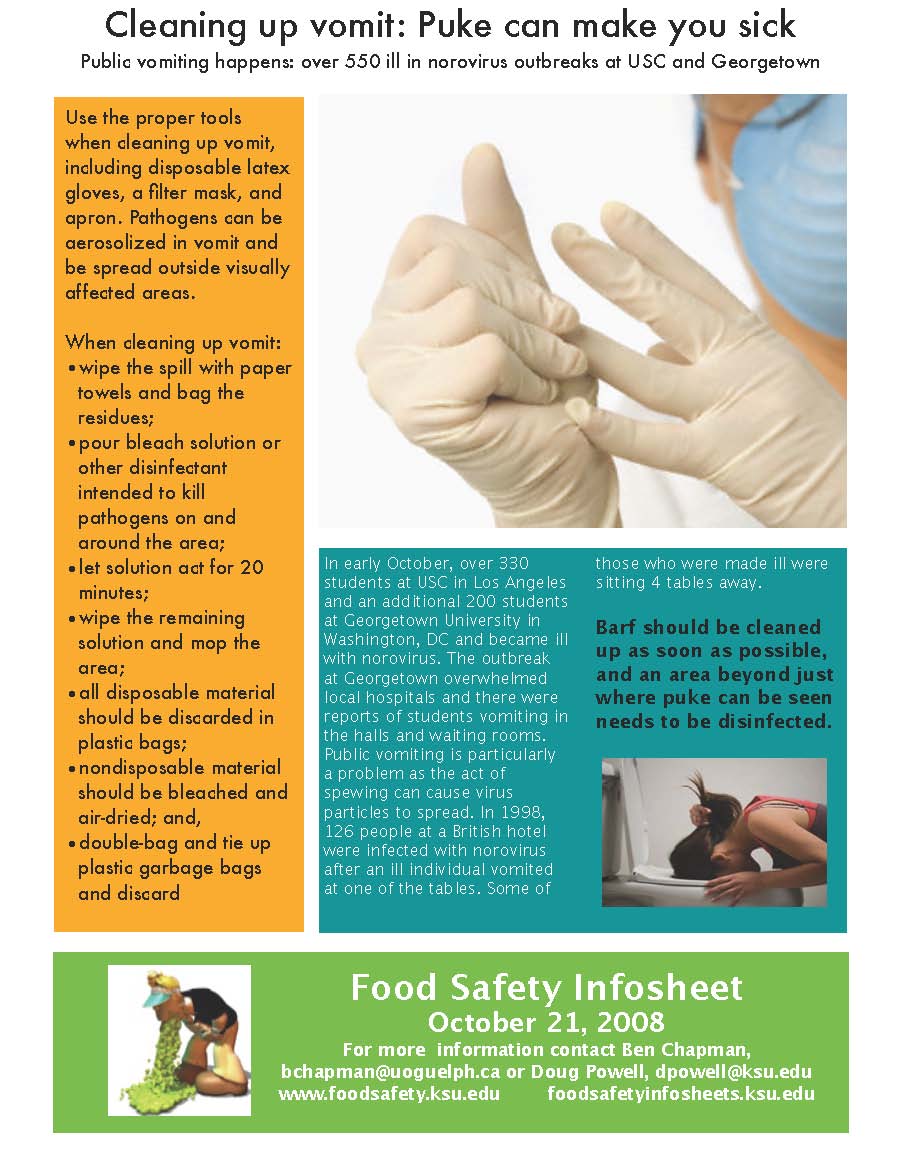
Vomit and other body fluids are potentially contaminated and can easily spread diseases like norovirus if not properly handled. Spills should be immediately cleaned and the area within 25-foot radius properly disinfected.

At Kansas State University, students and faculty are advised to notify the custodial department immediately and to avoid coming into contact with vomit, according to John Woods, director of Facilities Services.

“Custodians are supposed to be trained to go in and handle vomit,” Woods said. “We will be limiting the number of staff authorized to handle vomit.”

Woods explained that custodians are required to wear gloves, goggles, and a mask. They are supposed to spray the area, wait a few minutes, and scoop the vomit in a plastic bag with paper towels. They turn in the plastic bag to public safety.

‘Razors in my stomach’ The human face of Harvey’s E. coli outbreak

Steve Carleton dubbed himself "Number 6" because when he was overcome with fierce stomach cramps last week and admitted to a northern Ontario hospital, health-care workers started numbering the beds.

While he jokes now that he "beat the rush," the 22-year-old North Bay police constable turns serious when recalling his bout with E. coli during an outbreak that, as of Sunday, may have sickened upwards of 159 people, mostly in his home town.

"It was like I had razor blades rolling around in my stomach, it was so excruciating," Carleton said.

"The pains were enough (that) you couldn’t stay in bed or sit down, because you’d sit down and it’d hit you again and you’d be up and it’d give you that urge and you’d have to run to the washroom again."

Carleton spent four, IV-drip-fuelled days recovering in hospital. He said he had earlier eaten a bacon cheeseburger at one of the busiest Harvey’s restaurants in the area.

"I consider myself pretty fit, and a healthy all around person," said Carleton, who exercises several times a week. "I couldn’t imagine an elderly person, or even a young child, being able to fight their way through it."

Baby barfs on Ben – Wiggles handwashing song to blame

PhD student Ben Chapman excitedly sent me this picture last night of baby barf. First-time parents get excited about things like that, along with the color, frequency and aroma of baby poop.

First-time parent-to-be Amy got excited last night as I got to display my story-telling skills at the last pre-natal class of parents-to-be. The instructor asked for a volunteer, and someone volunteered me as the “most experienced” which meant, “the old guy.”

The book was Robert Munsch’s 1986, Love You Forever, one of the most popular children’s books ever, with some 8 million copies sold (my kids preferred The Paper Bag Princess, while I preferred Good Families Don’t, because it’s about farts).

I gave an animated telling of the story, complete with bad singing, based on years of practice, and because I’d seen Guelph-resident Munsch tell the story a few times. That was 20 years ago, and I was wearing the same hoodie (left)

Seeing as it’s Global Handwashing Day and in keeping with the kiddie theme, I note “United Nations Children’s Fund (UNICEF) Goodwill Ambassadors, The Wiggles, have created a catchy tune to help motivate millions of children worldwide to transform the mundane act of handwashing into an enjoyable habit, thereby improving hygiene and reducing the risk of disease.”

Here’s my parenting approach: kid, wash your damn hands.

Barfing 101 – How to handle vomit in the classroom

Amy brought up the question of how to handle barfing in class, when one of her students vomited during an exam. She said the student cleaned most of it, but she participated in the cleaning too.

At Kansas State University, students and faculty are advised to notify the custodial department immediately and to avoid coming into contact with vomit, according to John Woods, director of Facilities Services.

“Custodians are supposed to be trained to go in and handle vomit,” Woods said. “We will be limiting the number of staff authorized to handle vomit.”

Woods explained that custodians are required to wear gloves, goggles, and a mask. They are supposed to spray the area, wait a few minutes, and scoop the vomit in a plastic bag with paper towels. They turn in the plastic bag to public safety.

 

Quebec cheese linked to two deaths, one miscarriage, 120 illnesses — gets government bailout

I was a fan of Quebec agriculture minister Laurent Lessard.

After two separate outbreaks  — one listeria, one salmonella – in Quebec-made cheese that killed two, caused one miscarriage, sickened six other pregnant women and their newborn babies, and sickened a total of about 120 people, Lessard ordered a crackdown.

When asked about compensation for cheese retailers who had to discard potentially contaminated product, Lessard said on Sept. 17,

"The province is not there to compensate. We aren’t an insurance company."

Retailers have a responsibility to market safe products, and if there’s a risk associated to what they’re selling they have to absorb the losses, he said.

But being astute about Quebec politics and the role of dairy producers, Lessard didn’t rule out possible compensation for cheese producers, even though provincial food inspectors found traces listeria in 16 different establishments, either on cheese or processing equipment.

Three weeks later, and it appears that politics has caught up with the public health overtures of Monsieur Lessard as he announced Friday that Quebec’s small cheese producers and retailers will receive a three-year, $8.4-million provincial aid package, along with $11.3-million in interest-free loans.

"I want to reassure Quebec consumers. All of Quebec’s cheese producers are presently offering safe and secure products.”

Approximately half of the aid package will be spent on improving quality control. Government inspections will be conducted monthly, the minister said, and retailers will receive guidelines on improving the handling of cheeses.

Producers and retailers reported a significant drop in sales of Quebec cheeses, which last year alone totaled $2.6-billion.

Where’s the compensation for the sick people? Where’s the effort to accurately present the risks of soft cheeses (oh, and deli meats) to certain populations, like pregnant women and the elderly.

I’m not such a fan anymore.