Food Safety Talk, a bi-weekly podcast for food safety nerds, by food safety nerds. The podcast is hosted by Ben Chapman and barfblog contributor Don Schaffner, Extension Specialist in Food Science and Professor at Rutgers University. Every two weeks or so, Ben and Don get together virtually and talk for about an hour.
They talk about what’s on their minds or in the news regarding food safety, and popular culture. They strive to be relevant, funny and informative — sometimes they succeed. You can download the audio recordings right from the website, or subscribe using iTunes.
Show notes and links so you can follow along at home:
Chipotle advertising before and since the crisis promises “Food with Integrity.” This is an interesting choice for a marketing slogan. Would anyone in their right mind want to eat food at a restaurant without integrity?
Chipotle frames the consumer choice as a moral one and uses a form of virtue signaling to draw customers. “We’re good and moral and if you buy our food you’re good too.”
It’s a smart marketing strategy. It recognizes that a culture obsessed with outward appearance of virtue will purchase more of a product they believe demonstrates virtue.
In short, customers buy more Chipotle when they identify with trigger words like organic, natural, locally sourced, sustainable, non-GMO, and so on.
Whatever the future holds for Chipotle the case raises interesting cultural questions.
In developed nations organic food seems largely a fad of the wealthy. By contrast in poor nations there is frequently no choice — everyone eats organic because cow dung, with its E. coli, is often all there is to fertilize crops. Nearly all of Africa’s farms live the slow food dream and are de facto “organic.”
Whatever the pros and cons, there is nothing inherently wrong with a preference to eat food fertilized with cow manure rather than with a nonbiological fertilizer.
Why, in wealthy nations, is this food market growing so fast? Organic food is typically 50 percent more expensive than alternatives. It is clearly not an economic decision. Something greater enters into decision making, something moral, even spiritual.
Perhaps it is because organic is associated with “natural.” Who wants to eat something labeled chemical, modified, synthetic, or unnatural?
Whether the visceral reaction is correct or not is beside the point. Organic food gets the benefit of the doubt and is generally considered pure, good, just the way God made it, because it is unsullied by the “improvements” of humans.
But in fact, all things being equal organic food is not necessarily more health giving. Organic produce contains natural pesticides, usually more than in produce grown using conventional pest management. At least, with conventional produce, one can wash off synthetic pesticide residues.
Try questioning the rationale of organic food at your local raw, whole, or organic market (or your church) and discover, as one reporter did, that some find this “not just akin to doubting the virtues of motherhood, but to reveal indifference to the poisoning of the nation and the fate of the planet.”
The assumption that Mother Nature always knows best is an important factor in the explosive growth in the organic market. For many it’s no longer just about food but about a sense of moral satisfaction, even a kind of righteousness.
In 2015, Minnesota counted 973 people with state-confirmed Salmonella, the most since health officials started tracking in the early 1990s. Cases were up 35 percent over 2014, according to the Minnesota Department of Health, with 115 people affected by the outbreak linked to Chipotle.
“It was a huge outbreak, the biggest salmonella outbreak [in this state] since 1994,” said Kirk Smith, the health department’s head of foodborne disease investigations.
The Chipotle case, along with a huge national outbreak last year involving cucumbers, highlights a growing problem: the spread of foodborne disease through produce.
Tomatoes connected to the Chipotle outbreak were traced back to a farm in Virginia, a big tomato-growing area linked to several salmonella outbreaks in the past 15 years.
Chipotle, hit by a series of foodborne illness outbreaks last year, did not return calls for comment.
Chipotle was cooperative in Minnesota’s investigation, Smith said, and analyzed its own supply chain data to determine that tomatoes linked to the outbreak likely came from a farm in Virginia.
According to the health department, the tomatoes were sold by Lipman Produce, an Immokalee, Fla.-based company that on its website bills itself as North America’s largest open field tomato grower.
Lipman’s CEO didn’t respond to requests for comment, but in a response to a lawsuit, the company denied that it was the source of the outbreak in Minnesota.
The Virginia tomatoes were sold to a produce wholesaler that packed or repacked them, and then moved on to a distributor that delivered them to Chipotle. Where exactly the tomatoes were tainted has not been identified, and the U.S. Food and Drug Administration (FDA) says it’s investigating.
Smith and other foodborne illness experts say contamination of produce usually occurs in unsanitary packing houses or in the fields, particularly through contaminated water.
From 1990 to 2010, there were 15 multistate salmonella outbreaks linked to raw tomatoes; four were traced to farms or packing houses in Virginia.
Virginia’s tomato industry is centered on its eastern shore, a peninsula framed by Chesapeake Bay and the Atlantic Ocean. Its gull and geese populations have been fingered as possible carriers of salmonella, as have chicken farms and processors to the north.
Whatever the reason, surface water and sediment in the area appear to be “long-term reservoirs of persistent and endemic contamination of this environment,” according to a study published last year in Frontiers in Microbiology.
The largest U.S. foodborne incident in 2015 was a Salmonella Poona outbreak that sickened 888 people nationwide, killing six. That outbreak included 43 illnesses in Minnesota, though no deaths.
The culprit: cucumbers imported from Mexico. It was the third significant U.S. outbreak of salmonella linked to cucumbers in three years.
The Daily Meal asked the public what impact, if any, the six-foodborne-illness-outbreaks-in-six months has had on the number of times they dine at Chipotle.Dan Myers writes 450 people responded, and here are the results:
I’ve never eaten at Chipotle, and I’m not about to start now: 5.9%
I’ve cut back on dining there, but haven’t completely stopped: 6.8%
I held off during the outbreak, but will start eating there again now that it’s over: 13.8%
It didn’t affect my Chipotle addiction at all: 21.8%
I’ve stopped dining there completely: 46.5%
Nearly half of all respondents have sworn off Chipotle completely, while only a relatively small percentage is planning on returning at all! At the other end of the spectrum, however, more than 20 percent of respondents remained loyal throughout the outbreak, food poisoning risk be damned. These loyalists weren’t enough to fend off a major drop in sales, however.
Chipotle has spent millions of dollars trying to woo customers back, and will continue to spend more, and the chain is confident that this plan will work. But if nearly half of its customer base swears the chain off for good, can it ever really recover?
That was a boring super bowl, full of gimmicks and a quarterback pushing Bud Light as his soundbite, but it won’t be as boring as Chipotle’s two-hour wankfest when they close their almost 2,000 outlets for a food safety pep talk.
It’s not food safety, it’s a marketing gimmick (which is how Chipotle has been getting money all along).
And they’re going to show how much they know about food safety risk communication.
Or how bad their PR consultants are.
The meeting will go over an improved farm-to-fork food safety program, which the chain implemented in January. It includes paid sick leave to make sure employees will stay home when they’re sick, DNA-based testing of ingredients before they’re shipped to restaurants and some changes in food preparation protocols.
Why didn’t they do this before?
Because there’s money to be made in marketing hucksterism.
Ask Dr. Oz.
About 500 people got sick last year from outbreaks due to Norovirus, E. coli O26 and Salmonella,, including an entire basketball team at Boston College. Some of the sickened diners have sued Chipotle. Profits plunged 44% in the fourth quarter compared to the year before. The U.S. Justice Department is investigating the company for possible criminal activity.
“The creative for this campaign, with one small exception, does not mention food safety or the recent incidents,” he said. “Instead, it reinforces our commitment to high-quality ingredients and great-tasting food.”
Market food safety. High-quality ingredients don’t mean shit (literally and metaphorically).
Beating up on Chipotle and hucksterism gets tiring. So let John Oliver do it.
Nice to see my microbiological friends Linda Harris and Trevor Suslow, both of the University of California, Davis, mentioned in this National Geographic piece.
Rachel Becker writes that Chipotle Mexican Grill has had a rough couple of months.
In early December, Chipotle declared that it would revamp its food handling practices to become an industry leader in food safety. It even took the unprecedented step of announcing it would close more than 2,000 locations for four hours on February 8 so employees could attend a company-wide meeting broadcast from Denver to discuss the company’s new food safety procedures.
But the bad press just keeps coming. In a country where foodborne illnesses sicken 48 million people, hospitalize 128,000, and kill 3,000 each year, does Chipotle deserve the scrutiny it’s been getting? Or is the company that makes its money selling “Food with Integrity,” shunning the standard fast food supply chain in favor of “responsible” food, just getting picked on for trying to stand out?
Linda Harris, a food safety microbiologist at the University of California, Davis (left, exactly as shown, and she was on my PhD advisory committee), thinks that the scrutiny is fair, adding that the number of outbreaks Chipotle has had this year is “verging on the ridiculous.”
“I think if other restaurants have had problems over that time frame and in those states, it would have been reported as much as it was for Chipotle,” she says.
In July, five people in Seattle came down with E. coli O157:H7 infections after eating at a local Chipotle. Then in August, norovirus struck a southern California Chipotle, sickening a final count of 234 people including 18 employees according to Ventura County environmental health spokesperson Doug Beach.
Around the same time, tomatoes contaminated with Salmonella Newport found their way into 22 Chipotle locations in Minnesota, infecting 64 people. Between October and December two strains of another type of E. coli, E. coli O26, infected 60 people in total who had eaten at Chipotle. To cap off a series of unfortunate events, in December 136 people were infected with norovirus in Boston after eating at the fast-casual restaurant—the outbreak was traced back to a sick employee.
Fortunately, there have been no deaths. But there has been a lot of diarrhea.
Chipotle has taken steps to address the problems. It’s moved tomato, lettuce, and cheese preparation to a central kitchen, implemented more testing for dangerous microbes, added a blanching step for some of the produce, changed marinating procedures, and added financial incentives for restaurant managers that are contingent on high food safety audit scores.
But it wasn’t enough to stop the financial bleeding. The restaurant announced on February 2 that revenue went down the toilet in the fourth quarter of 2015 with a 44% decrease in profit.
Doug Powell, a former professor of food safety at Kansas State University and founder of the appropriately named food safety blog, barfblog.com, says that he anticipated these outbreaks at Chipotle years ago.
“I’ve pointed this out since 2007,” he says. “They were more concerned about GMO-free, sustainable, natural, antibiotic-free—and in my experience when you do that, you tend to lose your focus on the things that actually make people sick.”
(Chipotle, to some extent, also anticipated these problems; their 2014 Annual Report listed food borne illness as a potential consequence of their emphasis on using fresh produce in their restaurants.)
Chris Arnold, a Chipotle spokesperson, disagrees that Chipotle’s priorities were misplaced. “I don’t think there is any validity at all to that,” he says. “We have always maintained food safety programs that are consistent with industry standards. These incidents have shown us that we need to do better, and that is what we are doing.”
Trevor Suslow, who specializes in food safety of produce at University of California, Davis, says that assessing whether Chipotle’s new food handling strategies will be effective requires that Chipotle make more details available. He expressed concerns that blanching—dipping foods into boiling water for a matter of seconds—might not kill certain kinds of bacteria embedded in produce or coating food items in a biofilm.
And Suslow, Harris, and Powell also note that there are limits to how much food testing can protect a food supply chain. “Product testing is a very last icing on the cake, if you will, of food safety management. It’s a verification activity only. It should not be the basis of your food safety management program,” Harris says.
Chipotle spokesperson Arnold responds that testing is an important part of their new plans, but not the only part. It’s “the layering of all of these program components that contribute to the strength of the whole food safety program,” he says in an email.
Instead, Harris and Powell say, the key to avoiding repeated outbreaks is a systemic culture of food safety.
“I think it really goes back to Chipotles’ attitude,” Powell says. “They want to put all of their money into sustainable, GMO-free, organic, whatever. That’s great. I don’t really care about how it’s grown. I care if it’s going to make people barf.”
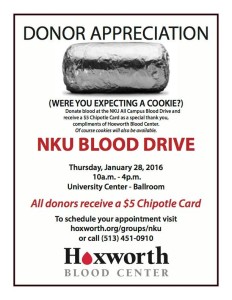
Chipotle is apparently targeting its hipster university campus demographic – the people who buy into Chipotle’s marketing BS – by offering a $5 off coupon for blood donations at Hoxworth Blood Center, which is associated with the University of Cincinnati Medical Center.
barfblog.com readers, please forward any other dubious marketing attempts to dpowell29@gmail.com.
Sure it was 4 a.m., I was talking with Joseph Erbentraut of The Huffington Post, getting ready for hockey, and didn’t want to deal with niceties.
It’s been six months since the start of Chipotle’s food safety crisis — a series of six outbreaks that have sickened at least 500 people.
The company has apologized for the outbreaks of norovirus and E. coli, tweaked its cooking methods and announced that it will temporarily close all its stores for a companywide food safety meeting on Feb. 8. But with an investigation by the Centers for Disease Control and Prevention still underway, it appears the company still hasn’t identified the source of the contamination.
Chipotle spokesman Chris Arnold pointed The Huffington Post to a Jan. 19 press release announcing that the company’s “comprehensive new food safety programs” are largely already in place, and that it will be sharing information with its employees at the Feb. 8 meeting about what they believe caused the food safety issues.
Doug Powell, a former Kansas State University food safety professor and the publisher and editor of Barfblog, a popular food safety blog, isn’t convinced. He’s been wary of Chipotle for almost a decade now, and has his doubts that the company’s new approach will solve anything.
HuffPost recently spoke with Powell about why Chipotle has struggled in its response to the outbreaks — and what it should be doing instead.
This interview has been edited for length and clarity.
Why is it taking Chipotle so long to figure out the source of this E. coli outbreak, compared to the other food safety issues they’ve had over this last year?
Never underestimate the power of denial. The epidemiology is clear that there was an outbreak involving E. coli O26, and in this case it was probably from the cilantro or some other fresh produce item that wasn’t cooked. Fresh produce is the biggest source of foodborne illness in the U.S. and has been for the last 10 years, and that’s because it’s not cooked. We want it fresh.
Somehow in the last five years in the U.S., the produce folks have gotten much more aggressive about having to test [bacteria] in the product and find it. Tell any scientist that and they’ll say that’s bullshit, because it’s a fresh product, so it’s here and gone and we’re not going to find [bacteria]. Testing really only tells you that this one really minor sample, in this one batch, in one lot, came back negative. It doesn’t tell you much else. You can’t test your way to a safe food supply.
Chipotle has really built its brand around using fresh produce, and consumer demand for food like this has been rising. So the company has put itself in this risky position, right?
It doesn’t have to increase the risk. It means that they have to be better at having on-farm food safety plans for their suppliers and enforcing them. It seems to me that Chipotle was much more concerned about being natural, sustainable, GMO-free, hormone-free — anything but microbiologically safe — and that’s why they’ve had six outbreaks in six months. The two norovirus outbreaks have nothing to do with the on-farm contamination. That’s human.
They say they’ve introduced sick leave [on Wednesday], but they actually had it six months ago. They’re recycling press releases at this point, which tells me they’re kind of desperate. They’re all about the money and they’ve lost 47 percent of their stock value.
The company is facing a new class-action lawsuit this week, where it’s being accused of a cover-up in the norovirus outbreak in Simi Valley, California. How much damage has this done to Chipotle’s brand at this point?
It’s billions of dollars. It’s embarrassing that a company is allowed to get away with this sort of stuff, these multiple failures, while at the same time they’re charging a premium for “sustainable” food, whatever that means. All these adjectives that they use in their marketing don’t really mean anything. This is a company really focused on bullshit rather than being focused on microbiologically safe food. [Chipotle has emphasized that it is just as dedicated to using what it calls the highest-quality ingredients as it is to being an industry leader in food safety.]
Does the question of government regulation play a role in this?
Government is there to ensure a minimum standard. But they do not make the profit and they do not really enforce safe food. That is up to the company… You want to make the profit off the food, you’re going to be liable. So they’re taking some well-deserved hits at this point. Whether they’ll recover or not — they can, but just going to the PR solution and this gimmick of shutting all the stores down for two hours on Feb. 8 isn’t how you do training. It takes every week reinforcing the messages and focusing on one goal.
What should Chipotle be doing right now that it isn’t already? Are there examples to look to of similar companies that have handled this effectively?
They’ve followed the Jack in the Box model from 1993 in that they hired some food safety consultants and they’re listening to them. That’s good, but that is not going to change the culture within the organization. Those two norovirus outbreaks are cultural things more than anything. That’s not some mysterious bug coming in — it’s employees showing up sick to work. They can say they have strict procedures that sick employees don’t work, but anyone who’s ever worked at a restaurant knows what happens when you don’t show up to work. You’re done.
I don’t see, so far, that they’ve gotten that religious about food safety. They’ve hired some good consultants and they’ll do more testing and that’s all good, but when you’ve got 2,000 locations, that’s a pretty big vulnerability.