
A Minnesota high school science project that involved hunting and butchering deer — including one road-kill capture — and turning the meat into venison kabobs backfired when 29 students were sickened with a rare kind of E. coli food poisoning, investigators say.
Linda Carroll of msnbc reports the 2010 incident, just now reported in the journal Emerging Infectious Diseases (abstract below) highlights the risks of E. coli contamination, not just from factory-produced meat, but also from small, local providers.
Doctors first knew they had a problem in December 2010 when two kids from the same high school turned up at a Minnesota hospital with abdominal pain and bloody diarrhea. Fearing they  had a food poisoning outbreak on their hands, they quickly called in the state’s top-notch public health officials.
Both teens had taken part in a school environmental science and outdoor recreation class that involving hunting, shooting and butchering six white-tailed deer, explained Joshua Rounds, the study’s lead author and an epidemiologist with the Minnesota Department of Public Health. A seventh deer was harvested after being hit by a car, the report says.
The deer were processed on school grounds and then grilled and eaten in class a few weeks before the students got sick.
Epidemiologists interviewed 117 kids in five class periods and found that 29 definitely had become ill, but not with E. coli O157:H7, the strain commonly associated with food poisoning from ground beef.
Rounds suspected the deer might have carried another E. coli strain that also produces poisons known as Shiga toxins. He was right. Samples from the students and the deer meet turned up E. coli O103:H2, which is part of a larger category of non-O157 Shiga toxin-producing E. coli bugs, known as STECs.
Scientists also turned up another E. coli strain, E. coli O145:NM that didn’t produce Shiga toxins.
People don’t usually get sick from eating hunks or steaks of muscle meat, Rounds said. In this case, however, the meat had been skewered and cooked only to medium-rare. The skewers had dragged contaminants from the meat’s surface down to the center of the kabobs, which hadn’t been cooked to a high enough temperature to kill the bacteria.
Another factor was hand-washing when handling meat — or the lack of it, Rounds said.
“If you think about high school males, they’re probably not the best when it comes to food safety practices,” he said. “So you can have cross-contamination.”
The case is a reminder, Rounds said, that all meat, no matter where it comes from, should be treated with careful precautions.
Rounds JM, Rigdon CE, Muhl LJ, Forstner M, Danzeisen GT, Koziol BS, et al. 2012. Non-O157 Shiga toxin–producing Escherichia coli associated with venison. Emerg Infect Dis http://dx.doi.org/10.3201/eid1802.110855
Abstract
We investigated an outbreak of non-O157 Shiga toxin–producing Escherichia coli at a high school in Minnesota, USA, in November 2010. Consuming undercooked venison and not washing hands after handling raw venison were associated with illness. E. coli O103:H2 and non-Shiga toxin–producing E. coli O145:NM were isolated from ill students and venison.
 strain turned up in samples from fields in three separate locations.
  deer were the source of contamination of the strawberries," Keene said.
  sickened 15; four people went to the hospital, including two people who suffered kidney failure.
.jpg) But the calls didn’t stop there. What they discovered is that the berries sometimes changed hands, traveling from buyer to farmers markets and then to consumers.
But the calls didn’t stop there. What they discovered is that the berries sometimes changed hands, traveling from buyer to farmers markets and then to consumers.  thoroughly. I was in bed, bemoaning the state of my insides, but that’s another story.
 In order to continue this wonderful tradition, Miller Park Zoo has designed ornaments and necklaces using actual reindeer droppings. If you adorn your tree or wear this necklace on Christmas Eve, it will help Santa and his reindeer find their way to your home. Because each ornament is handmade, they vary in size, shape and color. Gem pieces are hand made by volunteers with all proceeds benefiting Miller Park Zoo.
 April placed the pieces of meat into freezer bags, handling the meat with her hands.
 That’s the advice from Erie County Health Commissioner Dr. Anthony J. Billittier IV after a dead deer was discovered being butchered in a restaurant.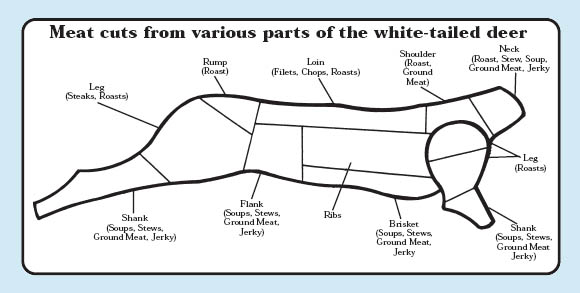
 I grew up in a deer hunting family, and although my own deer hunting career started and ended when I was 13, I was so used to eating venison that beef tasted weird. I still remember one deer my family butchered at home, and my brother chased me around the house with an eyeball. We packaged and marked the cuts, but they stayed in our family freezer. Perhaps we had some guests over for dinner or gave some to a friend at church, but if anyone got sick, it was us.