The South Dakota department of health is investigating several cases of E. coli in northeastern South Dakota.
The cases are in and around the Sisseton area.
According to state epidemiologist Joshua Clayton, some of the symptoms of E-Coli are bloody diarrhea and abdominal pain without any fever.
Those who have symptoms should see their medical provider and get tested. Clayton also said the state is still working to determine the source of the E-Coli.
“At this point, we have not identified a single source that’s causing the illnesses up in the area,” Clayton said. “But we are investigating to identify what might be common among the cases that we know of. The department of health is contacting those individuals and identifying where they may have been the time leading up to their illness.”
E. coli can cause an unpleasant diarrhoeal illness with stomach cramps and occasionally fever. Most people will recover without the need for medical treatment, but younger and older people may go on to develop complications of the infection, leading to kidney failure. This rare condition is called haemolytic uraemic syndrome (HUS), which in very rare circumstances can be fatal.
E. coli is caught through ingesting contaminated food or water.
PHE recommends travellers to the region to: where possible, avoid eating salads and uncooked vegetables;
only eat fruit they can peel avoid unpasteurised milk, cheese and ice cream
avoid food that has been left uncovered in warm environments and exposed to flies ensure all meat is cooked thoroughly before you eat it, avoiding any meat that is pink or cold avoid ice, unless made with filtered or bottled water, and tap water, even when brushing teeth
only drink bottled water or use ice made from bottled/filtered water
wash your hands thoroughly after visiting the toilet, and always before preparing or eating food. Alcohol gel can be helpful (but not entirely effective) when hand washing facilities are not available
when swimming, try and avoid swallowing water where possible and supervise children when swimming.
Andie Fontaine of Grapevine writes that 16 children have been diagnosed with E. coli, and concerns have been raised that tourists may spread it further, RÚV reports.
The outbreak is purported to have originated in Efstadal 2, a farm and restaurant near Laugarvatn, after a group of school children visited the place, with some of them contracting E. coli. To be clear: none of the food nor any of the employees tested positive for E. coli. Rather, it is all but certain the bacteria originated from the faecal matter of calves on the farm.
Health authorities have pointed out that there are many rural restaurants in Iceland that are located near farms, prompting a more thorough investigation into stopping the infection’s spread. Further, these locations are visited by many tourists, which could potentially increase the risk of spreading E. coli.
Ottawa, July 16, 2019 – Northfork Bison Distributions Inc. is voluntarily recalling ground bison products from the marketplace due to possible E. coli O121 and O103 contamination. Consumers should not consume the recalled products described below.
Packed on 19-02-22
Packed on 19-02-25
Packed on 19-02-26
Packed on 19-02-27
Packed on 19-02-28
Packed on 19-03-01
Northfork Canadian Bison Ranch
Bison ground regular
1.25 kg
86768420002577
Packed on 19-02-22
Packed on 19-02-25
Packed on 19-02-26
Packed on 19-02-27
Packed on 19-02-28
Packed on 19-03-01
Northfork Canadian Bison Ranch
Bison ground regular
4.54 kg /10 lb
86768420002263
Packed on 19-02-22
Packed on 19-02-25
Packed on 19-02-26
Packed on 19-02-27
Packed on 19-02-28
Packed on 19-03-01
Northfork Canadian Bison Ranch
Bison ground 10 lbs regular
4.54 kg
96768420111061
Packed on 19-02-22
Packed on 19-02-25
Packed on 19-02-26
Packed on 19-02-27
Packed on 19-02-28
Packed on 19-03-01
Northfork Canadian Bison Ranch
Bison Ground 1 l b regular
0.45 kg / 1 lb
96768420111054
Packed on 19-02-22
Packed on 19-02-25
Packed on 19-02-26
Packed on 19-02-27
Packed on 19-02-28
Packed on 19-03-01
Northfork Canadian Bison Ranch
Bison Burger 20 x 8oz
2 lb
96768420111092
Packed on 19-02-22
Packed on 19-02-25
Packed on 19-02-26
Packed on 19-02-27
Packed on 19-02-28
Packed on 19-03-01
Northfork Canadian Bison Ranch
Bison Burger 4oz x 4
1 lb
96768420111184
Packed on 19-02-22
Packed on 19-02-25
Packed on 19-02-26
Packed on 19-02-27
Packed on 19-02-28
Packed on 19-03-01
What you should do
If you think you became sick from consuming a recalled product, call your doctor.
Check to see if you have recalled products in your home. Recalled products should be thrown out or returned to the store where they were purchased.
Food contaminated with E. coli O121 and O103 may not look or smell spoiled but can still make you sick. Symptoms can include nausea, vomiting, mild to severe abdominal cramps and watery to bloody diarrhea. In severe cases of illness, some people may have seizures or strokes, need blood transfusions and kidney dialysis or live with permanent kidney damage. In severe cases of illness, people may die.
Outbreak News Today reports Iceland health officials have reported four pediatric Shiga-toxin-producing E. coli (STEC) cases. Officials say all the children are from the capital of Reykjavik; however, all have probably been infected in Árnessýsla county or, more specifically, in Bláskógabyggð.
The source of the infection is unknown at this time. The Icelandic Food and Veterinary Authority and the South Iceland Health Inspectorate are now working to analyze the origin of the infections and stop further spread.
The study examines the influence, and potential confluence, of message framing and issue involvement on consumer food safety perceptions. We assess the impact of gain and loss-framed messages and issue involvement on perceptions of two food safety enhancing technologies, cattle vaccines against E. coli and direct-fed microbials.
A survey with six information treatments was developed. Empirical results show that both loss-framed and gain-framed messages were persuasive in influencing safety perceptions of the two technologies under low issue involvement. Under high issue involvement, however, only the loss-framed message influenced consumers’ safety perceptions. High issue involvement also heightened concerns about foodborne infections.
Shaping food safety perceptions: The Influence of informational nudges
The testing was carried out on around 600 samples of lamb, beef, pork, and chicken of both Icelandic and foreign origin between March and December 2018. The purpose of the testing was to determine the prevalence of pathogenic micro-organisms in products when they reach the consumer, and for this reason the samples were taken from shops.
Campylobacter and salmonella were not detected in pork or chicken samples, with the exception of a single sample of pork from Spain. MAST attributes this to improved preventative measures in slaughterhouses.
MAST points to several ways consumers can reduce the risk of infection from salmonella, campylobacter, and E. coli, including cooking meat all the way through and taking care to avoid cross-contamination. Most E. coli is found on the surface of meat, and therefore is killed by frying or grilling, but when meat is ground, the bacteria is distributed throughout. Therefore, hamburgers and other types of ground meat should be cooked through.
Sixteen-year-old Anna Rexford is, according to this story, a winner. Not only is she the goalkeeper for the two-time state champions West Jessamine High School girls’ soccer team, Anna was named MVP for the tournament two years in a row. After her first season at West Jessamine, she committed to playing for University of Cincinnati and is a contender to play in the Allstate All-America Cup this summer. Clearly, Anna is at the top of her game. But just three short years ago, a harrowing illness made her future uncertain.
Anna Rexford on June 7, 2019. Photo by Mark Cornelison | UKphoto
In July 2016, Anna and her mother Tracy went on a week-long mission trip to Haiti. Tracy is a nurse, and the two spent the week doing health screenings and nutrition programs for children. Anna played with the local children nonstop during that week, challenging them to soccer and leading them in games.
“She gave 110 percent,” said Tracy. “She was always with the kids, playing and giving her whole heart to them.”
Within hours of returning home to Wilmore, Anna began to feel unwell. She had pounding headache and her whole body hurt. Her mother took her temperature. It was a staggering 106.8 degrees.
“I knew, as a nurse, that was almost incompatible with life and that we needed to get help,” said Tracy.
Anna was admitted to Kentucky Children’s Hospital and diagnosed with a rare case of four different strands of E.coli, two of which were toxic. She was showing signs of sepsis, a bacterial infection of the blood, as well as organ failure.
“There was one particular night where I didn’t think she would make it,” said Tracy. “There were some confusing times, questioning God, “‘God, you called a 14-year-old passionate Christian to go and serve, and you want to end it like this? You want to end it where she dies?'”
I revealed last week I was nervous about doing a media interview, because I’ve been out of the game for a while, and my brain, just don’t work so well.
Fell again today and it hurt.
I have no balance.
But I still have a brain.
So when a U.S. reporter agrees to chat at 4 a.m. EST (6 p.m. EST) I say sure, because I’ve always been a media whore. How else to spread the message.
I particularily like the lede.
Kate Bernot of The Take Out wrote, “If you ask anyone in food safety, ‘What is the one food you will not eat?’ Raw sprouts tops the list, always.”
That’s one of the first sentences out of the mouth of Doug Powell, a former professor of food safety and the publisher of barfblog, a frequently updated site that publishes evidence-based opinions on food safety.
I’ve asked him whether food-safety fears about sprouts—those tiny, crunchy squiggles in your salad or sandwich—are well-founded. He tells me the public isn’t concerned enough about them.
“Risk is inherent in the nature of the product which is why Walmart and Costco got rid of them,” he says. (Kroger also stopped selling sprouts in 2012.) “This is not a new problem. It’s been going on for decades.”
According to a paper he and three colleagues published in the journal Food Control in 2012, sprouts have been responsible for at least 55 documented foodborne outbreaks affecting more than 15,000 people globally in the past two decades. The Food And Drug Administration tallies 46 reported outbreaks of foodborne illness in the United States linked to sprouts between 1996 and 2016, accounting for for 2,474 illnesses, 187 hospitalizations, and three deaths. In an effort to reduce these outbreaks, the FDA in 2017 collected 825 samples of sprouts from across the U.S.; 14 of those tested positive for E. coli, listeria, or salmonella.
The first reason sprouts—whether alfalfa or mung bean or radish or other varieties—can carry E. coli or salmonella bacteria has to do with how the sprouts are produced. The conditions that cause a seed to sprout are the same conditions that cause bacteria to breed: warm, moist air.
“The sprout is made from germinating seeds and the seeds themselves may be the source of the contamination. When you’re germinating a seed and growing a sprout, you’re providing conditions for the sprout growth that are ideal also for bacterial growth,” says Craig Hedberg, a professor in the School Of Public Health at University Of Minnesota. “This is a product that went through incubator-like circumstances.”
The second reason is related to how most of us consume sprouts: raw. Because we value sprouts’ crunch, we rarely cook them before adding them to a dish. Powell notes that people in many Southeast Asian countries do blanch their sprouts before cooking with them, but that the West tends to consume them raw.
“The seeds can get contaminated as they’re growing, so the contamination can be internal,” Powell tells me. “So you’re never going to wash it off.”
Sprouts do have their defenders, though, who note higher levels of soluble fiber, antioxidants, vitamins, and mineral bioavailability compared to non-sprouted grains and vegetables. The Academy Of Nutrition And Dietetics statesthat “in general, the health benefits associated with savoring raw or lightly cooked sprouts outweigh risks for healthy individuals. However, be aware that there is risk of food poisoning if you plan to eat them.”
The FDA recommends cooking sprouts thoroughly to kill bacteria, and further advises that the elderly, children, people who are pregnant, and people with compromised immune systems should not eat sprouts at all. To further reduce your risk of sprout-related foodborne illness, the FDA says consumers can “request that raw sprouts not be added to your food.” So, bottom line, if you’re concerned—yeah, just don’t eat them. May we suggest beet slivers or carrot ribbons for crunch?
I seemed to have missed this, which is inexcusable, volunteer or not, medical stuff for me or not, but here it is, a month later (and if I did publish it, shows where my brain is going).
Kristen and Brad Bell felt a little sick after eating the salad last October.
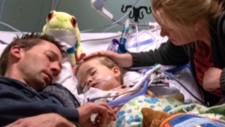
Their two-year-old son soon started to show more severe symptoms. Cooper Bell was vomiting. He developed diarrhea. Then his mother noticed the blood in his diaper.
“I had no idea [what] was happening,” Kristen Bell told CTV News from her home in Stirling, Ont.
“I thought ‘This is not normal.'”
An emergency room doctor thought Cooper might have contracted a bacterial infection. The family’s pediatrician agreed, saying the Bells should keep their son hydrated and bring him back in the morning.
Soon after the Bells returned home, they noticed some worrying changes in Cooper’s behavior.
“He wasn’t responding to me the same as he was earlier. It wasn’t long after that, that he had a seizure in Brad’s arms,” Kristen Bell said.
Seeing their son shaking uncontrollably with his eyes closed, the Bells called an ambulance. He spent a few hours in hospital in nearby Belleville, Ont., and was then airlifted to the Children’s Hospital of Eastern Ontario in Ottawa.
Doctors at CHEO diagnosed Cooper with kidney failure brought on by E. coli. He suffered cardiac arrest and died. The Bells believe it was the romaine lettuce that made Cooper sick, although they were unable to send the lettuce for testing to confirm their belief because it had been thrown out.
There were 29 illnesses and 10 hospitalizations reported across Canada during last fall’s E. coli outbreak, according to the Public Health Agency of Canada. It was one of three outbreaks in North America over the past year all of which were linked to romaine lettuce.
Keith Warriner, a food safety expert and professor at the University of Guelph in Ontario, said in an interview that the food industry has long been slow to improve its testing practices something that could improve overall food safety, but would mean extra costs for their operations.
“The industry itself has known for many years what it needs to do, but it’s just been reluctant to do it,” he said.
The Bells agree. They’re sharing their story of grief with the hope it will help hospital workers and other parents better understand the danger of E. coli, but also because they want to see changes at the food production level.
“E. coli shouldn’t be in our food,” Brad Bell said.
“The way that we’re growing food is dangerous, and something has to change.”