8 now sickened from E. coli burgers in Canada

A person in Saskatchewan has been confirmed with E. coli O157:H7  linked to a nation-wide outbreak, bringing the total to eight.

People began getting sick in Nov. 2012 and investigators honed in on burgers made by Cardinal Meats.

Matt McClure of the Calgary Herald reported yesterday that the outbreak raises questions about when to go public with health information.

“If we were in a situation where tons and tons of people were getting sick, we’d salmonella.hamburger.patty.recallprobably act faster,” Dr. Gregory Taylor, the health agency’s deputy chief, said.

“You don’t want to initiate a food recall unless you have good solid evidence that’s the offending product because there’s big implications … for the producer and marketer it’s a big loss and cost to them.”

The information from the three ill patients last fall did prompt the CFIA staff to quietly begin testing packages of the suspect Butcher’s Choice brand inspectors collected from store shelves.

But because none were initially able to provide a product box or a store receipt that would allow investigators to pinpoint a lot number or production day at the facility, the government didn’t sound the alarm.

Unable to find an unopened package in the market that was tainted, officials at the two federal agencies waited until the additional cases popped up on their computer screens in early December before convening an emergency meeting with their provincial counterparts.

Even then, federal employees believed there was inadequate proof to order a recall by a plant that churns out over $100 million in product each year.

The decision was made that another round of testing of product from store shelves was necessary. When CFIA found a contaminated package on Dec. 12, federal officials finally felt they had the scientific basis to issue a public health alert.

Some consumer advocates and food safety experts say the federal government’s handling of the Cardinal investigation and its delays during the XL Foods outbreak that left 18 people ill earlier last fall show it has conflicting priorities.

Rick Holley, a meat microbiologist at the University of Manitoba, thinks CFIA and PHAC could have acted sooner.

“They don’t have an excuse to wait for an analytical result from a food product,” Holley said. “Epidemiological evidence from patients is enough in Canada, just like it is in the United States.”

In the wake of the 2008 listeria outbreak at Maple Leaf Foods that killed 23 people and left dozens more ill, an independent investigator told CFIA and PHAC they should look more at the food histories of patients and depend less on finding tainted product on store shelves when deciding whether a health alert is warranted.

A new policy issued two years ago by Health Canada was supposed to ensure that the total weight of evidence would determine the course of action during future outbreaks.

“But because O157 still isn’t considered an adulterant under Canadian legislation,” said Holley, “I expect there’s still some reluctance to follow those rules.”

Beef trim from Canada, New Zealand and Australia had been used to make the tainted burgers, but investigators were never able to pinpoint a specific source of the contamination.

By Christmas Eve, though, CFIA officials thought they had all the tainted product off the shelves and issued a release to say their investigation was concluded.

Within weeks, they would be forced to resume their probe.

Two more patients — one in Manitoba and another in Ontario — fell ill last month from what PHAC now says is a strain of bacteria nearly identical to one found earlier.

Taylor said consumers shouldn’t depend on CFIA and PHAC staff to ensure their beef isn’t tainted.

“The consistent message we have to Canadians is to fully cook your hamburger,” he said. “We’ve got a good food safety system in this country, but nothing’s perfect.”


Meat safety management in complex world

I’m at the L.A. airport and can’t get to Kansas City for my interview to prove I’m worthy to be a U.S. citizen because of snow. Bloody Marys and free Internet ease the angst (I don’t really have angst).

And I won’t be at the seminar by Scott Goltry, vice president, technical services, American Meat Institute at 4 pm today at Kansas State University. scott.goltry.ami.feb.13But that’s what the Internet is for.

Scott provides oversight to AMI’s packer and processor members on current and proposed inspection related issues. He is responsible for audit harmonization, food defense and sanitary design of facility and equipment initiatives at AMI. Scott is a Kansas native and K-State alum.

The seminar takes place at the Mara Conference Center, 4th Floors, Trotter Hall – College of Veterinary Medicine.

The live stream will be available at

http://www.vet.k-state.edu/liveStream/liveStream.htm.

Did Salmonella in tea help those stars trim up for Oscars?

Watching the iconized stars walk the red carpet at the Oscars after their cayenne, lemon and tea detox to squeeze into those outfits I wonder: how many lost weight using the barf-from Salmonella diet?

Yesterday the Canadian Food Inspection Agency warned folks not to consume certain Tega brand Organic Lemon Hibiscus Green Rooibos Herbal Tea because it may be contaminated with Salmonella.

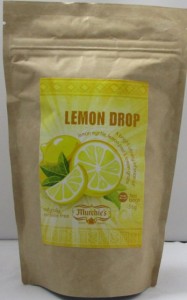
Today, CFIA added Murchie’s Lemon Drop Tea and Co-Op Gold Organic Pomegranate White Tea to the list.

Would Salmonella survive the tea-making process? Probably not. Is cross contamination a risk when handling a tea bag? Probably yes.

pomegranate.white.tea.salmlemon.drop.tea.salm

Horse meat blame game ‘audits are useless’

As Germans blame Poles, Ireland finds fraud, and Australians wonder what will happen to the 700 horses slaughtered each month at two abattoirs for human consumption overseas, a retired meat inspector told a UK sunnybrook-auditorgovernment committee the audit system is a “disgrace” and in need of a “total review.”

Food Navigator reports that in written evidence to the Environment, Food and Rural Affairs Committee, Paul Smith a retired inspector with 43 years of experience in the meat industry said, there is a “massive failure” of “multiple retailers” to monitor suppliers through appropriate inspections at appropriate intervals.

“The suppliers (the auditees) can select which “approved inspection body” they use. They also pay for the audit.

“In practice, they also pick which auditor by heaping praise on them followed by request for same individual next visit.”

I’ve yet to hear a company stand up and say, this is how we will prevent this in the future. Instead it’s just more of the same thing – audits and inspections – but in the future they will be really, really super serious.

That’s crazy.

We looked at why audits and inspections are never enough, and concluded:

• food safety audits and inspections are a key component of the nation’s food safety system and their use will expand in the future, for both domestic and imported foodstuffs, but recent failures can be emotionally, physically and financially devastating to the victims and the businesses involved;

• many outbreaks involve firms that have had their food production systems verified and received acceptable ratings from food safety auditors or horse.meat.09government inspectors;

• while inspectors and auditors play an active role in overseeing compliance, the burden for food safety lies primarily with food producers;

• there are lots of limitations with audits and inspections, just like with restaurants inspections, but with an estimated 48 million sick each year in the U.S., the question should be, how best to improve food safety;

• audit reports are only useful if the purchaser or  food producer reviews the results, understands the risks addressed by the standards and makes risk-reduction decisions based on the results;

• there appears to be a disconnect between what auditors provide (a snapshot) and what buyers believe they are doing (a full verification or certification of product and process);

• third-party audits are only one performance indicator and need to be supplemented with microbial testing, second-party audits of suppliers and horse.office.feb.13the in-house capacity to meaningfully assess the results of audits and inspections;

• companies who blame the auditor or inspector for outbreaks of foodborne illness should also blame themselves;

• assessing food-handling practices of staff through internal observations, externally-led evaluations, and audit and inspection results can provide indicators of a food safety culture; and,

• the use of audits to help create, improve, and maintain a genuine food safety culture holds the most promise in preventing foodborne illness and safeguarding public health.

Audits and inspections are never enough: A critique to enhance food safety

30.aug.12

Food Control

D.A. Powell, S. Erdozain, C. Dodd, R. Costa, K. Morley, B.J. Chapman

http://www.sciencedirect.com/science/article/pii/S0956713512004409?v=s5

Abstract

Internal and external food safety audits are conducted to assess the safety and quality of food including on-farm production, manufacturing practices, sanitation, and hygiene. Some auditors are direct stakeholders that are bureaucratemployed by food establishments to conduct internal audits, while other auditors may represent the interests of a second-party purchaser or a third-party auditing agency. Some buyers conduct their own audits or additional testing, while some buyers trust the results of third-party audits or inspections. Third-party auditors, however, use various food safety audit standards and most do not have a vested interest in the products being sold. Audits are conducted under a proprietary standard, while food safety inspections are generally conducted within a legal framework. There have been many foodborne illness outbreaks linked to food processors that have passed third-party audits and inspections, raising questions about the utility of both. Supporters argue third-party audits are a way to ensure food safety in an era of dwindling economic resources. Critics contend that while external audits and inspections can be a valuable tool to help ensure safe food, such activities represent only a snapshot in time. This paper identifies limitations of food safety inspections and audits and provides recommendations for strengthening the system, based on developing a strong food safety culture, including risk-based verification steps, throughout the food safety system.

Wash. steakhouse closed after 22 sickened with stomach flu

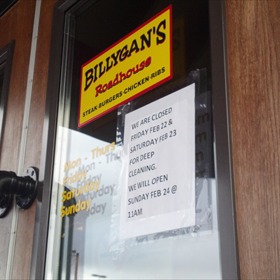
Billygan’s Roadhouse in Salmon Creek, Washington, was set to reopen today after being closed Friday when at least 22 people contracted gastroenteritis

Clark County Health Officer Dr. Diana Yu came to the decision to close the restaurant after consulting with the state Department of Health Food Safety Program. The health Salmon Creek steakhousedepartment said it is working with Billygan’s staff to sanitize the restaurant’s surfaces and equipment and dispose of possible contaminated food. 

“Restaurant management and staff are following all our recommendations,” Dr. Yu said in a press release.

Who uses girlfriend as gunrest? Did illegal deer meat make its way to Jersey restaurants?

Oh, Jersey.

According to nj.com, authorities said they could not find any evidence that two New Jersey restaurants illegally purchased deer meat from a chris.walken.deer.hunterman accused of forcing his girlfriend to hunt while he used her head as a gunrest.

A Belmar restaurant and a Raritan restaurant were mentioned in a criminal complaint against Mark N. Jarema, who was charged in Pennsylvania for allegedly forcing his then-girlfriend to help him illegally hunt, among other things.

The complaint also alleged Jarema sold the deer meat to the two restaurants.

“We did not file any charges against any restaurants,” said Department of Environmental Protection spokesman Larry Haina. “We were involved in providing information to the game commission, but we were not able to prove any connection to purchases or the sale.”

The Northeast Game Commission investigated Jarema after his girlfriend accused him of stealing a .30-06 caliber rifle from her mother’s house and using it to fire 30 shots, killing six to 10 deer before driving back to her mother’s house with three of the dead deer in 2010.

In her criminal complaint, the girlfriend said Jarema would sometimes use her head as a gun rest to steady the rifle.

The girlfriend said Jarema processed the deer in her mother’s basement on Oct. 24, and forced her to take pictures of him with the deer in various poses. Some of the poses show Jarema holding up the deer in his arms, some with beer bottles shoved in the deer’s mouths, according to the complaint. Others show the deer being “hung, skinned and and cut up for sale,” according to the complaint.

On Oct. 26, the girlfriend said, Jarema loaded the deer into the truck and had her drive him to the restaurant in Belmar; then to the restaurant in Raritan; and then to an auto garage in Bridgewater.

I’ll have snapper, scallops, bay bugs and tuna; stories about mislabeled fish make me want authentic

As Europeans and others try to decide if that burger or frozen lasagna is made with horsemeat, rampant food fraud has once again been snapper.feb.13confirmed in U.S. seafood.

So I had to have fish for dinner.

A two-year investigation of seafood by the world’s largest ocean conservation group, Oceana, found a fillet red snapper could be cheap tilapia; a pricey wild-caught salmon steak from Alaska could be farmed Atlantic salmon from Chile; sushi in a restaurant could be anything.

Elizabeth Weise of USA Today reports Oceana’s volunteers collected fish samples at 674 supermarkets, restaurants and sushi counters in 21 states and found several examples of fish fraud. For instance, 87% of the snapper samples were not snapper. White tuna was mislabeled 59% of the time. Between one-third and one-fifth of the halibut, grouper, cod and Chilean sea bass tested were mislabeled.

“Honestly, it was a surprise,” says Beth Lowell, who coordinated the survey for Oceana. “Everywhere we looked for seafood fraud, we found tuna.feb.13,jpgit. It’s consistent around the country.”

At sushi restaurants, 74% had at least one sample come back mislabeled. At restaurants, 38% had at least one problem sample; in grocery stores, 18% did.

Oceana wasn’t able to determine whether the mislabeling occurred at the supplier, distributor or retailer. Seafood goes through many hands, so it’s easy for someone to substitute it, partly because 84% of the seafood eaten in the United States is imported, according to Gavin Gibbons of the National Fisheries Institute, a seafood industry trade group.

The good news for consumers is that Oceana found mislabeling only in the highest-priced seafood. The five most commonly eaten seafood types in the United States are shrimp, canned tuna, salmon, pollock (used in fish sticks) and tilapia, Gibbons says. All are low-cost and not often substituted.

Oceana’s Lowell offers this advice for consumers:

– Ask questions at the restaurant or market about where the fish comes from.

– When possible, buy a whole fish. Fish look different even when their fillets look similar. ​

Ocenana’s Lowell told the N.Y. Times, “Even a relatively educated consumer couldn’t look at a whole fish and say, ‘I’m sure that’s a red snapper and not lane snapper.’ ”

Reading about all this fish made me hunger for the real thing, or at least some form of verification, so off we went off to our local fish monger.

For lunch we had a chunk of Sashimi grade Yellowfin Tuna. How did I know it was what it proclaimed to be? Fishmonger showed me the rest fish.bbq.feb.13of the fish out back.

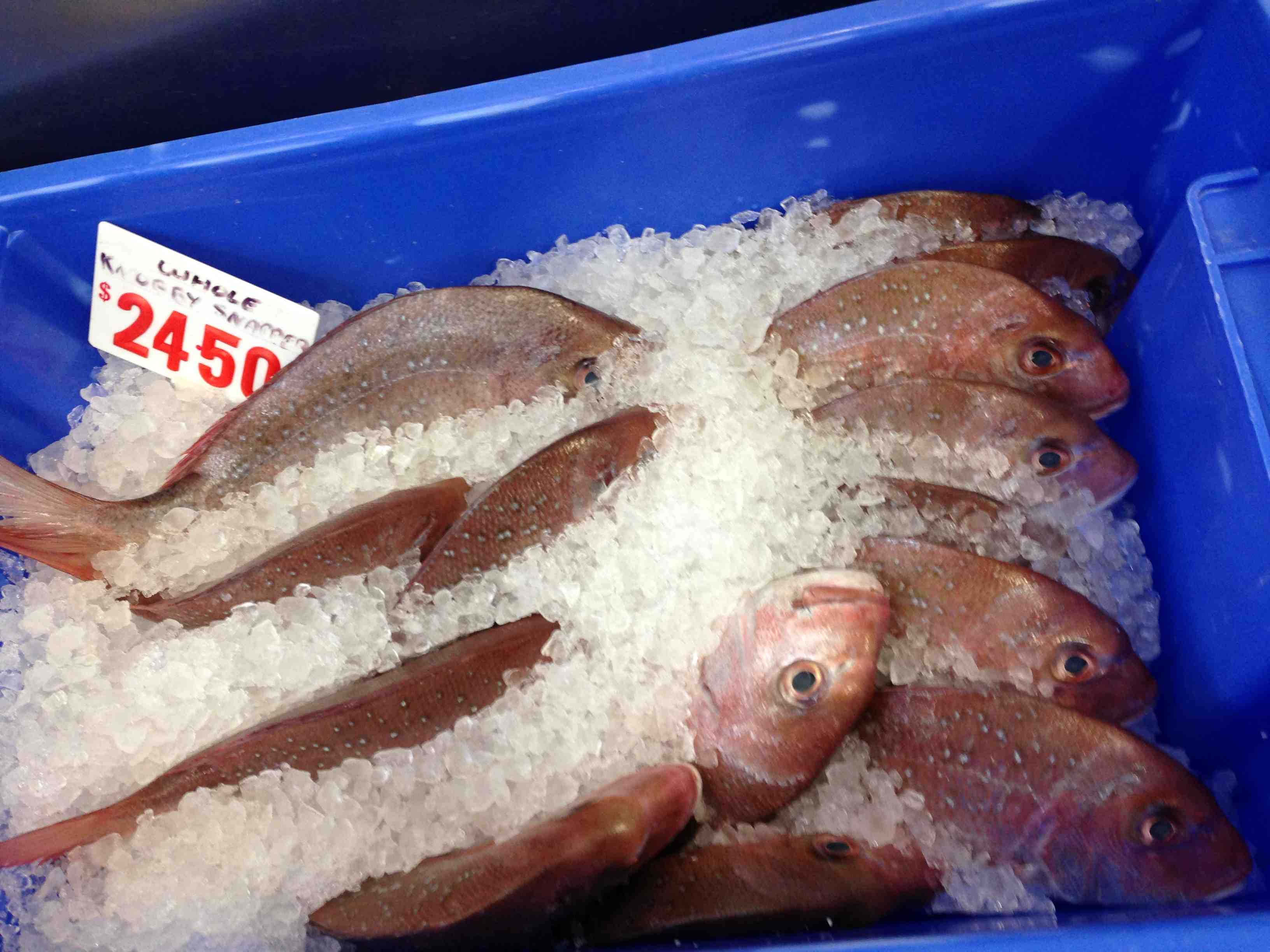
For dinner we had some kind of snapper fished off New Zealand, along with scallops and bay bugs (and a pizza for Sorenne).

We’re fortunate to live close to such great seafood, but as fishmonger told me, mislabeling is rampant in Australia as well.

I’m a landlubber and wouldn’t know the difference, but DNA testing is becoming increasingly available and simple. Those retailers that are selling the real deal – and there’s a premium involved – should be able to collect valid data and use that to market their wares. Trust and faith ain’t worth much. Data is.

2 more sick from E. coli burgers from Canada’s Cardinal Meat; 1 death in Dec. just now revealed

Two days after the Canadian Food Inspection Agency (CFIA) warned about another or related outbreak linked to the Cardinal Meat plant in Ontario, the rapid response folks at the Public Health Agency of Canada Chicago_meat_inspection_swift_co_1906-268x300decided to say, yes, two more people had been sickened with E. coli O157:H7, bringing the total to seven.

And that’s all they said.

Fortunately, Matt McClure of the Calgary Herald had already done lots of digging and revealed two days earlier that not only were there additional illnesses, but that a death was related to product from the same plant.

The Public Health Agency of Canada confirmed Wednesday that testing has shown the two outbreaks share a similar, but slightly different genetic fingerprint – a potential sign that they were caused by a common source of E.coli contamination.

“Work is underway to assess if and how these two situations may be linked,” CFIA said in a written statement.

Cardinal president Brent Cator said although the firm conducts random tests of the beef trim it uses to make burgers and every 500 kg of finished product, Cator said he depends on the food safety programs of the meat packers that supply his grinding facility.

Back in Dec., Cator, told the Herald his company makes frozen patties using beef trim from various Canadian and international processors that has been certified as free from E. coli O157:H7. However, he refused to identify the sources of the meat used in the recalled burgers.

Unwilling to tell consumers where their food comes from? Don’t buy it.

In Dec., McClure says, some food safety experts criticized the federal agency for waiting nearly two months to recall product after it had positive test results from patients with food histories that pointed to frozen burgers from Cardinal.

Oh, and by the way, McClure got PHAC to admit there was another patient who actually died in early December after being infected with the same strain of E. coli as the one found in the recalled burgers.

Officials at the federal health agency had said that the DNA fingerprint in those cases had never been seen before in North America and was strong evidence all the patients got sick from eating the same product.

But PHAC’s website now says those test results weren’t enough proof to say the fatality was caused by a tainted burger.

Canadians will apparently tolerate anything.

Closed for Renovations means closed by health department; Dirty dining in Vegas

The sign on the door says ” Closed for Renovations.” But on Feb. 7, Chow Mein Express was closed by the Health District after racking up 43 demerits.

Darcy Spears of KTNV explains they should be displaying the Health District’s closure sign, but that’s missing. And that means Chow Mein Chow Mein Express.vegasExpress is in even more trouble for trying to hide the reason for their closure from the public.

“Hello? Anybody home? Anybody in there remodeling?” Contact 13 Chief Investigator Darcy Spears called through the locked door.

When inspectors were there on Feb. 7, they found an imminent health hazard.

There was “no working refrigeration” according to the health report.

Add that to the fact that just about everything in the place was dirty and you’ve got an easy recipe for closure.

Photos inspectors took show the restaurant hadn’t bothered to clean up spilled fried rice and chunks of meat on the floor.

Inspectors found most of the equipment was dirty–the oven, wok, food containers, utensils, prep tables, floor sinks, floors and walls–that pretty much describes the whole place.

Oh, and there was no sanitizer around to clean anything.

Employees weren’t washing their hands and it wouldn’t have mattered much if they did, because there was no soap at the handsinks.

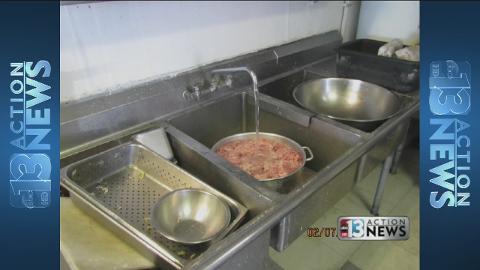
Inspectors also found food was being prepared in the mop sink. And raw beef was stored in another sink next to dirty dishes.