18 now sick; Campylobacter linked to raw milk in Alaska outbreak

The Alaska Department of Health and Social Services says that 18 people have now been identified with Campylobacter associated with raw-milkconsuming raw milk distributed by a Kenai-based cow-share program.

Two required hospitalization.

All probable and confirmed cases have been linked to consumption of raw milk from a farm on the Kenai Peninsula that operates a cow-share program. The milk is distributed to shareholders throughout the Kenai Peninsula, in Anchorage, and in Sitka. There is at least one secondary case of an infant who became ill after having close contact with a laboratory-confirmed case.

‘Why have I a soggy fishcake on my plate?’ Tesco customers’ horror as they find dead bird in salad during meal

It’s happened before it will happen again, but the discovery of a dead bird in a store-bought salad still has a gross factor, regardless of biological realities.

According to the Mail Online, James, 30, and Jasmine Watson, 32, of Yate, Gloucestershire, made the grisly find in a £1.50 bag of the blackcap-bird-songbird-warbler.jpg.492x0_q85_crop-smartsupermarket’s Babyleaf Rocket Salad when they began eating in dimmed light.

The five-inch bird, which Tesco later identified as a Blackcap European warbler, was inside the salad which Mrs Watson had ordered from the supermarket’s website three weeks ago on January 30.

The couple went into their local Tesco Extra store to complain – and a manager visited their home to remove the bird. The supermarket later apologized and offered a £200 gift card as compensation.

Mr Watson said, We had the food delivery a couple of days before and then had gone out for a few drinks on the Friday evening. We came back and were preparing dinner in the kitchen.

“My wife was cooking some scallops and steak and I prepared the salad. I opened the bag, tipped it into a salad bowl and cut up some 6478873W004 TESCO BIRD IN SALAD.jpgother salad bits and put them on top.

“Then I served the salad on some plates. We sat down at the breakfast bar and only had a few low lights on so we were effectively eating by candlelight.

“I took three mouthfuls and then saw it. My first reaction was why have I got a soggy fishcake on my plate? But this was a full-size dead bird.”

A Tesco spokesman said, “We were concerned to learn of this issue and have investigated thoroughly with our supplier. 

“Both we and our suppliers have robust measures in place to prevent incidents such as this, and our salad leaves go through complex filtering and washing systems.

“We have been in contact with our customer to reassure them how seriously we have taken this matter, and offered them a gesture of goodwill.”

But Mr Watson said, “I want to know how it happened. I would really like someone from Tesco to sit down and explain me how an animal so large got into a bag of salad not so large.”

‘Fast food should be made of fast animals’ Stephen Colbert on horse meat

Eater summarizes the latest, best take on the on-going horse meat scandal (U.S. fish are next, and, as I told Huffington Post today, if all these big chains with their food-safety-is-first traceability schemes don’t horse-hamburgerknow what’s in the products they’re hawking, how are mere mortals and consumers to know?).

Last night on the Colbert Report, Stephen Colbert took on “a story that is rocking the world of meat,” the European horse meat scandal. He goes through the back story of how the scandal spread through Europe with blame landing on Romania and perhaps organized crime. And he is not at all surprised the mob might be involved because, after all, “if you’re going to leave a horse head in a bed, why waste all that good body meat?”

But Colbert doesn’t really understand what everyone is so upset about. As he says, “We don’t feel guilty when we happily consume the rest of Noah’s Ark” — and he also jokes that Europeans are all worried about eating horse burgers “instead of their usual delicacy of pickled sheep brain.” In the end, he proclaims, “There’s nothing wrong with eating horse burgers. Fast food should be made of fast animals.” Scandal over?

Jail finally possible for (alleged) food safety cheats in US

In Jan. 2009, Peanut Corporation of America (PCA) recalled over 3,900 peanut butter and other peanut-containing products from more than 350 companies after an outbreak of Salmonella Typhimurium ultimately sickened 714 people and killed nine across 46 U.S. states and Canada.

The human toll related to a bunch of peanut-paste containing crackers and snacky thingies seems tragically outrageous. How people and PCA.AIB.certificatecorporations responded seems tragically disrespectful to those who got sick and died.

Kellogg was one of the hardest hit food processors that used PCA paste, recalling hundreds of products. In response to the outbreak, then CEO David Mackay told a congressional hearing on March 19, 2009, that PCA had been audited by the American Institute of Baking (AIB) “the most commonly used auditor in the U.S” and received a SUPERIOR rating.

Audits and inspections are never enough; but they are tools in the food safety toolkit that can ultimately create awareness and possibly prevent tragedy. Jail and steep fines are others, ones many other countries are quick to use.

The Justice Department on Thursday alleged that Stewart Parnell, the former owner of Peanut Corp. of America, and other employees engaged in a multiyear conspiracy to hide the fact that many company products were tainted with salmonella.

Prosecutors said the company failed to notify its customers—including several national food companies—when independent lab tests revealed the presence of salmonella. In some cases, company officials fabricated lab results, stating that peanut products were salmonella-free even when tests showed otherwise, or when no tests had been conducted at all, the department said.

The New York Times reports that criminal charges are relatively rare in food-poisoning cases. One of the few examples came in 2000 when the company then known as Sara Lee Foods pleaded guilty to a misdemeanor charge over selling adulterated meat and paid more than $4.4 million.

The 76-count indictment against the Peanut Corp. owner and employees includes charges for shipment fraud, wire fraud, conspiracy and obstruction of justice.

“These defendants cared less about the quality of the food they were providing to the American people and more about the quantity of money they were gathering while disregarding food safety,” said Michael Moore, the U.S. attorney for the Middle District of Georgia.

The indictment includes details of alleged communications Mr. Parnell had with customers and employees. According to the charges, after one customer notified him that Peanut Corp. products had tested positive for salmonella, Mr. Parnell allegedly stated—falsely—that he was “dumbfounded” by the finding and had never “seen any instance of this.”

In one internal email, Mr. Parnell allegedly told employees they couldn’t waste peanuts. “These are not peanuts you are throwing away every day…IT IS…MONEY THAT WE DO NOT HAVE,” Mr. Parnell allegedly wrote, according to the indictment.

The indictment also charges Michael Parnell, who is Stewart Parnell’s brother and a former supervisor, as well as Samuel Lightsey, a onetime plant operator, with many violations related to the company’s alleged deceptions.

Mary Wilkerson, a former quality-assurance manager, was included in obstruction-of-justice charges. The Justice Department said another y a t il un pilote dans l'avion ?former employee, Daniel Kilgore, has pleaded guilty to several charges.

The company filed for Chapter 7 bankruptcy protection in early 2009, weeks after the outbreak began.

Stuart F. Delery, who heads the Justice Department’s Civil Division, said, “The Department of Justice will not hesitate to pursue any person whose criminal conduct risks the safety of Americans who have done nothing more than eat a peanut butter and jelly sandwich.”

In response, attorneys Bill Gust and Tom Bondurant said in a statement “At this point, we will evaluate the charges that have been filed against Mr. Parnell and will prepare for a vigorous defense. There is little doubt that as the facts in this case are revealed, it will become apparent that the FDA was in regular contact with (Peanut Corporation of America) about its food handling policy and was well aware of its salmonella testing protocols.”

Jim Parkman, a lawyer for Lightsey, said nothing in the indictment surprises him and he is eager to defend his client.

“I’m glad it finally came out so we can get this cleared up and clear Sammy’s name,” he said. “We look forward to getting to a trial where we can finish the story.”

The safety of roadkill is a risk/benefit question

Food safety is all about risk/benefit tradeoffs and trust. I base my consumption choices on lots of factors with risk level, source and production practices amongst them (mixed in with price and taste).

I don’t eat raw sprouts because they’ve been linked to lots of outbreaks; seed stock can be contaminated and there seems to be an inconsistent implementation of best practices.  And no one has peeled back the curtain on day-to-day management and marketed food safety by sharing real-time data on irrigation effluent sampling, product sampling or proof of implementation which would increase my trust. The risks don’t outweigh the benefits, to me. The information just isn’t there.

Eating roadkill is another risk/benefit decision. I’ve never had any (that I know of) but it’s not a strictly bad practice/good practice situation. While illegal to harvest side-of-the-road dead animals in some jurisdictions, others, like Montana, are investigating relaxed rules.

The risk/benefit decision is often murky. Food safety is important, but so is actually having food. New friend Andrea Anater of RTI and I shared a guest lecture this week around coping strategies for individuals and families with very low food security and- meaning they often do not have enough to eat and food safety is not as high of a priority as calories. And sometimes people eat roadkill.roadkill-1

Liz Neporant of ABC news reports,

By passing a bill last week that allows motorists to eat their roadkill, the Montana House of Representatives may be on their way to legalizing the ultimate drive-through experience.
State Rep. Steve Lavin originally introduced the bill into Montana’s House to allow “game animals, fur-bearing animals, migratory game birds and upland game birds” who have been killed by a car to be harvested for food.

“This includes deer, elk, moose and antelope, the animals with the most meat,” said Lavin.

“The risk is relative depending on the condition of the animal and how it was killed,” said Benjamin Chapman, a food safety specialist with North Carolina State University. “In roadkill if you happen upon the animal, you don’t know its condition, which makes it riskier than eating regulated food or an animal you’ve hunted.”

Should you decide that flattened moose is what’s for dinner, Chapman advised using a meat thermometer and cooking large game to a temperature of at least 160 degrees Fahrenheit. When dressing the carcass, keep it away from other foods, scrub work surfaces with bleach afterward, and wash hands thoroughly.

Being hungry and sick from foodborne illness (or another zoonoses) isn’t a good thing.  The conditions under which the animal died might not be known (like whether it sick when hit) or how long it has been sitting at the side of the road (with pathogens potentially growing and creating toxins). Those are the things I worry about, but I’m fortunate enough to have ready access to food.

Food safety fines in Brisbane

The problem with Brisbane’s restaurant inspection disclosure program is that it’s voluntary: only got two stars out of five? Don’t post the grade.

They may suck at public disclosure, but they’re good at sending a eat.safe.brisbanemessage with fines when problems are discovered.

According to the Australian Institute of Food Safety:

• A combination lodging amenity and restaurant located on Flockton Street was fined for multiple issues, including old food scraps being left on and in food containers and live roaches found throughout the establishment. The fine for this issue was $25,000.

• A café that is located in the Mount Gravatt area was actually fined because a rat infestation was found on the premises. Additionally, the café placed rat poison in areas that also contained food for human consumption. In this instance, the fine was $25,000.

• A restaurant on Compton Road racked up more than 40 violations such as mice on the premises, broken and open food storage containers, improper control of food temperatures, and unsanitary food storage, and was fined $27,000.

• On Queen Street, a place to provide health drinks was fined because a customer found a used bandage in their beverage. The fine in this instance was $20,000.

Note no names were named so as a consumer, how would I know which places I might want to avoid. Doesn’t seem democratic. We have some experience with this.

Filion, K. and Powell, D.A. 2009. The use of restaurant inspection disclosure systems as a means of communicating food safety information. Journal of Foodservice 20: 287-297.

The World Health Organization estimates that up to 30% of individuals in developed countries become ill from food or water each year. Up to 70% of these illnesses are estimated to be linked to food prepared at foodservice establishments. Consumer confidence in the safety of food prepared in restaurants isfragile, varying significantly from year to year, with many consumers attributing foodborne illness to foodservice. One of the key drivers of restaurant choice is consumer perception of the hygiene of a restaurant. Restaurant hygiene information is something consumers desire, and when available, may use to make dining decisions.

Designing a national restaurant inspection disclosure system for New Zealand?
01.nov.11
Journal of Food Protection 74(11): 1869-1874
Katie Filion and Douglas Powell
Department of Diagnostic Medicine/Pathobiology, Kansas State University, Manhattan, Kansas 66506, USA
http://www.ingentaconnect.com/content/iafp/jfp/2011/00000074/00000011/art00010
The World Health Organization estimates that up to 30% of individuals in developed countries become ill from contaminated food or water each year, and up to 70% of these illnesses are estimated to be linked to food service facilities. The aim of restaurant inspections is to reduce foodborne outbreaks and enhance consumer confidence in food service. Inspection disclosure systems have been developed as tools for consumers and incentives for food service operators. Disclosure systems are common in developed countries but are inconsistently used, possibly because previous research has not determined the best format for disclosing inspection results. This study was conducted to develop a consistent, compelling, and trusted inspection disclosure system for New Zealand. Existing international and national disclosure systems were evaluated. Two cards, a letter grade (A, B, C, or F) and a gauge (speedometer style), were designed to represent a restaurant’s inspection result and were provided to 371 premises in six districts for 3 months. Operators (n = 269) and consumers (n = 991) were interviewed to determine which card design best communicated inspection results. Less than half of the consumers noticed cards before entering the premises; these data indicated that the letter attracted more initial attention (78%) than the gauge (45%). Fifty-eight percent (38) of the operators with the gauge preferred the letter; and 79% (47) of the operators with letter preferred the letter. Eighty-eight percent (133) of the consumers in gauge districts preferred the letter, and 72% (161) of those in letter districts preferring the letter. Based on these data, the letter method was recommended for a national disclosure system for New Zealand.

KFC employee fired for photo of potato licking

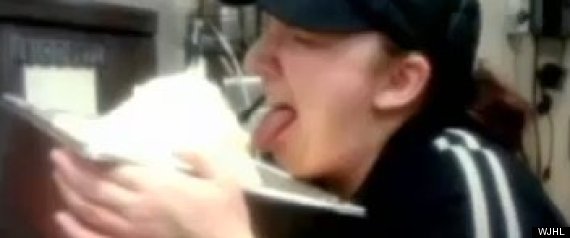
Note to daughters working in food service: don’t pretend to lick the food you may be serving and post it on facebook. Someone may notice and you may get fired.

But by all means, the next time some suit blathers on about how food safety is the most important thing ever and ever, please, post evidence r-KFC-MASHED-POTATO-PHOTO-large570to refute such blatant nose stretchers.

I got your back.

An employee at the Kentucky Fried Chicken in Tennessee distributed a pic of her holding a plate of mashed potatoes close to her face, as if she was going to lick them.

A company spokesman on Monday said customers did not receive those potatoes.

KFC spokesman Rick Maynard wrote to Johnson City Press via email and said this food was not served.

“Nothing is more important to KFC than food safety. As soon as our franchisee became aware of the issue, immediate action was taken. The franchisee’s investigation confirmed the photos were taken after the restaurant was closed and none of the food was served. The employee involved was immediately terminated.”

Mad cow, mushy peas and horse; UK horrified by what it’s eating; what took them so long?

The Daily Show with Jon Stewart has a long history of making fun of Brits. Last night, the crew took on the horse meat scandal, which is jon-stewart-35quickly becoming global, with a new segment called, “We may be —ked but at least god isn’t hurling rocks and loose horsemeat at us.”

The clip below, which won’t play in some countries, is fairly apt.

Today, the horse meat scandal spread to Asia where an imported lasagne brand was pulled from the shelves in Hong Kong, as Czech officials ordered similar action on frozen meals mislabelled “beef.”

A host of top players have been caught up in the spiralling scandal including Nestle, the world’s biggest food company, top beef producer JBS of Brazil and British supermarket chain Tesco.

Audits and inspections are never enough.

German officials, the same ones who oversaw an outbreak of E. coli O104 in sprouts in 2011 that killed 53, vowed tighter controls on meat products and stronger penalties for companies that violate food-labeling rules as more items marketed as “all beef” were pulled from supermarket shelves after testing positive for horse meat.


They don’t get Britain in Texas; bad advice on safe chicken livers

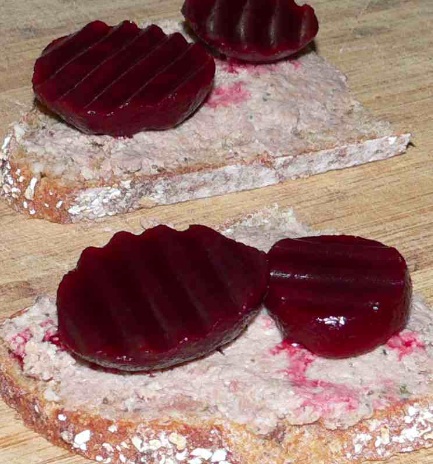
Communication by stagecoach may be a Texas tradition but maybe they would have heard of all the outbreaks of campylobacter in poorly pate.beet.dp.mar.12prepared chicken pate in the UK.

David Uygur, chef and owner of Lucia, told the Dallas News, it’s important to cook the livers just to medium doneness, signaled by a rosy-pink center. “I think well-done chicken livers are gross. It’s not the end of the world if you overcook them, but they will have a grainy texture and a more iron-y flavor.”

Color tells a chef nothing. Use a tip-sensitive digital thermometer and stick it in.

barfblog.Stick It In