
Epidémie à shigella en belgique liée à un membre du personnel d’une cafétéria

Qu’est-ce que Shigella ?

• Shigella est une bactérie qui va d’une personne à l’autre via une contamination transmise par la voie fécale-orale (ce qui signifie la présence de selles dans les aliments, sur les mains ou sur les surfaces).
• Les symptômes habituels peuvent comprendre du sang et du mucus dans des selles fréquentes (diarrhée), souvent appelée dysenterie.
• Si une personne est malade, elle peut transmettre Shigella aux autres personnes longtemps après que les symptômes ne soient plus présents.
• Shigella peut être transmis même si la personne ne montre pas de symptômes.

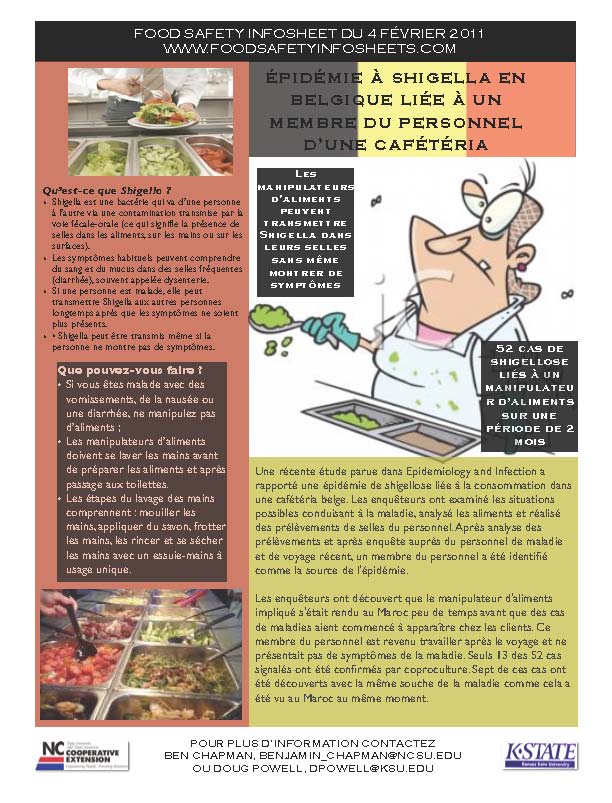
Les manipulateurs d’aliments peuvent transmettre Shigella dans leurs selles sans même montrer de symptômes

52 cas de shigellose liés à un manipulateur d’aliments sur une période de 2 mois

Que pouvez-vous faire ?
• Si vous êtes malade avec des vomissements, de la nausée ou une diarrhée, ne manipulez pas d’aliments ;
• Les manipulateurs d’aliments doivent se laver les mains avant de préparer les aliments et après passage aux toilettes.
• Les étapes du lavage des mains comprennent :
mouiller les mains, appliquer du savon, frotter les mains, les rincer et se sécher les mains avec un essuie-mains à usage unique.

Une récente étude parue dans Epidemiology and Infection a rapporté une épidémie de shigellose liée à la consommation dans une cafétéria belge. Les enquêteurs ont examiné les situations possibles conduisant à la maladie, analysé les aliments et réalisé des prélèvements de selles du personnel. Après analyse des prélèvements et après enquête auprès du personnel de maladie et de voyage récent, un membre du personnel a été identifié comme la source de l’épidémie.

Les enquêteurs ont découvert que le manipulateur d’aliments impliqué s’était rendu au Maroc peu de temps avant que des cas de maladies aient commencé à apparaître chez les clients. Ce membre du personnel est revenu travailler après le voyage et ne présentait pas de symptômes de la maladie. Seuls 13 des 52 cas signalés ont été confirmés par coproculture. Sept de ces cas ont été découverts avec la même souche de la maladie comme cela a été vu au Maroc au même moment.

Pour plus d’information contactez Ben Chapman, benjamin_chapman@ncsu.edu ou Doug Powell, dpowell@ksu.edu
 

No puppies in the post

The UPS store has many informative flyers, signs and brochures. One is a Ghostbusters’ circle with a line through it to indicate, no animals: UPS will not courier pets.

I asked the woman who was preparing my package if the sign was really necessary and she said, yes. Some people try to mail pets elsewhere; on a UPS truck, in a box.

A 39-year-old Minnesota woman was charged with cruelty to animals after she allegedly tried to post a puppy to a relative from one side of America to the other.

Last week Stacey Champion sealed the dog, a male four-month-old Schnauzer called Guess, in a box and was outted only when the cardboard box containing the dog fell off the counter when she was trying to pay for ‘high priority’

Mrs Champion, who had paid $22 for Guess to be posted, wanted to transport the puppy quickly, using two-day priority.

Mrs Champion was charged with animal cruelty. She now apparently wants the dog back.
 

Amish smugglers’ raw milk run

In January, The Daily rode along on a raw milk smuggling run. Excerpts below.

Wearing a black-brimmed country hat, suspenders and an Amish beard, "Samuel" unloaded his contraband from an unmarked white truck on a busy block in Manhattan (New York, not Kansas).

He was at the tail end of a long smuggling run that had begun before dawn at his Pennsylvania farm. As he wearily stacked brown cardboard boxes on the sidewalk, a few upscale clients in the Chelsea neighborhood lurked nearby, eyeing the new shipment hungrily.??Clearly, they couldn’t wait to get a taste.??
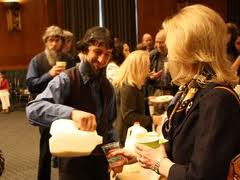
Samuel is part of a shadowy community of outlaw Amish and Mennonite dairy farmers who risk fines, loss of equipment and product, and even imprisonment to transport raw milk across state lines and satisfy a burgeoning appetite for illegal raw milk in places like New York.

Samuel has more than 140 customers waiting for him, ready to pay $6 a gallon. ??Samuel’s smuggling run started in Pennsylvania’s Amish country, where his family farm is located. As Amish doctrine prohibits him from operating an automobile, he paid a non-Amish person to drive. ??The final destination was an unmarked converted factory on the eastern edge of Chelsea.

Churning out the product??In mid-January, I paid a visit to Amish country to explore the roots of the raw milk supply chain. The dairy farm I visited was run by Isaac, an Amish raw milk black-marketer who, like Samuel, agreed to discuss his operation on the condition that his identity was concealed.??

Isaac, wearing traditional Amish clothing and an Amish beard, nodded in agreement. ??Maurer dismissed the FDA’s findings on raw milk, saying he’s never heard of anyone getting more than a bellyache from the stuff. ??For Isaac, the issues are cultural. When it comes to dairy farming, becoming a smuggler was the only way to maintain a pure, Amish way of life.“

60-day aging rule for raw milk cheese revisited

The N.Y. Times reports this morning that federal regulators are considering whether to tighten food safety rules for cheese made with unpasteurized milk — and the possibility has cheesemakers and foodies worried that the result will be cheese that is less tasty and not much safer.

The new proposals, which are expected in the next several months, come after a very tough year for this country’s fast-growing gourmet cheese industry, marked by recalls and two multistate E. coli outbreaks that sickened nearly 50 people.

The debate focuses on a federal rule that requires cheese made from raw milk to be aged for 60 days before it is deemed safe to eat. Raw milk has not been heated to kill harmful bacteria, a process known as pasteurization. So aging allows the chemicals in cheese, acids and salt, time to destroy harmful bacteria.
Scientists have found, however, that 60 days of aging is an overly simplistic guideline, in part because there are so many types of cheese and different ones may require different safeguards.

The Food and Drug Administration began a comprehensive review of the 60-day aging rule in 2009. Officials said the review was done and was awaiting approval before release.

Cheesemakers say pasteurizing milk destroys enzymes and good bacteria that add flavor to cheese. Raw milk cheese, they say, has flavors that derive from the animals and the pastureland that produced the milk, much as wine is said to draw unique flavors from individual vineyards.

Cheese made with pasteurized milk can also present food safety hazards if it becomes contaminated after the pasteurization step — during production or aging, for example. Last year, at least nine domestic cheesemakers issued major recalls. Five used pasteurized milk and four used raw milk.

But two of the raw milk cheese recalls came after the cheese was linked to outbreaks of a highly toxic form of E. coli bacteria.

In one outbreak, 38 people in five states became sick from raw milk gouda made by Bravo Farms of Traver, Calif., and sold through Costco. In another outbreak, eight people in four states were sickened by bacteria traced to soft cheeses made by Sally Jackson, a pioneering cheesemaker in Oroville, Wash.

In Ms. Jackson’s case, investigators documented unsanitary conditions that could have played a role in making the cheese unsafe. And in the Bravo case, investigators charged the company with packaging cheese for sale before the required 60-day aging was complete.

The aging rule was created in the late 1940s in response to outbreaks of typhoid fever linked to cheese.

Scientists knew then that hard cheeses, like cheddar, dried out as they aged, making them less hospitable to bacteria.

So regulators decided that if cheese was not made with pasteurized milk, it should be aged. But the choice of 60 days as the necessary threshold was a fairly arbitrary one, according to Dennis J. D’Amico, senior research scientist of the Vermont Institute for Artisan Cheese of the University of Vermont.

“The 60-day rule wasn’t based on real science,” Dr. D’Amico said. “The pathogens have changed and the cheeses have certainly changed. But the rule has not.”

Dr. D’Amico and Catherine W. Donnelly, co-director of the Vermont institute, published a paper late last year showing that toxic E. coli could survive in cheese for more than a year.

Another study, which they published in 2008, showed that listeria levels increased in soft cheeses, like brie, as they aged, making them potentially more dangerous. Those cheeses have a higher moisture content and become less acidic as they age, conditions that can favor bacterial growth.

Dr. D’Amico said that aging could be effective as a safeguard in hard cheeses if it were combined with careful control of milk quality, improved sanitation and testing in cheese plants.
 

Denmark: Cook frozen raspberries to avoid norovirus infection

Danish authorities are again recommending frozen raspberries be rapidly boiled before being used in smoothies, desserts and other dishes. The fruit must cook one minute.

Outbreaks of norovirus have stricken hospital staff, canteen and restaurant guests and individuals who have been eating frozen raspberries from abroad.

"Food Administration takes this situation very seriously, and that is why we now recommend the boiling of frozen raspberries both at home and businesses such as restaurants and cafeterias," says Annette Perge in the Food Agency.
 

New Food Safety Infosheet: Belgian Shigella outbreak linked to cafeteria worker

I didn’t eat a lot of cafeteria food while in high school. The cafeteria had a bunch of fries, chicken burgers, chicken fingers and other healthy options — I usually stuck to sandwiches and fruit from home. Sometimes I ventured in there for a rice krispie square or bagel with bacon and cheddar, but mainly I avoided the lines.

The newest food safety infosheet is all about an outbreak linked to a Belgian cafeteria worker who had just returned from a trip to Morocco with a new friend, asymptomatic shigellosis.

Click here to download the infosheet.

Salmonella in South Australian custard sickens a lot

Different Australian states seem to have decidedly different ways for informing the public about food-related risks.

South Australia Health says there’s been a large increase in cases of Salmonella Typhimurium phage type 9 over the past week, but it won’t provide any numbers.

SA Health’s investigation into the potential causes for this increase has associated Vili’s custard-filled berliners and St George Cakes & Gelati’s custard filled cannolis and éclairs with the Salmonella infection.

SA Health’s Public Health Director, Dr Kevin Buckett, said, “Both companies are co-operating fully with SA Health and are working with the department to ensure that all of these custard items are removed from supermarket and store shelves. They have also both voluntarily stopped making these items until any potential source of contamination has been remedied and the product is safe. Extensive testing of ingredients and equipment at both premises has not yet identified a source of contamination.

The SA Health statement also says, “Only these three custard-filled items, Vili’s berliners and St George Cakes and Gelati cannolis and éclairs, have been linked to the infection and there has been no evidence to suspect that any other Vili’s or St George Cakes & Gelati’s products are a risk.”

The statement does not say whether the facilities have been closed or if the two businesses are still making other products, which is odd since the source of the salmonella has not been determined.

So, SA Health, how many people are sick? How did this outbreak get detected? Do these two businesses use the same supplier?
 

Brote de Shigella 
en una cafetería en Bélgica causado por un empleado

Traducido por Gonzalo Erdozain
Resumen del folleto informativo mas reciente:
– 52 casos de shigelosis conectados a un trabajador en un periodo de 2 meses.
– Preparadores de alimentos pueden transmitir Shigella 
sin tener síntomas de enfermedad.
– Si esta enfermo, y sus síntomas incluyen nausea, vomito o diarrea, no prepare alimentos.
– Preparadores de alimentos deben lavarse las manos antes de preparar/cocinar alimentos, y luego de ir al baño.
Los folletos informativos son creados semanalmente y puestos en restaurantes, tiendas y granjas, y son usados para entrenar y educar a través del mundo. Si usted quiere proponer un tema o mandar fotos para los folletos, contacte a Ben Chapman a benjamin_chapman@ncsu.edu.
Puede seguir las historias de los folletos informativos y barfblog en twitter
@benjaminchapman y @barfblog.
 

Manitoba Hutterite company fined for reselling turkeys to Guelph man and used for hockey fundraisers

CBC News reports that a business owned by a Manitoba Hutterite colony has been fined for selling thousands of turkeys deemed not fit for human consumption.

Hazelridge-based Heartland Colony Farms Ltd. recently pleaded guilty to a charge under the federal Meat Inspection Act in a Winnipeg courtroom and was handed a $10,000 fine.

"There are very much public safety concerns here," provincial court Judge Sid Lerner said, adding the company showed "negligent conduct" in how it allowed the roughly 13,154 kilograms of frozen turkey carcasses to be re-introduced into the food chain.

According to the facts of the case presented by federal Crown attorney Jeremy Akerstream, the colony purchased the turkeys "sight unseen" for $16,000 in 2007 after a truck ferrying them from a British Columbia plant crashed on an Alberta highway.

They were transferred from the crashed truck to two others, meaning the turkeys were no longer fit for human consumption unless they were reinspected under federally-approved guidelines, Akerstream said.

The turkeys, which were the property of an unidentified major meat processing company, were then sold in a salvage deal to the Manitoba colony.

The colony took possession of the birds and had them repackaged into clear plastic bags. They then sold and shipped the majority to a man in Guelph, Ont. for about $27,000.

In turn, he passed on the turkeys to minor hockey league clubs in Aurora and Markham, as well as to a business, the prosecutor said.

There were no illnesses reported as a result of the birds being back in the food chain, Akerstream said.

In one interview, a company official said, "he didn’t know what the big deal was, he had eaten some of the turkeys and no one got sick," Akerstream said.

When the charge was laid, many on the colony reacted with "complete and utter shock," said defence lawyer Jamie Kagan, who represented the company in court.

"This has become a very, very expensive mistake from their perspective," he said.
 

Did you just vomit or are you my waiter? Or both

Do people prepare and serve food at restaurants and other forms of food service, while barfing or crapping?

They sure do.

Is that a risk factor for disease transmission?

Depends.

A bunch of U.S. researchers interviewed 491 food workers and their managers (n = 387) in nine states and found that 12 per cent of workers said they had worked while suffering vomiting or diarrhea on two or more shifts in the previous year.

“Factors associated with workers having worked while experiencing vomiting or diarrhea were (i) high volume of meals served, (ii) lack of policies requiring workers to report illness to managers, (iii) lack of on-call workers, (iv) lack of manager experience, and (v) workers of the male gender.”

The researchers acknowledged the study had several limitations – the uselessness of self-reported data, workers that were interviewed were chosen by the boss, not randomly, and not all infectious workers experience symptoms such as vomiting and diarrhea.

What the researchers do not seem to have acknowledged is this: not everyone who works at a restaurant is barfing or crapping because they are infectious or ill; some are just hungover.

Factors associated with food workers working while experiencing vomiting or diarrhea
03.feb.11
Journal of Food Protection®, Volume 74, Number 2, February 2011 , pp. 215-220(6)
Sumner, Steven; Brown, Laura Green; Frick, Roberta; Stone, Carmily; Carpenter, L. Rand; Bushnell, Lisa; Nicholas, Dave; Mack, James; Blade, Henry; Tobin-D’Angelo, Melissa; Everstine, Karen
http://www.ingentaconnect.com/content/iafp/jfp/2011/00000074/00000002/art00006
Abstract:
This study sought to determine the frequency with which food workers said they had worked while experiencing vomiting or diarrhea, and to identify restaurant and worker characteristics associated with this behavior. We conducted interviews with food workers (n = 491) and their managers (n = 387) in the nine states that participate in the Centers for Disease Control and Prevention’s Environmental Health Specialists Network. Restaurant and worker characteristics associated with repeatedly working while experiencing vomiting or diarrhea were analyzed via multivariable regression. Fifty-eight (11.9%) workers said they had worked while suffering vomiting or diarrhea on two or more shifts in the previous year. Factors associated with workers having worked while experiencing vomiting or diarrhea were (i) high volume of meals served, (ii) lack of policies requiring workers to report illness to managers, (iii) lack of on-call workers, (iv) lack of manager experience, and (v) workers of the male gender. Our findings suggest that policies that encourage workers to tell managers when they are ill and that help mitigate pressures to work while ill could reduce the number of food workers who work while experiencing vomiting or diarrhea.