Oregon bill to exempt farmers’ markets ignores food safety

There’s always weird stuff going on with state legislators. Anyone who watches Big Love on HBO would know that polygamist and newly elected state representative Bill is just making a mess of things in the TV version of Utah.

In Oregon, Rep. Matt Wingard, R-Wilsonville, introduced House Bill 2336 to balance promotion of farmers’ markets with protection for food safety.

?“I believe we have adequately addressed the issues and you have a bill before you that allows farmers’ markets to continue to grow and thrive. … The principal ingredients must be grown and processed by their producer, it must list ingredients and the name and address of the producer, the producer is limited to $20,000 in annual sales, and it must carry a label that it is homemade and is not prepared in an inspected food establishment.”?

Faith-based food safety is in no one’s interest.
 

Risk comparisons are risky, and sick people are not statistics

Some 1,200 people have, according to legal-types in the U.K., been sickened after staying at the First Choice-owned Holiday Village Turkey resort since 2005.

Although First Choice has paid out over £100,000 to 34 claimants who stayed at the hotel in 2005 and 2007, solicitors say it has "refused to accept responsibility" over more recent cases.

First Choice said they were in negotiations with the law firm to resolve the issue amicably and couldn’t comment further, but they did manage to keep talking and do further damage:

"First Choice would like to take this opportunity to assure all its customers that we closely audit all the resorts to which we operate, including the Holiday Village Turkey, to ensure that health, hygiene and comfort levels are maintained.

"Reports of sickness in 2010 were minimal; in particular, out of the 46,000 customers who have stayed there this year, only 0.42 per cent have reported minor ailments such as a mild stomach upset.

"This figure is extremely low, and has been substantiated by the Health Protection Agency, who have confirmed that they have received no reports of infection at the property this year.”

Telling 193 paying customers that their barfing was a statistical anomaly isn’t going to win future customers. And won’t help in court.
 

Rodents and roaches and urine, oh my; contaminated chile ordered destroyed

A New Mexico company was ordered to destroy $171,000 worth of red chile after federal authorities say it was contaminated by rodent droppings and urine, insect larvae and roaches, according to the U.S. Attorney’s Office.

Deputy U.S. marshals seized 25 tons of Mexican-imported chile from the Duran and Sons warehouse in Derry, N.M. on Dec. 13, 2010. The imported pods are alleged to have contaminated 50 tons of New Mexican red chile that was also kept in the warehouse.

The company was ordered Monday by U.S. District Judge M. Christina Armijo to pay for destroying the produce under the supervision of the Food and Drug Administration, by no later than March 17.

Inspectors in November allegedly found rodent nests and evidence that mice had gnawed, defecated and urinated on the chile pods, ground chile and crushed chile after they had been shipped to the Duran & Sons Chile Products warehouse, about eight miles north of Hatch.

Apart from the chile, however, Duran’s warehouse was also allegedly home to "a live cat, live birds, apparent bird nesting, bird droppings, rodent nesting, rodent excreta pellets, animal feces, animal urine, lice and dead insects and insect larvae and moth-like insects," according to court documents.

Lewis Black on Taco Bell meat

Taco Bell behaved poorly during an E. coli O157:H7 outbreak in 2006 that was linked to lettuce.

Who knows what’s in the meat. 12 per cent is a secret. Lewis Black explains on last night’s Daily Show.

The Daily Show With Jon Stewart Mon – Thurs 11p / 10c
Back in Black – Meat Edition
www.thedailyshow.com
Daily Show Full Episodes Political Humor & Satire Blog</a> The Daily Show on Facebook

Kudos to Cargill for showing Oprah how meat is made

The bartender was riveted. So was the waitress. My requests for a beverage
on a quiet Tuesday afternoon in Kansas City in 1998 would have to wait until
commercial. Such was the power of Oprah.

That’s Oprah Winfrey – actress cum talk show diva – who today did a segment on beef production as part of her go-vegan spiel.

The results were far more conciliatory than earlier meat outings on Oprah, and the credit goes to Cargill, who opened one of their Colorado processing plants to Oprah’s cameras and rather than resort to a corporate spokesthingy, featured a surprisingly effective Nicole Johnson-Hoffman, the plant’s general manager.

Things didn’t go so well for the meat folks in 1996.

On March 29, 1996, nine days after the U.K. officially linked bovine spongiform encephalopathy, or BSE, with a new human disease, the U.S. Department of Agriculture and the U.S. Food and Drug Administration announced they were expediting regulations prohibiting ruminant protein in ruminant feeds, boosting
surveillance and expanding research.

The same day, several producer groups, including the U.S. National Cattlemen’s Beef Association (NCBA), issued a statement supporting the moves and instituted a voluntary ban on ruminant protein in ruminant feed. Draft legislation was published in January 1997 and enacted into law later that year.

Then came Oprah. On April 16, 1996, Oprah announced during a show on food safety and mad cow disease she would stop eating hamburgers because of fears over BSE and that she was shocked after a guest said meat and bone meal made from cattle was routinely fed to other cattle to boost their meat and milk production.

The camera showed members of the studio audience gasping in surprise as vegetarian activist Howard Lyman explained how cattle parts and downer cattle (downer is the generic term used to describe cattle who can simply no longer stand) were rendered and fed to other cattle, and that BSE could make AIDS look like a common cold. The chief scientist for the U.S. National Cattleman’s Beef Association, rather than stressing the risk management actions that had been taken, was left arguing that cows were not vegetarians because they drank milk.
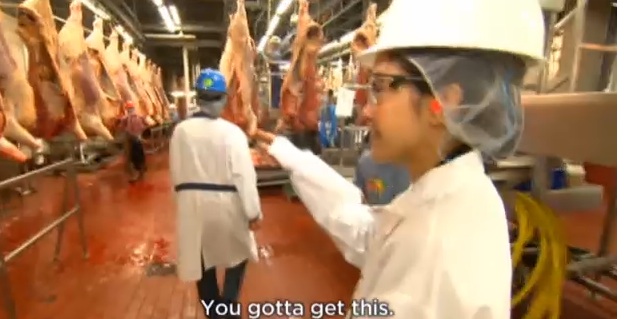
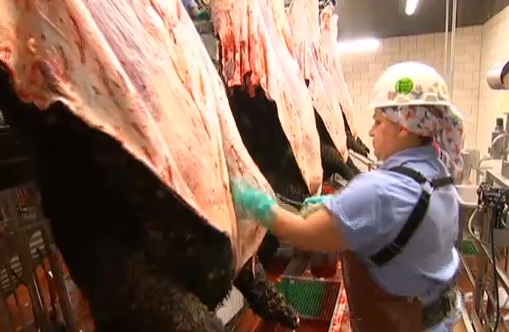
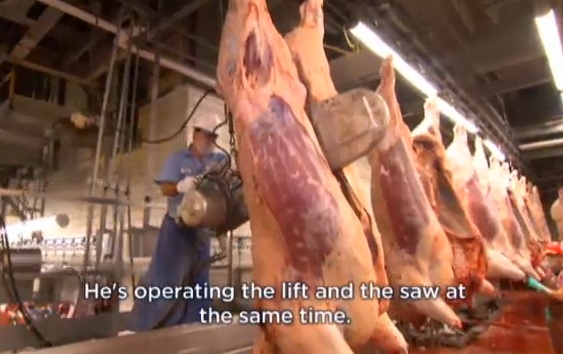
Today’s broadcast was different. Foodie journalist Michael Pollan wants people to know where their food comes from; Cargill obliged.

“Lisa Ling travels to Colorado, where Cargill, the biggest producer of ground beef in the world, gives her a rare inside look at how our meat is made.

“Upon arrival, the cattle are held in pens for two hours to calm them before they’re sent to be slaughtered. Each cow is then shot in the head with a bolt, which renders it insensible to pain. The cow’s artery is then cut, and about two minutes later, it dies from blood loss. After the animal’s death, the body is immediately washed, the skin is removed, and within minutes, the workers also remove the hooves, the hide and the head. The carcass is then moved to a giant cooler, where it stays for up to two days. After it’s been inspected and graded, it’s packaged, loaded on trucks and soon ends up in our local restaurants and stores.

“Nicole says she was happy to have Lisa at the plant, because she thinks people should know where their food is coming from. ‘I would not ridicule people who believe that you shouldn’t eat animals, but I would say that we are committed to doing it right. And I believe that when animals are handled with dignity and harvested carefully, that’s the natural order of things,’ says Nicole.

Whether you eat meat or not, Nicole thinks everyone who’s interested in the American food system can work together to create better results. ‘I think we’re all on the same path trying to figure out the right way to get to good health for our families and environmental sustainability and humane treatment,’ she says. ‘We’ll find a better result together, even if we have perhaps different perspectives or different beliefs.’”

The slaughterhouse portion of the video is available at:=

http://www.oprah.com/oprahshow/Inside-a-Slaughterhouse-Video/topic/oprahshow
UAE restaurants braced for inspectors

The first 150 graduates of a new municipality training programme are ready to take on the task of ensuring their restaurants are safe and clean.

Under Dubai Municipality’s Person in Charge (PIC) program, food outlets will be expected to take the initiative to ensure they meet safety standards rather than relying on the municipality’s Food Control department to police them.

The PIC idea was part of a plan to raise restaurant standards and lower the number of food poisoning cases in Dubai. That plan gained momentum in August 2009 after the deaths of two young siblings who ate spoiled takeaway food in Al Qusais.

By the end of this year, every restaurant and cafeteria in the emirate is expected to have a trained PIC.

Those who successfully complete the PIC exam act as liaison between the premises and the municipality. Their job is to ensure that municipal policies are carried out correctly at all times by anyone handling food.
 

Seek and ye shall find; FDA finds problems at egg farms

The U.S. Food and Drug Administration is finding problems at egg farms beyond the Iowa operations linked to last summer’s salmonella outbreak. The agency inspected 35 farms from September to December and released a report today on its findings.

Those 35 farms, located in Ohio, Maine, Pennsylvania, South Carolina, Utah and Washington, were picked for inspection because they had been associated with pervious outbreaks or had a history of poor compliance. Nine separate companies operate the 35 farms. The names were not released.

Twelve of the farms needed to take action to fix problems. Eleven others did not. Evaluations of the remaining 12 farms are still pending, mostly in Washington state.

Most of the problems cited by the agency involve inadequate record keeping.

Farms are required to document compliance a variety of issues, including rodent monitoring and compliance with biosecurity measures.
 

But celebrities have tea here: Victorian-style cafe fined over salmonella

I don’t care about personal or business fetishes – go ahead and wear that Victorian garb – but if you’re going to make chocolate mousse cake and serve it to a bunch of people, use pasteurized instead of raw eggs.

A U.K. court heard that 10 customers and staff were stricken with salmonella after eating a chocolate mousse cake made with raw egg at Badgers’ cafe, Llandudno, in Sept, 2009. Badgers was fined £8,015, which will cut into the Victorian-era outfits worn by staff.

Badgers cafe admitted selling the cake when unfit for human consumption and apologised to those affected; the company also pleaded guilty to two breaches of food hygiene regulations a year later.

But not until Rhian Gilligan made the best food safety legal defense ever: the cafe had attracted high-profile politicians and celebrities and was visited by many holidaymakers during the summer.

In a statement after the case the Badgers company said it would like to apologize "unreservedly to those affected.

"Badgers has always sought to achieve the highest standards in food hygiene and customer service and continues to do so.”

More focus on food safety, less on the costumes.

Food worker delivers Morocco strain of shigella; sickens 52 in a Belgian cafeteria

On Nov. 13, 2009, a Belgian physician notified authorities about an apparent cluster of Shigella sonnei; ultimately, 52 cases were identified over two months, and most were linked to a canteen in a public institution building. Best guess is that a food handler who travelled to Morocco shortly before detection of the first laboratory-confirmed case, picked up shigella, and then transmitted it through food.

The details can be found in the current issue of Epidemiology and Infection, where researchers report on a matched case-control study to test an association between shigellosis and canteen-food consumption.

The three food handlers working permanently in the canteen responded to the questionnaire. Food handler A travelled to Turkey from 23 September to
4 October 2009. She started working on 7 October. She prepared sandwiches, washed dishes and served food. She fell ill on 20 October, and had been exposed to canteen food during the 4 days prior to disease onset. Food handler B travelled to Morocco from 23 September to 1 October. This person started working on 4 October and was involved in vegetable washing, preparation of hot meals, sandwiches, cold dishes involving vegetables and cleaning the canteen. He did not declare having fallen sick. Food handler C was also involved in all activities except in hot meal preparation. He had not travelled, been absent or fallen sick.

Of the 52 shigella cases found in 708 employees of a public institution in Flemish Brabant province, Belgium, between September and November 2009, seven cases were confirmed as S. sonnei. There was a common PFGE profile which resembled those from archived specimens from Morocco. Cases of
shigellosis were associated with canteen-food consumption.

Investigators worked with three hypotheses: (i) waterborne transmission through a contaminated water dispenser, (ii) person-to-person transmission or via surfaces (toilets), or (iii) foodborne transmission (through previously contaminated food or during the preparation process by a contaminated food handler).

Foodborne transmission through canteen food is supported by the results of the employee survey and by the matched case-control study. This led us to think that a food handler might have been the source of the outbreak. Food handler B returned from Morocco shortly before the appearance of the first confirmed cases. He did not report any symptoms and worked continuously since his return.

Foodborne transmission might have happened had he been an asymptomatic case. Healthy carriers can shed 102 Shigella c.f.u./g of feces during 1 month.
Thus, food handler B could have unintentionally acted as an intermittent source of food contamination during the period of faecal shedding. Conversely, food handler A, who had travelled to Turkey, could not be the source of the outbreak, since her onset of disease happened after the onset of symptoms of some confirmed cases.

The researchers recommend:
• washing hands with soap and water before eating and after defecation for employees and food handlers;
• preventing sick food handlers from working until full recovery or until negative fecal culture in the case of laboratory confirmation;
• maintaining surveillance of further possible cases of shigellosis through the institution’s prevention service; and,
• collecting information on the workplace when interviewing notifiable cases in order to detect infectious disease clusters early.

Shigellosis outbreak linked to canteen-food consumption in a public institution: a matched case-control study
01.feb.11
Epidemiology and Infection
I. Gutiérrez Garitano, M. Naranjo, A. Forier, R. Hendriks, K. De Schrijver, S. Bertrand, K. Dierick, E. Robesyn, and S. Quoilin
http://journals.cambridge.org/action/displayAbstract?fromPage=online&aid=8024291
Abstract
On 13 November 2009, the authorities of Flemish Brabant, Belgium, received an alert concerning a potential outbreak of Shigella sonnei at a public institution. A study was conducted to assess the extent, discover the source and to implement further measures. We performed a matched case-control study to test an association between shigellosis and canteen-food consumption. Water samples and food handlers’ faecal samples were tested. The reference laboratory characterized the retrospectively collected Shigella specimens. We found 52 cases distributed over space (25/35 departments) and time (2 months). We found a matched odds ratio of 3·84 (95% confidence interval 1·02–14·44) for canteen-food consumption. A food handler had travelled to Morocco shortly before detection of the first laboratory-confirmed case. Water samples and food handlers’ faecal samples tested negative for Shigella. Confirmed cases presented PFGE profiles, highly similar to archived isolates from Morocco. Foodborne transmission associated with the canteen was strongly suspected.
 

‘Gasquet’s kiss’ to clear Contador of clenbuterol?***

It was just a kiss.

Two years ago French tennis player Richard Gasquet was cleared of doping after insisting he had tested positive for a tiny quantity of cocaine because he had kissed a girl in a disco in Miami. Both the French Tennis Federation and WADA considered that even though this was an unlikely cause for a positive, it was the most probable reason.

Cycling Weekly – which I read daily – reports that a lawyer for Alberto Contador will use essentially the same defense: that even if eating contaminated beef sounds like an implausible reason for finding tiny traces of a banned substance in his organism, that is the most likely explanation.

If the glove don’t fit you must acquit.

Also, like Gasquet said about his cocaine positive, the clenbuterol could have had no effect on his performance because it was present in such tiny quantities.

Cycling is a mess.