Amy’s father and stepmom came for a visit and yesterday we went to a local eatery for a late lunch.
When Amy’s dad ordered a burger, the server asked how he would like the burger cooked.
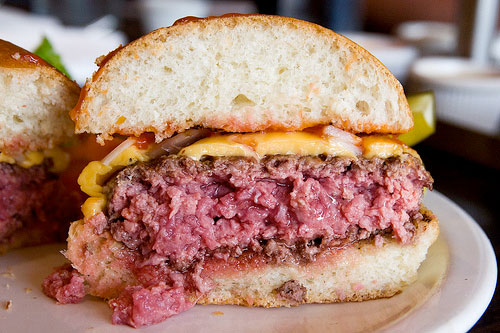 He said medium-well.
The server said he could get the burger as rare as he wanted.
Amy said really, and started asking, just what was a medium-rare burger.
The server said it all had to do with color, and after some back and forth with the cooks, said the beef they get has nothing bad in it anyway.
Color is a lousy indicator.
During the same meal, a reporter called to ask, why do companies – big companies, huge chains and brand names — knowingly follow or ignore bad safety practices? (that story should appear Sunday).
It comes down to culture – the food safety culture of a restaurant, a supermarket, a butcher shop, a government agency.
Culture encompasses the shared values, mores, customary practices, inherited traditions, and prevailing habits of communities. The culture of today’s food system (including its farms, food processing facilities, domestic and international distribution channels, retail outlets, restaurants, and domestic kitchens) is saturated with information but short on behavioral-change insights. Creating a culture of food safety requires application of the best science with the best management and communication systems, including compelling, rapid, relevant, reliable and repeated, multi-linguistic and culturally-sensitive messages.
Sixteen years after E. coli O157:H7 killed four and sickened hundreds who ate hamburgers at the Jack-in-the-Box chain, the challenge remains: how to get people to take food safety seriously? ??????Lots of companies do take food safety seriously and the bulk of American meals are microbiologically safe. But recent food safety failures have been so extravagant, so insidious and so continual that consumers must feel betrayed.??????
Frank Yiannas, the vice-president of food safety at Wal-Mart writes in his book, Food Safety Culture: Creating a Behavior-based Food Safety Management System, that an organization’s food safety systems need to be an integral part of its culture.
The other guru of food safety culture, Chris Griffith of the University of Wales, features prominently in the report by Professor Hugh Pennington into the 2005 E.coli outbreak in Wales that killed 5-year-old Mason Jones and sickened another 160 school kids.
 Yesterday, the board of the U.K. Food Standards Agency (FSA), in response to Pennington’s report, approved a five-year plan that will push food businesses to adopt a food safety culture and comply with hygiene laws, and urge stricter punishments for those that do not. The FSA will also ensure health inspectors are better trained.
A report put before FSA board members in London stated “culture change in all of the relevant parts of the food supply chain” is necessary.
Mason Jones’ mum Sharon Mills said she is pleased with the action being taken by the FSA.
“This sounds promising and shows they are moving in the right direction. … Things are slowly changing and hopefully we will all see the benefits sooner rather than later.”
Maybe. I’m still not convinced FSA understands what culture is all about. And how will these changes be evaluated. Is there any evidence that social marketing is effective in creating food safety behavior change? Those issues get to the essence of food safety culture, yet are glossed over with a training session – more of the same.
And why wait for government. The best food producers, processors, retailers and restaurants should go above and beyond minimal government and auditor standards and sell food safety solutions directly to the public. The best organizations will use their own people to demand ingredients from the best suppliers; use a mixture of encouragement and enforcement to foster a food safety culture; and use technology to be transparent — whether it’s live webcams in the facility or real-time test results on the website — to help restore the shattered trust with the buying public.
.jpeg)

 The epidemiological investigation based on interviews with the patients pointed at sugar snaps from Kenya as the source. Shigella was not detected in samples of sugar snaps. However, Escherichia coli was confirmed in three of four samples indicating contamination by faecal material.
  Nguyen Thi Thu Nga, chief inspector of the HCMC Animal Health Agency, said the products were contaminated with bacteria, including Salmonella and E.coli, and also failed to meet other food safety criteria.
 So in what seems an excessively harsh penalty, if true,
  Dave Theno became head of Jack in the Box’s food safety shortly after the outbreak. I too have known Dave for 16 years. However, I only learned recently a significant fact about Dave – one that made me admire him even more – one that I think, not only that all leaders in corporate food safety should emulate, but one that both Secretaries Vilsack and Sebelius should pay attention too.

 The guidelines in this document are targeted to local, state and federal agencies and provide model practices used in foodborne disease outbreaks, including planning, detection, investigation, control and prevention. Local and state agencies vary in their approach to, experience with, and capacity to respond to foodborne disease outbreaks. The guidelines are intended to give all agencies a common foundation from which to work and to provide examples of the key activities that should occur during the response to outbreaks of foodborne disease. The guidelines were developed by a broad range of contributors from local, state and federal agencies with expertise in epidemiology, environmental health, laboratory science and communications. The document has gone through a public review and comment process.
 This morning, while drinking morning tea and perusing my Google Alerts, I came across a few stories on restaurant inspection disclosure systems. Another district in Connecticut has adopted symbols to aid consumer interpretation of inspection scores, while a city in New Mexico proposes changing from a pass-fail system to letter grades.