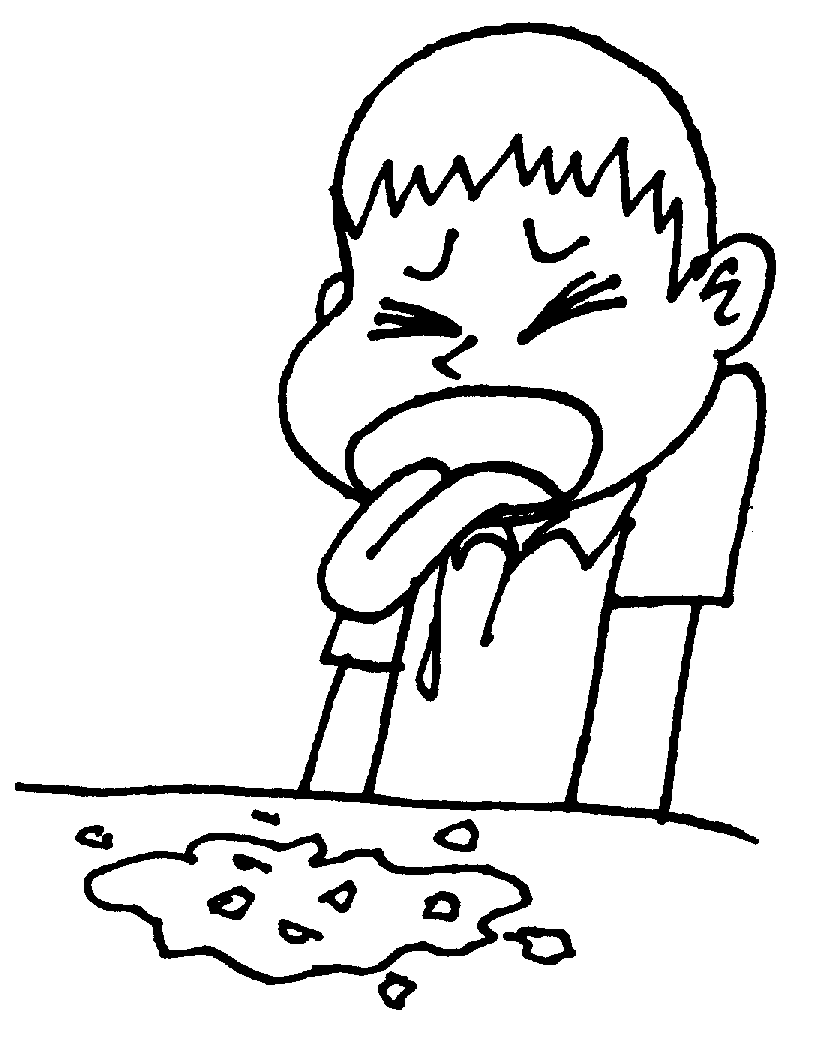
Virus strikes Illinois State football team

Pantagraph.com reports that more than 35 members of the Illinois State football team were stricken with a stomach virus this week that caused them to miss practice.

“The carnage ended up being about 50 people, coaches, trainers, players, managers. It was unbelievable. I’ve never been through that before,” said Coach Brock Spack. “But what doesn’t kill us makes us tougher and better.”

“Some of the volleyball players are sick. I’m hearing some other people on campus are sick,” Spack said. “I was one of the victims. It’s not a lot of fun. It’s pretty intense for about 24 hours.”
 

Up to 35 sick after Easter brunch in Mass

No one wants to barf after Easter brunch.

Or any other meal.

But the Worcester Telegram & Gazette reports that city health inspectors are investigating an outbreak of illnesses in patrons who ate Easter brunch at Luciano’s Cotton Club restaurant at Union Station.

Eight people have reported becoming ill to the city’s Health Department, according to Amanda Wilson, the city’s director of housing and health inspections. One person was admitted to the hospital. As many as 35 may have been sickened, she said.

“At this point, there is no confirmed case that shows this is a foodborne illness,” Ms. Wilson said yesterday. “We are treating it as some kind of communicable disease. We have not confirmed the source.”

The Health Department started receiving calls from Luciano’s patrons on Tuesday, and immediately sent inspectors to the restaurant, she said. The inspectors found two violations of the city’s food handling regulations. There was evidence of rodents on the premises, she said, and two reach-in coolers were not set at the correct temperature for the food they were storing.

The restaurant immediately took steps to correct the problems, and a follow-up inspection the next day found the restaurant to be in compliance, she said. The restaurant has been given full inspections three times in three days, she said.
Inspectors are also interviewing all the staff at Luciano’s, she said. She said that one Luciano’s staff member was apparently sick with a stomach illness in the days before the brunch. Another staff member has been sick since the brunch, according to Alex Barbosa, the restaurant’s general manager.

Gus Giordano, owner of Luciano’s Cotton Club at Union Station said the restaurant is fully complying with city health inspectors, adding, “We’re assuming it’s something airborne. This is the train station, it could have been anything. I have a reputation in this business, it’s on the line. I would put my life on it that it wasn’t food poisoning.”

What about that sick employee?
 

How to avoid norovirus: don’t watch people barf, or hold their hair back

You can earn some credibility holding back a woman’s hair while she vomits; you can lose credibility when a 2-year-old vomits all over the car seat, and then while attempting to clean it up, you vomit in response, like in Stand By Me (see below).

I’ve done both.

Researchers from the U.S. Centers for Disease Control investigated a 2009 outbreak on a cruise ship and concluded infected passengers were significantly more likely to have an ill cabin mate, and to have resided or dined on the deck level where a vomiting incident had occurred during boarding.

That’s right: someone barfed while passengers were boarding the ship and just watching and trying to contain that little bit of throw-up that just happened in your mouth was a statistically significant risk factor.

Questionnaires about when people did or did not seek medical care, hygiene practices, and possible norovirus exposure were placed in every cabin after the outbreak began. The ship had 1,842 passengers on board, and 83 percent returned the questionnaires. Of the 15 percent of respondents who met the case definition for acute gastroenteritis, only 60 percent had sought medical care on the ship.

Less than 1 per cent of the crew reported illness, and their low attack rate may have been due to the few crew members who had direct contact with passengers. This included separate sleeping and dining areas and alternate passages for boarding and exiting the ship.

"Cruise line personnel should discourage ill passengers from boarding their ships," according to study author Mary Wikswo, MPH, of the Centers for Disease Control and Prevention. "Once on board, passengers and crew who become ill should report to the ship’s medical center as soon as possible. These quick actions are crucial in preventing the introduction and spread of norovirus on cruise ships and allow ship personnel to take immediate steps to prevent the spread of illness."

What I conclude, based on this and other studies, including our own, is that telling people to wash their hands has almost no effect — and that the best way to control the spread of norovirus – on cruise ships, in restaurants, in schools – is to break the infection cycle because these noroviruses are crazy infective: stay home, isolate yourself, tie your hair in a bun, and barf away.

Cricket-security police fall ill with food poisoning

Apparently there’s a World Cup of cricket and apparently it’s being held in Dhaka, the capital of Bangladesh.

I’m not being disrespectful, I just wouldn’t know. I do know there’s a Capitals-Flyers game on TV tonight (that’s hockey).

Whatever the sport, players play lousy when they barf. And if security’s barfing, there should be some red flags around the athletes.

Reuters reports around 60 policemen on World Cup security duty in Dhaka fell sick on Tuesday after eating contaminated food.

The policemen, who were on duty at Dhaka’s Sher-e-Bangla Stadium and the teams’ hotel, were taken to hospital after eating food supplied by a local contractor.

Colonel Mesbahuddin, the security chief for the local organising committee, said, "The policeman started vomiting shortly after having the food. Around 50 of them were taken to hospital for treatment."

The sick policeman included more than a dozen members of the elite security force, Rapid Action Battalion. The food supplier was taken into custody.

The incident took place on the eve of the first quarter-final between Pakistan and West Indies.

The vomit clause: should ferry workers get double pay for cleaning up barf?

Amy has written before about a student barfing in class, and the policy at Kansas State University is students and faculty are advised to notify the custodial department immediately and to avoid coming into contact with vomit.

Should custodial staff get double pay for cleaning up vomit?

According to KOMO News in Seattle, ferry workers get double pay for cleaning up messy situations in what some call, "the vomit clause."

State Sen. Mary Margaret Haugen, D-Camano Island says the clause makes her want to barf (not really).

But Haugen did tell the Everett Daily Herald other state workers aren’t paid extra for such work, adding, "That’s one that really stuck in my craw. We certainly don’t give overtime to some prison guard who cleans up after an inmate or even someone who worked caring for a person in their home and had to do an unpleasant task."

Who says ‘craw.’

The ferry workers’ union say the clause actually covers broader clean up of hazardous materials and sewage systems, and workers rarely get paid more for vomit situations.

Terri Mast of Inland Boatmen’s Union said, "It could be vomit. It could be blood. It could be feces.”
 

Kansas State BBall star barfing but ready to give it all tonight

March Madness is March Boredom. Basketball is that dull.

Some of the food safety nerds I know have a NCAA pool called Food Safety Nerds who Like Basketball. Amy gets involved. I don’t. Hockey is more interesting at this time of year, and like hockey a few years ago, the rules for basketball seriously need to change: the last two minutes of each half cannot each take an hour to complete.

But, being in a college town, I know the chances of Kansas State hinge on The Beard: as senior Jacob Fear-the-Beard Pullen goes, so go the prospects of KState.

The Kansas City Star reported that Pullen was sick Wednesday and did not practice.

Kansas State officials told Star that Pullen had been suffering from flu-like symptoms and a high fever, but they expect him to recover in time to play against Utah State on Thursday night in the second round of the NCAA tournament.

Teammates said Pullen was suffering from food poisoning.

Sophomore Jordan Henriquez-Roberts, who apparently does not have a future in epidemiology, told the Star,

"It was from something he ate last night, a cheeseburger or something like that. But he’s going to be all right and he’s going to go tomorrow. I know Jake … he’s going to give his all tomorrow whether he’s 100 percent or not."
 

BARF diet for pets endangers species

The BARF diet is rooted in the philosophy that all things natural are good, and that science or human experience cannot improve on nature.

The Biologically Appropriate Raw Food, or Bones And Raw Food, diet, also known as the "prey model," in which owners try to feed their pets critters similar to what they’d hunt in the wild, has resulted in a surge in illegal sales of raw wild game online, Florida wildlife investigators say.

USA Today reports that in 2010, its first year, Florida Fish and Wildlife’s Internet Crimes Unit logged 177 arrests and 92 warnings for cases involving illegally buying or selling wildlife or raw game meat online, some of it for pets.

Pet owners go on Craigslist and eBay, asking where they can score a squirrel, pheasant, rabbit, goose, duck, chicken, just about any game to feed their cats and dogs. Some seek raw fish, meaty bones and organs such as hearts, livers and kidneys — everything a growing carnivore needs.

"It’s happening nationwide," said Lt. George Wilson, head of the Internet Crimes Unit. "The philosophy behind it is feeding your pet a hormone-free, naturally grazed diet.

"We’re seeing solicitations for wild ducks, anything wild."

The Internet provides a way around having to pay taxes or pay for licenses to sell wild game, investigators say.

But these Internet outlaws skirt regulations that ensure meat is sanitary and comes from game hunted in-season. They threaten to create black markets for wildlife similar to what existed for alligators 50 years ago, Wilson said.

"It’s the unlicensed people that would be trafficking them," said Jim Deason, owner of Sweetwater Plantation, a farm in Bristol, Fla., that sells live deer for breeding. "Any of the people that I know, they’re pretty above board on things like that. If there’s anybody selling game, it’s probably going to be backwoodsy folks."
 

Will fewer people barf after Obama signs food safety bill? No

Maybe? Who knows? But with all the gushing —"The Food Safety Modernization Act is the most significant food safety law of the past 100 years" – Debora MacKenzie of New Scientist presents me as food safety grump.

It’s accurate.

Margaret Hamburg, head of the FDA, said at a press conference on 3 January that the law will shift the FDA’s approach to food safety "from a reactive to a preventive mode", regardless of funding.

Didn’t that happen years ago?

On 15 December the US Centers for Disease Control and Prevention issued its first estimate since 1999 of the toll of food-borne diseases in the US: 48 million people sick each year, 128,000 hospitalized and 3000 deaths.

This is down from 5,000 deaths in 1999, but it could be even lower if the FDA inspected food producers more often, says Michael Jacobson, head of the Center for Science in the Public Interest, a food-safety pressure group in Washington DC. The FDA, which regulates all foods except meat and eggs in the US, normally inspects producers once every five or 10 years.

The new law gives the FDA more inspectors and mandates more inspections. It also requires producers to have written risk-management plans, requires importers to check the safety of imported products, and excludes foreign producers who refuse FDA inspections. In a food-poisoning emergency it gives the FDA power to inspect producers’ records and to order a recall if a producer refuses to do it voluntarily.

The last measure "is a red herring", says Powell: faced with a public relations disaster, no producer ever refuses to recall suspect food.

The bill gives the FDA the money to do its extra inspections by allowing it to charge for them. The expected bill, $1.4 billion over five years, is far less, the FDA argues, than the cost of poisoning incidents to the food industry.

The most effective way forward, Powell believes, is to make producers list safety procedures and track records on food packaging, and compete for buyers on the basis of safety.

Thank you for barfing; no money for US food safety changes

The ink hasn’t dried on the new U.S. food safety bill – because it won’t be signed until Jan. 2011 – but many are already saying there’s no money to implement the proposed changes, and Republicans are going to make sure of it.

I still don’t care; it’s all political claptrap.

Rep. Jack Kingston of Georgia, the ranking Republican on the appropriations subcommittee that oversees the Food and Drug Administration, told the Washington Post today the number of cases of foodborne illnesses in the U.S. does not justify the $1.4 billion the new law is estimated to cost over the first five years, adding,

"I would not identify it as something that will necessarily be zeroed out, but it is quite possible it will be scaled back if it is significant overreach. We still have a food supply that’s 99.99 percent safe. No one wants anybody to get sick, and we should always strive to make sure food is safe. But the case for a $1.4 billion expenditure isn’t there."

Iowa Republican Rep. Tom Latham said the same thing a few days ago.

“We simply don’t have the money to pay for it.”

FDA also released a Food Bill For Dummies guide to the proposed changes a couple of days ago.

The Food Safety Modernization Act (FSMA) gives FDA a mandate to pursue a system that is based on science and addresses hazards from farm to table, putting greater emphasis on preventing food-borne illness. The reasoning is simple: The better the system handles producing, processing, transporting, and preparing foods, the safer our food supply will be.

I thought FDA was already supposed to do this.

The legislation, which FDA experts say transforms the food safety system, includes the following major provisions:

* Food facilities must have a written preventive controls plan that spells out the possible problems that could affect the safety of their products. This plan would outline steps that a food facility would take to prevent or significantly minimize the likelihood of those problems occurring.

* FDA must establish science-based standards for the safe production and harvesting of fruits and vegetables. These standards must consider not only man-made risks to fresh produce safety, but also naturally-occurring hazards—such as those posed by the soil, animals, and water in the growing area.

* FDA is directed to increase the frequency of inspections. High-risk domestic facilities must receive an initial inspection within the next five years and no less than every three years after that. During the next year, FDA must inspect at least 600 foreign food facilities and double the number of those inspections every year for the next five years. With the availability of resources, FDA will build the inspection capacity to meet these important goals.

* FDA is authorized to mandate a recall of unsafe food if the food company fails to do it voluntarily. The law also provides a more flexible standard for administrative detention (the procedure FDA uses to keep suspect food from being moved); allows FDA to suspend the registration of a food facility associated with unsafe food, thereby preventing it from distributing food; and directs the agency to improve its ability to track both domestic and imported foods.

In testimony before Congress in March, FDA Commissioner Margaret Hamburg said that user fees collected from food companies and farms would pay for most of the increased inspections and other costs associated with the legislation. But a provision for user fees in the House version was cut from the final language, leaving the government to foot the entire cost.

Mark McClellan, who served as FDA commissioner from 2002 to 2004, said that without additional funding, Congress is unfairly raising expectations, adding,

"It’s relatively easy to pass legislation that the FDA needs to do more things. It’s very hard to back that up with resources. And problems may be compounded by legislation like this, which raises expectations that the FDA should be doing this, that or other things."

Producers, processors, retailers, restaurants, mere mortals, take care of food safety. And if you do, tell the world about it, market it, promote microbiologically-safe food. People care about this stuff. Politicians, not so much.

 

Merry Christmas from The Trailer Park Boys

Holidays are all about tradition. After five years in Kansas, Amy and Sorenne and I have settled into a routine of lamb (that was last night), fish, cognac and champagne and no barfing, except 2006, when Amy was so sick we got married.

There’s the television shows: It’s a Wonderful Life, White Christmas, Scrooged, endless children’s specials. TBS runs a 24-hour marathon of nothing but the quirky 1983 holiday entry, A Christmas Story. But for us, nothing captures the true meaning of Christmas better than the 2004 Trailer Park Boys Christmas Special.

In this scene (language warning), Ricky extols to the congregation in Dartmouth, Nova Scotia (that’s in Canada), about the true meaning of Christmas.

“Sorry to interrupt, but I just had one of those brain-learning things pop into my head. … What is Christmas? I just got out of jail, which was awesome, you know, they don’t have presents and lights and tress, we just get stoned and drunk, it’s the best time. And I get out here and I’m all stressed out.

“… That’s not what Christmas should be, you should be getting drunk and stoned with your friends and family, people that you love. … That’s Christmas. … Getting drunk and stoned with your families and the people that you love. And if you don’t smoke or drink, just spend time with your families. It’s awesome. Merry Christmas.”

Or as Sorenne says, don’t make your friends and family barf with bad food safety.