People sick but how many remains a Canadian mystery; E. coli O157 in burgers

The Canadian Food Inspection Agency (CFIA) and Canada Safeway Limited are warning the public not to consume The Gourmet Meat Shoppe and The Butcher’s Cut brands of Frozen Beef Burgers described below because these products may be contaminated with E. coli O157:H7 bacteria.

This recall is the result of E. coli O157:H7 product testing by the CFIA related to an ongoing outbreak investigation. The CFIA is currently conducting a food safety investigation at the producing facility to determine if any additional products may be affected.e.coli.burger.2.13d

e.coli.burger.feb.13

8 sick with Salmonella in Coffs Habour, Australia

Coffs Harbour is, I’ve heard, a lovely beach town in northeast New South Wales on the Pacific Ocean, not too far south of the Gold Coast.

The Coffs Coast Advocate reports a total of eight cases of salmonella Coffs Harbourpoisoning in the Coffs Harbour region have been reported.

“Four people were admitted to the Coffs Harbour Base Hospital and another two received treatment at the Emergency Department and were discharged,” said Paul Corben, director of the Public Health Unit.

“A further two people received treatment at home from a general practitioner.”

No idea what caused this, but given Australia’s history with raw-egg related outbreaks, and the prevalence of mayo and aioli made with raw eggs, especially at seafood places, it’s where I’d start.

A table of raw egg related outbreaks specific for Australia is available at http://bites.ksu.edu/raw-egg-related-outbreaks-australia.

Evaluation of a hand hygiene campaign in outpatient health care clinics

Full kudos to my colleague Kate KuKanich, an assistant professor in the veterinary college at Kansas State, for managing clinics, a kid, bringing me duck eggs when I’m in town, and shepherding this project through to completion.

It’s the third paper we’ve published together in two years, with another kate.jackone on the way. Who says I can’t collaborate.

Evaluation of a hand hygiene campaign in outpatient health care clinics

Am J Nurs. 2013 Feb

Kukanich KS, Kaur R, Freeman LC,  Powell, D.A.

Abstract

An intervention improved the frequency of hand hygiene attempts.

OBJECTIVE:

To improve hand hygiene in two outpatient health care clinics through the introduction of a gel sanitizer and an informational poster.

METHODS:

In this interventional study, health care workers at two outpatient clinics were observed for frequency of hand hygiene (attempts versus opportunities). Gel sanitizer and informational posters were introduced together as an intervention. Direct observation of the frequency of hand hygiene was performed during baseline, intervention, and follow-up. A post-study survey of health care workers was also distributed and collected.

RESULTS:

In both clinics, the frequency of hand hygiene was poor at baseline (11% and 21%) but improved significantly after intervention (36% and 54%) and was maintained through the follow-up period (32% and 51%). Throughout the study, post-contact hand hygiene was observed significantly more often than pre-contact hand hygiene. In both clinics, health care workers reported a preference for soap and water; yet observations showed that when the intervention made gel sanitizer available, sanitizer use predominated. Fifty percent of the surveyed health care workers considered the introduction of gel sanitizer to be an effective motivating tool for improving hand hygiene.

CONCLUSIONS:

Hand hygiene performance by health care workers in outpatient clinics may be improved through promoting the use of gel sanitizer and using informational posters. Compared with surveys, direct observation by trained observers may provide more accurate information about worker preferences for hand hygiene tools.

Fancy food ain’t safe food: £72,000 fine for UK hotel

Add 5-star Frimley Hall Hotel to the embarrassingly long list of fancy-pants eateries that don’t know how to cook chicken to inactivate Campylobacter.

According to Camberley People, dozens of diners celebrating the marriage of a Mr and Mrs Dunsford fell ill after eating a contaminated Frimley Hall Hotelchicken liver parfait, served up at on May 28, 2011.

Now its operators have been ordered to pay a £72,000 fine and costs for the food safety breaches.

Macdonald Frimley Hall pleaded guilty on February 12 to two charges including serving the contaminated chicken dish.

The second charge related to a failure to identify potential food safety hazards that could arise from the parfait so that steps can be taken to reduce or eliminate risk.

Tim Pashen, the council’s executive head of community, said, “In this case, the parfait had been cooked at too low a heat and there was no recording system in place to check how long it had been held at the necessary temperature. The recipe was new to the hotel and no regard had been given to clear and publicised warnings from the Food Standards Agency concerning the need to undertake rigorous checks.”

The judge commented that the failures had resulted in an ‘entirely foreseeable outcome’. 

A Macdonald Hotels spokesman said: “Despite its five star food rating and its on-going due diligence the company would like to apologise for any distress that was caused to guests attending the function in question.”

Top-10 shared clubs of some (male) top-20 food safety educators

•Top Ten Males In Food Safety Who Once Wrote Movie Reviews

• People Who Forgot Most of the Math They Learned

powell.talk.nude.conagra
• Mediocre Researchers with Insufficient Ambition

• Adult Males With Professional Careers Who Shave Too Infrequently

• Guys Who Wear Pajamas – or nothing, Doug — on Conference Calls

• People Who Have A Hard Time Leaving Parties

• Body Hair Tragedies

• Who Sharted in the Hot Tub?

• Microbiologists with Embarrassingly Bad Grades in Microbiology

• Canadians with Skin-Colored Beards

Flyer, fart away; good families don’t unless you’re on a plane

The morning ritual involves plopping on the couch to ply through information while Sorenne has some milk, gets oriented and watches Blinkey Bill.

good.families.don'tThen, she farts.

Loudly.

We all do, in a way that reminds me of Larry the Cable Guy: Health Inspector, when he asks, you ever fart so hard your back cracks?

Apparently, when people fly, changes in air pressure at altitude result in the gut producing more gas.

When Danish gastroenterologist Jacob Rosenberg encountered the malodorous problem first-hand on a flight from Copenhagen to Tokyo, he enlisted some of the finest minds in his field to address the issue. The result was an in-depth review of scientific literature on flatulence, looking at issues such as whether women’s farts smell worse than men’s (yes), what causes the odour (sulphur) and how often the average person passes wind every day (10).

The bottom line, according to the 3,000-word study published in the New Zealand Medical Journal on Friday, is that airline passengers should ignore the social embarrassment of breaking wind and “just let it go”. “(Holding back) holds significant drawbacks for the individual, such as discomfort and even pain, bloating, dyspepsia (indigestion), pyrosis (heartburn) just to name but a few resulting abdominal symptoms,” the study found. “Moreover, problems resulting from the required concentration to maintain such control may even result in subsequent stress symptoms.”

The authors—five gastroenterologists from Denmark and Britain—said that while passengers may experience poor service from the cabin crew as a result of their decision, the health benefits outweighed any negative impacts. However, they said the cockpit crew faced a lose-lose situation. “On the one hand, if the pilot restrains a fart, all the drawbacks previously mentioned, including impaired concentration, may affect his abilities to control the plane,” the researchers said. “On the other hand, if he lets go of the fart, his co-pilot may be affected by its odour, which again reduces safety onboard the flight.”

“We humbly propose that active charcoal should be embedded in the seat cushion, since this material is able to neutralise the odour,” they said. “Moreover active charcoal may be used in trousers and blankets to emphasise this effect.” Air New Zealand declined to comment.

It’s not just bacteria and viruses; parasites in leafy greens

On July 7, 1997, a company physician reported to the Alexandria Department of Health (ADOH) that most of the employees who attended a corporate luncheon on June 26 at the company’s branch in Fairfax, Virginia, had developed gastrointestinal illness. On July 11, the health department was notified that a stool specimen from one of the employees who attended the luncheon was positive for Cyclospora oocysts. Many others tested positive. It was subsequently revealed in a July 19, 1997, Washington Post story citing pesto_basil_cyclosporalocal health department officials that basil and pesto from four Sutton Place Gourmet stores around Washington D.C. was the source of cyclospora for 126 people who attended at least 19 separate events where Sutton Place basil products were served, from small dinner parties and baby showers to corporate gatherings. Of the 126, 30 members of the National Symphony Orchestra became sick after they ate box lunches provided by Sutton Place at Wolf Trap Farm Park.
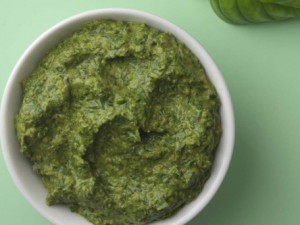
In May 2001, 17 people in British Columbia were sickened with cyclospora associated with basil from Thailand. In 2005, 300 people in Florida were sickened with cyclospora from fresh basil.

My aunt was part of that outbreak.

Parasites. They’re everywhere.

Canadian researchers report in the Journal of Food Protection a “relatively high prevalence” of Cyclospora, Cryptosporidium and Giardia in ready-to-eat packaged leafy greens; most of the products were grown in the U.S.

Abstract below.

Detection of Cyclospora, Cryptosporidium, and Giardia in ready-to-eat packaged leafy greens in Ontario, Canada

Journal of Food Protection®, Number 2, February 2013, pp. 192-369 , pp. 307-313(7)

Dixon, Brent; Parrington, Lorna; Cook, Angela; Pollari, Frank; Farber, Jeffrey

http://www.ingentaconnect.com/content/iafp/jfp/2013/00000076/00000002/art00016

Numerous foodborne outbreaks of diarrheal illness associated with the consumption of produce contaminated with protozoan parasites have been reported in North America in recent years. The present study reports on the presence of Cyclospora, Cryptosporidium, and Giardia in precut salads and lettuceleafy greens purchased at retail in Ontario, Canada. A total of 544 retail samples were collected between April 2009 and March 2010 and included a variety of salad blends and individual leafy greens. Most of these products were grown in the United States, with some from Canada and Mexico. Parasites were eluted and concentrated before detection by PCR and immunofluorescence microscopy. DNA sequences were aligned with reference sequences in GenBank. Cyclospora spp. were identified by PCR-restriction fragment length polymorphism in nine (1.7 % ) samples and by DNA sequence analysis. Cryptosporidium spp. were identified in 32 (5.9%) samples; 29 were sequenced and aligned with the zoonotic species Cryptosporidium parvum. Giardia duodenalis was identified in 10 (1.8%) samples, and of the 9 samples successfully sequenced, 7 aligned with G. duodenalis assemblage B and 2 with assemblage A, both of which are also zoonotic. The presence of Cryptosporidium oocysts and Giardia cysts was confirmed in some of the PCR-positive samples using microscopy, while Cyclospora -like oocysts were observed in most of the Cyclospora PCR-positive samples. The relatively high prevalence of these parasites in packaged salads and leafy greens establishes a baseline for further studies and suggests a need for additional research with respect to the possible sources of contamination of these foods, the determination of parasite viability and virulence, and means to reduce foodborne transmission to humans.

Cupcake crazy: flagship bakery shuttered for health violations

I don’t get the cupcake craze. Seems like the S&M variant of food porn.

Just don’t tell that to the patrons of a New York Village cupcake shop that was shut down on Valentines Day after city health inspectors discovered it was in cupcakeviolation of at least five “critical” infractions.

DNA info reports the flagship location of Magnolia Bakery, which has been credited with kicking off the last decade’s cupcake craze for cranking out the fluffy, old-school confections along with others — like icebox cakes and cream pies — was cited for having “evidence of mice or live mice” taking residence in the bakery, 1010 WINS News first reported on Saturday.

Other infractions at the Bleecker Street shop noted on the Health Department’s report, filed Feb. 14, state the presence of rats, “filth flies” or food refuse that would indicate the flies, as well as “food not protected from contamination” during preparation, transportation, storage or display.

The report also said raw or prepared food was cross-contaminated, contaminated, or not discarded properly, another critical offense.

The location, which opened in 1996, was the first of the company’s seven stores which now hawk the famous baked goods from New York to L.A. Last year, the company began shipping the delicious cupcakes, which gained fame with an appearance on “Sex and the City,” nationwide.

That would be the porn connection.

The problems with vermin began only after Hurricane Sandy flooding compromised the store and mice came in, a spokeswoman for the chain said.

dodgeball.s&m

2 kids sick; meat in Sweden recalled over E.coli feces fears

Give the Swedes credit: they’re direct.

None of this, “abundance of caution” crap, when meat is recalled, it’s because sweden.meat.e.coliof crap.

thelocalse.com reports around six tonnes of hamburger and kebab meat distributed and sold across Sweden may have been contaminated by intestinal bacteria which may have been caused by animal excrement.

The meat, which has been on sale across the country for the past four months, has been found to contain traces of the potentially life-threatening E .coli bacteria.

The contaminated meat was brought to the attention of the authorities when two children fell ill in Västerås in eastern Sweden in January.

The beef has been traced to the distributor Sven P in Stockholm, but is originally from a slaughterhouse in the Netherlands.