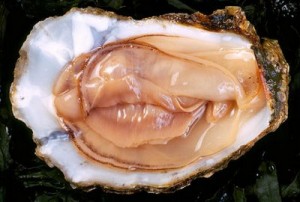
Retailer recalls oysters in Belgium amid norovirus concerns

Supermarket chain Carrefour has recalled oysters marketed under its own brand as well as the Cultimer brand after testing positive for norovirus.

The supermarket chain urges customers who ate ‘Normandy oysters’ and who SUN0705N-Oyster7display symptoms of vomiting, diarrhea and/or a temperature to see their doctor.

Sewage running down walls; poop piles up on stranded Gulf cruise ship

Passengers on a Carnival cruise ship drifting in the Gulf of Mexico are sleeping on its decks, making do with a few working toilets, and doing what they can to get food — all due to a weekend engine fire left the vessel dead in the water.

CNN reports the Carnival Triumph was about 150 miles off the coast of Mexico’s Yucatan Peninsula, heading back Sunday morning to Galveston, Sewage_spews_from_drai19b1ae5e-dd69-4635-9537-a7f0ae9ac62d0000_20120424235220_320_240Texas — where it had departed Thursday on a four-day trip — when a fire broke out in an engine room, according to Carnival Cruise Lines.

The ship’s automatic fire extinguishing system kicked in and soon contained the flames, and no injuries were reported, Carnival reported.

Yet this fire left the ship — and its 3,143 passengers and 1,086 crew members — adrift without propulsion, the cruise line said, halting its trip back to port.

The first of two tugboats that will tow the ship to Mobile, Alabama, arrived on Monday evening, the cruise line said in a statement. The ship should arrive in the Gulf city some time Thursday.

Not being able to sail, though, is just one of the problems. Issues with running water, scarce electricity and more contributed to headaches big and small, according to passengers and their loved ones.

Toby Barlow’s wife Ann told him there was “sewage running down the walls and floors” with passengers being asked to defecate in bags and urinate in showers due to a lack of functioning toilets. Food lines ran 3½ hours long and some, like herself, slept outside to keep cool.

Horsemeat scandal – like every other scandal — turns into blame game

The story is dominating local news: illicit activity, selling something not as advertised, possible links with organized crime.

Footy in Australia is under intense scrutiny as government types realize, there may be a problem. Like cycling and the Tour de France.

Like horse meat substituting for other meat apparently throughout the EU.

Doug Powell, a Kansas State University food safety expert, told the Toronto Star“It isn’t really a food safety story at this point. It is food fraud. How could
gummer.hamburgersomeone not have known? Now you’ll get a lot of finger pointing.”

What I also said was that food fraud is centuries old, and that only now is technology available to provide data to support all kinds of food hucksterism.

I also mentioned that companies marketing stuff they don’t know about are the primary villains here; government and regulatory complacency is to be expected.

Ed Bedington, editor of Meat Trades Journal, told the BBC the Findus horse meat case has brought into question the security of supply chains.

“Retailers make great play about the audits they do and the robustness of the supply chain. But as a long-term observer of the sector, it calls all that into question.”

But rest assured Canadians, home of the Walkerton E. coli-in-water outbreak, 23 deaths from listeria-in-deli meats, and the 2003 downer-cattle-slaughtered-after-hours at Aylmer Meats: rapid DNA tests of 15 hamburgers by University of Guelph types has concluded they were all beef.

Mudguards reduce barfing in cycling events

Amy and I brought a couple of U.S. bicycles with us – and a bag full of skates and kid’s hockey equipment – when we returned to Brisbane.

We may be biking more, but won’t be entering any off-road races (that’s Amy on her previous bike, left, in Kansas, and below, right, today, both not exactly as shown).

Those who do, know there have been race-related outbreaks of Campylobacter and other bugs throughout the world, probably due to biking wizozwiththrough mud and crap on paths that may have been used by livestock or contaminated via runoff.

Mud guards apparently work.

Norwegian researchers report in Epidemiol. Infect. (2013), 141, 517–523, that in 2009, following a bike race, a gastrointestinal illness outbreak affected many participants.

A cohort study showed an attack rate of 16.3% with the main risk factor being mud splashes to the face. Considering these findings, in 2010 recommendations to participants in the bike race were issued and environmental control measures were implemented. In 2010, a retrospective cohort study using web-based questionnaires was conducted to measure the use of preventive measures and to assess risk factors associated with gastrointestinal illness. A 69% response rate was achieved and 11721 records Eva Sizzles for Bebe Sportanalysed, with 572 (attack rate 4.9%) matching the case definition, i.e. participants reporting diarrhoea within 10 days of race. There was a clear increase in the use of mudguards (96.7% reported access to/receiving information on preventive measures) and a significant decrease in gastrointestinal illness. This may indicate that the measures have been effective and should be considered, both in terms of environmental control measures as well as individual measures.

Reusable bags redux: dirty bags kill

The Internet is there to provide data for what you already believe.” That’s what Doug emailed me in a conversation we were having about the endless coverage of the supposed maim and chaos that reusable shopping bags have on public health.. The reusable-shopping-bags-are-killing-us discourse took a turn into the mainstream when the NY Post and San Francisco Chronicle covered a publishing-by-press-release paper by Jonathan Klick and Joshua Wright.

They also put their paper on the Internet, on the Social Science Research Network, carrying the tag line of U of Penn Inst for Law & Econ Research Paper. But not in a peer reviewed journal that deals with food safety, microbiology or public health.

Klick and Wright claim that something stinky has been going on since San Francisco banned plastic shopping bags, and the replacements, reusable polypropylene and or canvas bags, are killing people.

From the paper,

We examine the pattern of emergency room admissions related to bacterial intestinal infections, especially those related to E. coli around the implementation of the San Francisco County ban in October 2007. We find that ER admissions increase by at least one fourth relative to other California counties. Subsequent bans in other California municipalities resulted in similar increases. An examination of deaths related to intestinal infections shows a comparable increase.vector_skull_halloween_trick_or_treat_grocery_tote_bag-p1496283172805687032wl6f_325(3)(2)

Krick and White choose to report hospital room illnesses and deaths from pathogenic E. coli – and omit statistics on other pathogens – and it’s not clear why. In the Chronicle, San Francisco health officer Tomás Aragón calls the research sloppy. I’m with him.
Cited in the research note is a paper from Williams and colleagues (2011) who have published the only peer-reviewed study on the microbial safety of reusable bags. They sampled 58 bags taken from shoppers in Arizona and California, finding coliform in just over half.  And E. coli matters more than coliform (which is commonly found on plant material and is not a good indicator of pathogen presence on food). At least E. coli demonstrates that a pathogen might be there. The Williams study showed generic E. coli can float around in bags – they recovered it in 12% of what they sampled (n=58).

An unanswered question is, can E. coli or other bugs be (or is it likely) transferred to any ready-to-eat foods, or somehow to food contact surfaces in the home? Seems like that matters. Just because the bacteria might be there, doesn’t mean it can contaminate a ready-to-eat food. No one has presented data to support that. We’ve done some cross-contamination work in bags recently and although I’ll wait for the peer review, the data shows that transfer is pretty unlikely.

I don’t know what happened in Frisco (I hear the folks from there hate that) but my guess is it ain’t the bags. I also visited in San Francisco in 2007, which correlates (but doesn’t prove causation) with the onset of the start of the illnesses. Maybe it was something I left behind.

Optimum cooking conditions for shrimp and Atlantic salmon

Sorenne and I dismembered a muddy for dinner the other day (after humanely anesthetizing it in the freezer for an hour) before cooking and devouring muddy along with some bay bugs.

Daughter Courtlynn and I have been e-mailing about the virtues of Australian doug.sorenne.mud.crab.feb.13crabs versus the sweetness of the stone crabs we had in Florida.
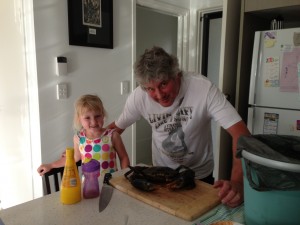
Not bad for a couple of landlubbers.

But whatever your nautical preference, cook it safe.

The following abstract was published in the current Journal of Food Science, focusing on safe shrimp and salmon preparation. The problem is, how is an extra jumbo shrimp defined? Maybe it’s in the paper, but why not just use a tip-sensitive digital thermometer to account for subjective variations?

Stick it in. I do

Optimum cooking conditions for shrimp and atlantic salmon

Journal of Food Science

Lauren Brookmire, P. Mallikarjunan, M. Jahncke, R. Grisso

The quality and safety of a cooked food product depends on many variables, including the cooking method and time–temperature combinations employed. The overall heating profile of the food can be useful in predicting the quality changes and microbial inactivation occurring during cooking. Mathematical barfblog.Stick It Inmodeling can be used to attain the complex heating profile of a food product during cooking. Studies were performed to monitor the product heating profile during the baking and boiling of shrimp and the baking and pan-frying of salmon. Product color, texture, moisture content, mass loss, and pressed juice were evaluated during the cooking processes as the products reached the internal temperature recommended by the FDA. Studies were also performed on the inactivation of Salmonella cocktails in shrimp and salmon. To effectively predict inactivation during cooking, the Bigelow, Fermi distribution, and Weibull distribution models were applied to the Salmonella thermal inactivation data. Minimum cooking temperatures necessary to destroy Salmonella in shrimp and salmon were determined. The heating profiles of the 2 products were modeled using the finite difference method. Temperature data directly from the modeled heating profiles were then used in the kinetic modeling of quality change and Salmonella inactivation during cooking. The optimum cooking times for a 3-log reduction of Salmonella and maintaining 95% of quality attributes are 100, 233, 159, 378, 1132, and 399 s for boiling extra jumbo shrimp, baking extra jumbo shrimp, boiling colossal shrimp, baking colossal shrimp, baking Atlantic salmon, and pan frying Atlantic Salmon, respectively.


 

Barfing at the BAFTAs

While Anne Hathaway delivered what some called a vomit-inducing acceptance speech at the British Academy of Film and Television Arts awards on Saturday, and while Argo won again but no one mentioned Canada’s role in getting those hostages out of Iran, Eddie Redmayne was backstage barfing.

I had to look up who Eddie Redmayne was, but realized I enjoyed his performance in The Good Shepherd, and he’s apparently in that French movie (see Anne Hathaway in the Zach clip below).

Eddie was slated to present an award with Lincoln’s Sally Field but was forced to pull out at the last minute. When Sally took to the stage, she said, “He is puking his guts out backstage.”

According to a source cited by Perez Hilton, “Eddie has bad food poisoning. It was a difficult for him to make it here today but he did his best. After doing the carpet he felt really sick again.”

Climate change responsible for increase in vibriosis?

Rob Mancini writes:

My wife and I decided to visit France and spend some time with her lovely relatives. We were treated like gold, they really like Canadians.  The scenery, the wine, cheese and the company was unsurpassed. As a treat one evening we caught some fresh oysters, shucked them, and ate them with a dash of lemon juice. This was followed with some great beer and local wine. I have oysternever been a fan of oysters because of the slimy texture and the risk of Vibrio spp. but had to try it and none of us became ill. A couple vacationing in Panama City wasn’t as lucky. The Huffington Post reports :

Forty-year-old Darrell Dishon wasn’t an oyster fan. Before June of 2009, he’d never even tried one. So when his wife Nicole proposed splitting a dozen raw shellfish at a restaurant in Panama City, Fla., where the two were vacationing, he was leery.

Nicole remembers eating 10. She says Darrell ate two.

The doctors delivered the awful news that he had contracted a form of vibriosis, one of the most deadly foodborne illnesses in the world. Over the following weeks, Darrell’s health continued to decline. He developed life-threatening septicemia. His doctors amputated both his legs above the knee in an effort to stop the spread. In December, Darrell Dishon became one of the approximately 15 people each year who succumb to vibriosis after eating raw oysters. Vibriosis is an incredibly rare disease — but Centers for Disease Control and Prevention data show that it’s getting more common.

“While all the other pathogens have shown a nice decline, the vibrios are about twice what it was since 1998. In a little over a decade, incidence has doubled. They’re still relatively small numbers — but it’s a very striking increase,” leading vibrio researcher Glenn Morris of the University of Florida’s Emerging Pathogens Institute told The Huffington Post.

Vibrio thrive in warm water. One widely publicized study published in July 2012 indicated that a 1-degree increase in the temperature of a body of water triples its vibrio population. For that reason, many scientists believe that climate change has contributed to the recent rise in vibriosis, and that it could make vibrio bacteria much more prevalent in coming years.

The culprit was Vibrio vulnificans, a bacterium in the same family as those that cause cholera. The bacterium causes fever, diarrhea, abdominal cramps, nausea, and vomiting, and often death. Cook shellfish thoroughly (63°C; 145°F) to avoid infection.

7 million hits on Australian state Name & Shame register

The New South Wales Food Authority has announced the popular Name and Shame register which publicly names businesses that fail to meet food safety standards has received more than 7 million hits online.

“This sends a clear message to food businesses that consumers expect high standards and are scanning the list of restaurants and other food outlets name.shame.restbefore deciding where to dine out,” said Katrina Hodgkinson NSW Minister for Primary Industries.

“A penalty notice on the register not only acts as a potential deterrent to would be diners it also serves as a deterrent to food businesses against making food safety breaches.”

There were almost 1.25 million views on the Name and Shame register in 2012 alone and more than 7.1 million since the register was established in 2008.

The most common food safety breaches under the Food Act 2003 are;

Cleaning and sanitation (35%)

Temperature control (13%)

Pest control – infestations, droppings (13%)

Hand washing offences (13%)

Protection from contamination – storage, personal hygiene (11%)

“The number of food businesses appearing on the register has almost halved in 3 years which shows the campaign is having the desired effect with more food outlets adhering to the rules,” Ms Hodgkinson said.

To view the Name and Shame register visit: www.foodauthority.nsw.gov.au/penalty-notices.

Fail: Horse meat in lasagna may be donkey

As questions become increasingly shocking in the EU horsegate scandal – do retailers have any idea what they are selling, was it the mob, how does donkey taste – Rob Mancini writes about being Italian and lasagna.

There are two prerequisites required for an Italian: being able to adequately cook and to kick ass in soccer. So when I come across a story where horse horse.laughmeat is used in lasagna, this irks me. FSAI reports

Findus’ own checks revealed that some of its frozen lasagnes contain more than 60% horse meat.  The products have been withdrawn from sale from Tesco stores in Ireland, but may also be on sale in independent retail shops. Tests are currently underway to determine if the horse meat contains the veterinary medicine, phenylbutazone, commonly known as “bute”.

Nature Of Danger:

Phenylbutazone is not permitted in the food chain as it can pose a risk to health. In rare cases it can cause a serious blood disorder.  However, if horse meat that is contaminated with bute is consumed, the risk of damage to human health is considered to be low.

A proper lasagna must have a delicate balance of veal and pork gently caressed in a slew of ricotta cheese peppered with a touch of fresh nutmeg. I know what I’m eating tonight. Awesome recipe here: http://www.foodnetwork.com/recipes/mario-batali/lasagne-bolognese-al-forno-recipe/index.htm